On April 6, 2026, the Artemis II crew completed a historic seven-hour flyby of the Moon's far side, capturing the first-ever human-observed solar eclipse from lunar orbit. For space enthusiasts, planetary geologists, and the global public, these newly released NASA images provide critical visual data that will shape future lunar surface exploration and eventual crewed missions to Mars. The visual data goes far beyond aesthetics, offering unprecedented insights into lunar geological history by documenting impact craters, ancient lava flows, and surface fractures under unique lighting conditions.
Furthermore, the crew unexpectedly captured six meteorite impacts and their resulting light flashes on the lunar surface. This rare event prompted immediate analysis by ground teams of the audio and visual data transmitted from the Orion spacecraft. These observations will directly influence the operational strategies and risk assessments for the upcoming Artemis III surface landing.
The Historic Visuals: Eclipse, Earthset, and Orientale Basin
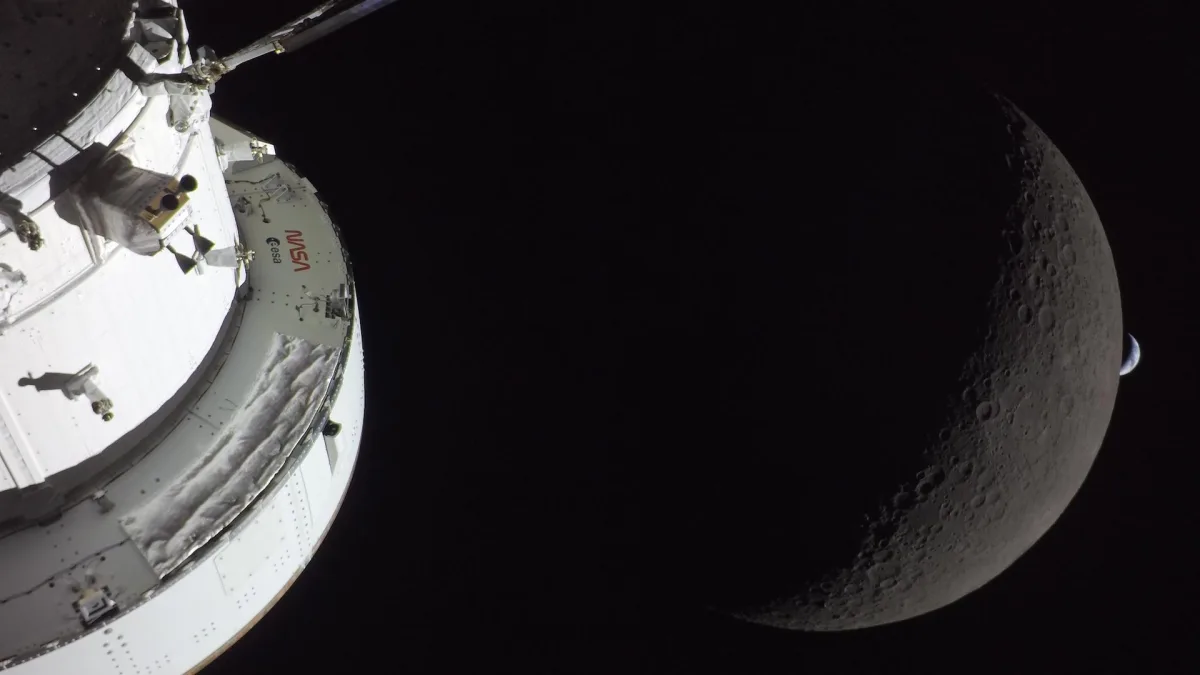
The standout image features the Moon plunged into shadow with the Sun positioned directly behind it, while Earthlight subtly illuminates the lunar edge. In the background of this surreal orbital perspective, the planets Saturn and Mars are clearly visible. Minutes before Orion passed behind the Moon - initiating a 40-minute communications blackout - the crew photographed a striking Earthset.
The Earthset image highlights swirling clouds over the Australia-Oceania region, serving as a modern counterpart to Bill Anders' iconic 1968 Apollo 8 Earthrise. However, this new perspective of Earth arrives with a stark environmental reality. Since the Apollo 8 mission, global atmospheric carbon dioxide levels have surged from 320 to 430 parts per million, and average global temperatures have risen by 1.2 degrees Celsius.
Inside Orion and Ground Control Reactions
NASA also released behind-the-scenes images of the crew - Commander Reid Wiseman, Pilot Victor Glover, and Mission Specialists Christina Koch and Jeremy Hansen - wearing protective eclipse glasses inside the capsule. Technical ingenuity was on display as Hansen was photographed using a camera cover over Orion's window 2 to eliminate glare, ensuring crisp orbital photography. Additional external cameras captured Orion's solar arrays on the seventh day of the mission, documenting the hardware's performance in deep space.
Back on Earth, the scientific team, including Deputy Lunar Science Lead Jacob Richardson and scientist Kiarre Dumes, monitored the live verbal descriptions from the crew. The Artemis II mission is scheduled to conclude with a splashdown in the Pacific Ocean off the coast of San Diego on Friday, April 10, 2026, at 20:07 local time.
My Take: The Strategic Value of Artemis II's Visual Data
The release of these Artemis II images represents a masterclass in blending public engagement with high-value scientific acquisition. The unexpected capture of six meteorite impacts demonstrates the unpredictable nature of deep-space observation and validates the decision to equip the Orion capsule with advanced, multi-angle imaging systems. This real-time data collection is crucial for identifying safe landing zones and understanding micrometeoroid risks for the upcoming Artemis III surface mission.
Furthermore, the stark contrast between the 1968 Earthrise and the 2026 Earthset serves as a powerful visual metric of our changing climate. By releasing these specific images, NASA is not just proving its technical capability to return humans to lunar orbit. The agency is actively leveraging the overview effect to maintain global funding and public support for the sustained, multi-decade Artemis program.
This article was written by AI from reporting by futura-sciences.com.