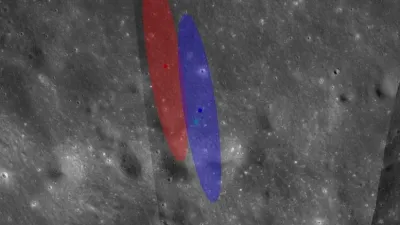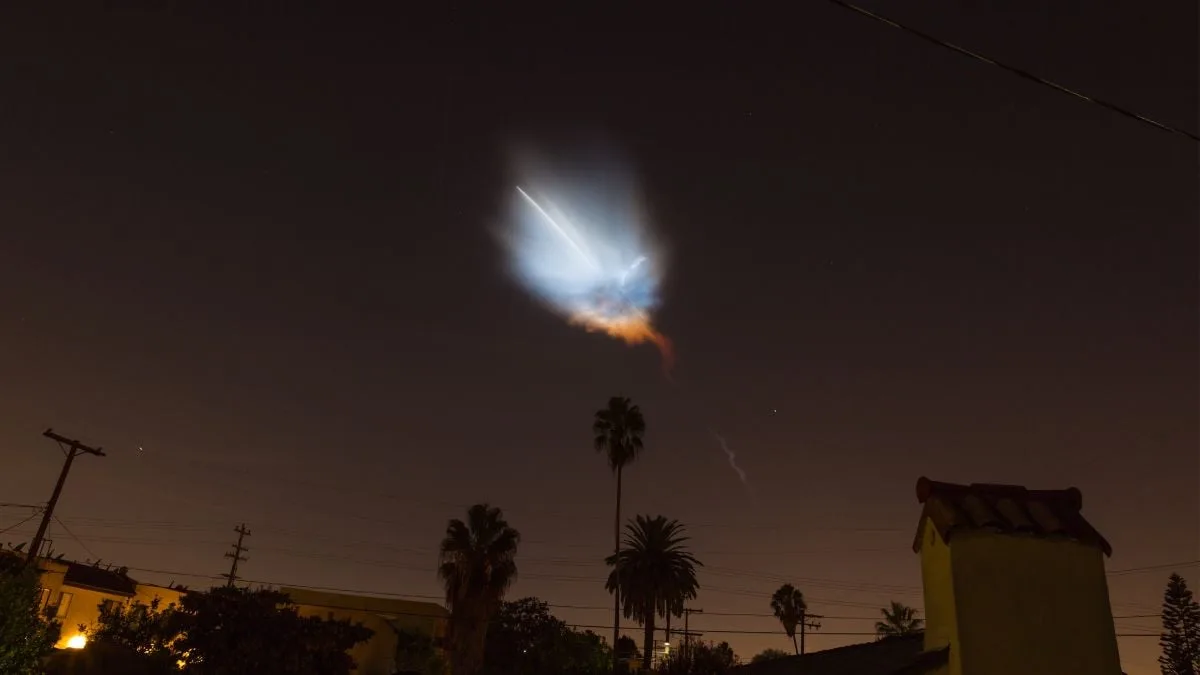
A discarded upper stage from a SpaceX Falcon 9 rocket is on a collision course with the Moon, hurtling toward the lunar surface at seven times the speed of sound. The spent booster, roughly the height of a five-story building, is projected to slam into the lunar surface on August 5, 2026, at approximately 06:44 UTC. The impact is expected to occur near the Einstein crater, a heavily battered region situated at the threshold between the Moon's near and far sides.
The impending crash highlights the growing unpredictability of deep-space debris. According to Bill Gray, an independent astronomer and developer of the Project Pluto tracking software, the object's trajectory is being actively manipulated by its environment. While the gravitational pull of the Earth, Moon, and Sun are highly predictable, the tumbling rocket stage is also being pushed by solar radiation pressure. This slight but constant force from sunlight adds up unpredictably over time, altering the object's path as it catches and reflects varying amounts of light.
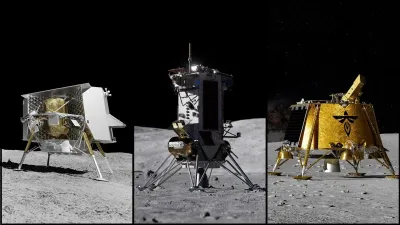
This specific Moon-bound debris originated from the 2025-010D Falcon 9 mission, which launched in January 2025. While the Falcon 9 is partially reusable - with its massive first stage returning to Earth - the second stage remains in orbit. This particular launch carried a payload featuring two lunar landers: the Blue Ghost mission 1 and the Hakuto-R Mission 2. Unlike many previous second stages that either burned up in Earth's atmosphere or entered a stable orbit around the Sun, this stage was left in a highly elliptical local orbit.
Tracking the 2025-010D Trajectory
The orbital mechanics driving this collision resemble a slow-motion cosmic trap. The second stage currently takes about 26 days to complete a single orbit around Earth. At its perigee (closest approach), it buzzes within 220,000 kilometers of our planet. At its apogee (farthest point), it swings out to roughly 510,000 kilometers, directly intersecting the Moon's gravitational track, which sits at an average distance of 400,000 kilometers.
"The orbit of the Moon and of this object, roughly speaking, intersect. Usually, one goes through the intersection point while the other is someplace else," Gray explained. However, on August 5, gravity will force the two bodies to reach that exact intersection point simultaneously.
This is not the first time human hardware has struck the lunar surface. In the 1970s, NASA intentionally crashed Apollo modules to study the Moon's composition via seismic readings. In 2009, the agency crashed its LCROSS probe into a permanently shadowed crater, kicking up dust that had been untouched for billions of years to confirm the presence of water ice. More recently, a suspected Chang'e 5-T1 booster struck the lunar far side in 2022, leaving a distinct double-crater formation.
The simplest way to avoid such lunar impacts could be to put upper stages in orbits where they will leave the Earth and Moon, and end up in orbit around the sun, such that they won't hit us for a long time.
- Bill Gray, Project Pluto
The Hidden Risk to Lunar Expansion
While this specific SpaceX Falcon 9 impact poses zero immediate danger to human life, it serves as a glaring warning siren for the next decade of space exploration. The Moon is currently a barren wasteland hosting only technological junk, golf balls, and discarded astronaut waste. However, that status quo is about to end abruptly. NASA's Artemis IV mission aims to place humans on the Moon in 2028, followed closely by a crewed Chinese mission targeted for 2030.
The fact that a 550,000-kilogram-class rocket's upper stage can tumble through cislunar space for over a year, subject to the unpredictable whims of solar radiation pressure, reveals a severe regulatory void. We are treating the space between Earth and the Moon as a lawless dumping ground. If space agencies and private companies like SpaceX do not mandate deep-space disposal protocols - such as pushing spent stages into heliocentric orbits - these "harmless" ballistics experiments will soon become lethal threats to multi-billion-dollar lunar habitats and the astronauts living inside them.