Breakthrough Test at Wenchang Launch Site
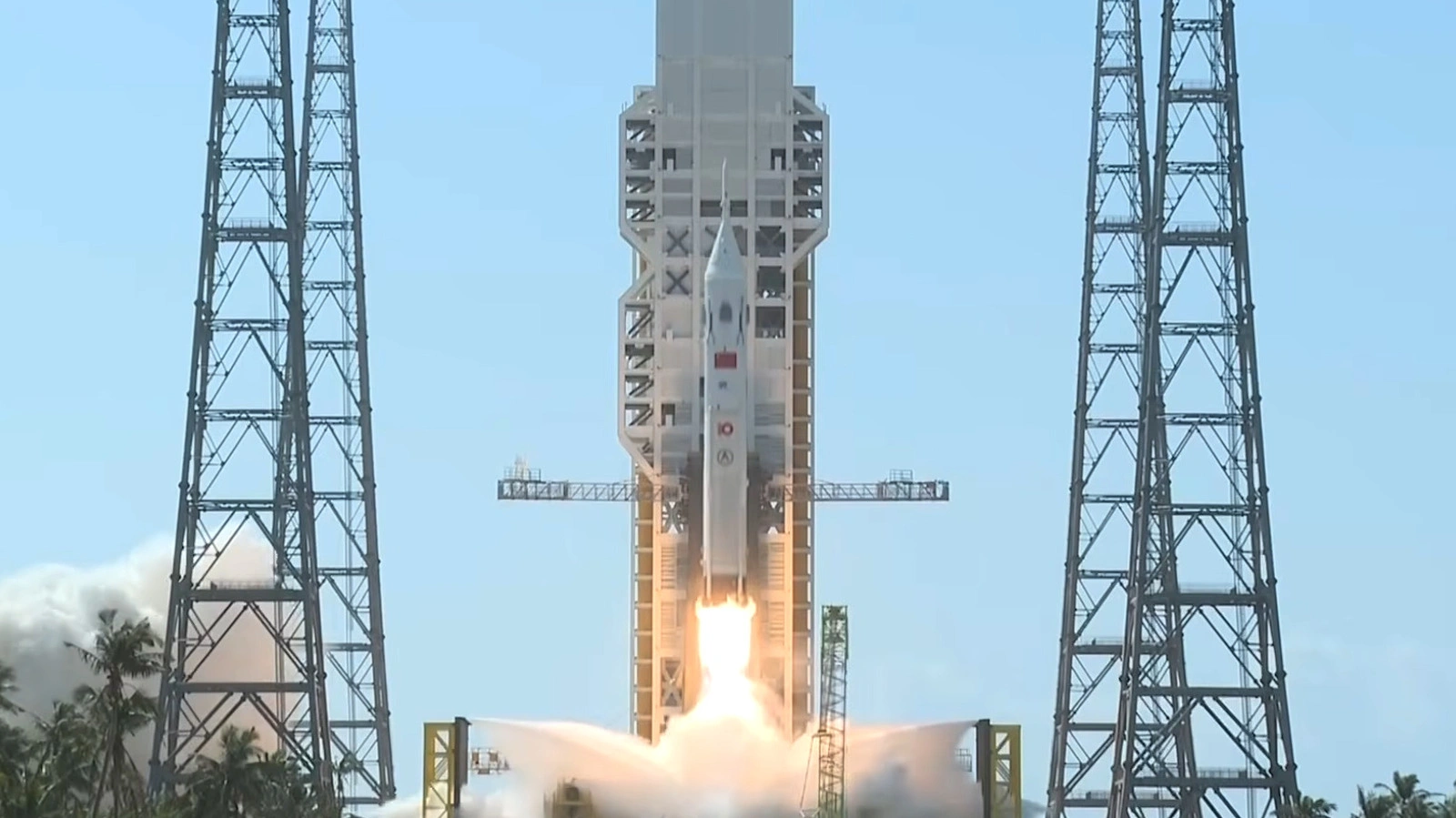
On February 11, 2026, China executed a landmark low-altitude demonstration flight of the Long March-10 carrier rocket alongside a maximum dynamic pressure abort test for its new-generation Mengzhou crewed spaceship. Both prototypes launched from the Wenchang Spacecraft Launch Site in Hainan Province, verifying critical ascent abort conditions, multi-stage parallel operations, and return-phase technologies.
The 55-meter rocket prototype, powered by seven liquid oxygen/kerosene engines in parallel, generated nearly 1,000 tonnes of thrustthe largest single-module thrust among China's rockets to date. At maximum dynamic pressure, the Mengzhou received an abort command, separated successfully, and its return capsule splashed down under parachutes in a predetermined sea area.
The rocket's first stage then ignited three engines successively for a controlled descent, deploying a tether mechanism at 120 meters to simulate ground-based net capture. It achieved quasi-hovering at 5 meters before a precise ocean splashdown, showcasing reusability features akin to SpaceX's Falcon 9.
Reusable Design Signals Cost Revolution
Prior static fire tests in August and September 2025 paved the way, followed by streamlined engine maintenance and minimal consumable replacements, underscoring rapid turnaround potential. Expert Yang Shutao from the China Aerospace Science and Technology Corporation (CASC) emphasized that reusability will slash launch costs and boost frequency, enabling large-scale space access essential for China's lunar goals.
The Long March-10 series includes a three-stage version with boosters (Long March-10) and a two-stage variant (Long March-10A). Using YF-100 engines fueled by liquid oxygen and kerosenesimilar to SpaceX's Merlin enginesthis heavy-lift vehicle supports Mengzhou, meaning "Dream Vessel," designed for crewed lunar missions before 2030.
Narrowing the Gap with Western Programs
This test, from a new launch pad with maritime recovery, represents multiple firsts: a novel rocket, spaceship, and pad integration. Analysts hail it as a "significant milestone," placing China "neck and neck" with the US. Aerospace engineer Rand Simberg noted China is now likely ready for crewed flights, while space historian Jonathan McDowell praised the bold dual-system test as a sign of high confidence.
Contrast this with NASA's Artemis II, a crewed lunar flyby slated no earlier than March 2026 using the Space Launch System (SLS). Artemis III aims for a 2028 landing via SpaceX's Starship, though timelines slip amid development hurdles. SpaceX and Blue Origin compete for US lunar landers, but China's steady progress revives the space race dynamic.
Implications for Astronauts and Exploration
For the four astronauts assigned to Artemis II, these Chinese advances heighten global stakes, pushing agencies to accelerate. China's program builds on prior successes like the Tiangong space station, with Mengzhou enabling taikonautsChina's astronautsto walk the lunar surface by decade's end, potentially spurring joint international efforts or renewed competition.
Reusability isn't just technical; it democratizes space for scientists and engineers worldwide. As Yang stated, it supports China's space sector growth, promising cheaper missions for lunar bases, resource mining, or telescopes. Humans on the moon again could unlock helium-3 fusion research or water ice studies, benefiting global energy and science.
Path to 2030 Lunar Landings
China's China Manned Space Agency (CMSA) confirmed the tests as major breakthroughs for crewed lunar exploration. The rocket didn't reach orbit, but validated emergency protocols vital for human safety. Future flights will scale up, with full reusability cutting costs dramaticallymuch like how SpaceX transformed orbital access.
Space analysts see this positioning Beijing for parity with Washington. While US programs face delays, China's methodical testsfrom static fires to splashdownsbuild unshakeable reliability. For the engineers who recovered the capsule from choppy seas, this success means one step closer to witnessing taikonauts plant flags on the lunar regolith.
These milestones remind us that space exploration thrives on competition, driving innovation that one day may see collaborative moon outposts. China's leap forward ensures the 2030s will redefine humanity's cosmic footprint.
This article was written by AI from reporting by slashgear.com.