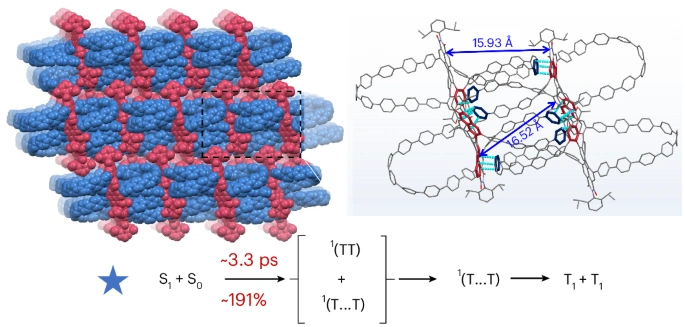
A groundbreaking study published in Nature Chemistry has redefined the boundaries of solar energy physics, demonstrating that singlet fission can occur at interchromophore distances of up to 16 Å. By utilizing precise carbon nanohoops to control the assembly of chromophores, researchers have overcome one of the most persistent limitations in organic photovoltaics, paving the way for solar cells that far exceed current efficiency limits.
The Mechanics of Singlet Fission
Singlet fission is a quantum mechanical process that holds the key to supercharging solar power. In traditional silicon solar cells, one photon of light generates one electron-hole pair. However, in materials capable of singlet fission, a single high-energy photon can split into two triplet excitons. This effectively doubles the electrical current generated from high-energy light, theoretically allowing solar cells to bypass the Shockley-Queisser efficiency limit of about 33%.
Historically, this process required the light-absorbing molecules, or chromophores, to be packed extremely tightlyoften within direct contact or less than 4 Å apart. This requirement severely limited the types of materials engineers could use, as maintaining such precise molecular packing in real-world devices is notoriously difficult. The new research fundamentally alters this landscape by proving that the process can be sustained over much larger distances.
Carbon Nanohoops as Molecular Scaffolds
The core innovation lies in the use of carbon nanohoops. These cyclic molecules act as a rigid scaffold, holding the chromophores in a specific orientation and distance relative to one another. By engineering these nanohoops, the research team successfully facilitated the conversion of a photoexcited singlet exciton into two triplet excitons via a triplet pair (TT) intermediate state, even when the molecules were separated by 16 Å.
This structural control allows for 'through-space' coupling rather than just 'through-bond' or direct contact interactions. For the solar industry, this means future organic solar cells could be made from a wider array of materials that are easier to manufacture and more durable, without sacrificing the efficiency gains provided by singlet fission.
| Feature | Traditional Singlet Fission | Nanohoop-Enabled Fission |
|---|---|---|
| Required Distance | < 4 Å (Tight Packing) | Up to 16 Å (Long Range) |
| Coupling Mechanism | Direct Orbital Overlap | Mediated via Nanohoop Scaffold |
| Material Flexibility | Low (Rigid Crystal Structures) | High (Tunable Molecular Assembly) |
| Solar Potential | Hard to Scale | Scalable Organic Photovoltaics |
Implications for Next-Gen Photovoltaics
The ability to sustain singlet fission at 16 Å introduces a new paradigm for organic electronics. It suggests that the strict requirement for crystalline perfection in organic solar films might be relaxed. Manufacturers could potentially develop flexible, transparent, or lightweight solar coatings that leverage this high-efficiency process without needing the brittle, dense packing of previous generations.
Furthermore, this discovery extends beyond just solar power. The principles of controlling exciton dynamics via carbon nanohoops could impact quantum information science and photocatalysis, where managing energy states at the molecular level is critical.
Frequently Asked Questions
What is singlet fission in simple terms?
It is a process in certain materials where one particle of light (photon) produces two energized particles (excitons) instead of one, potentially doubling solar cell current.
Why are carbon nanohoops important in this study?
They act as a structural frame that holds the active molecules at a precise distance (16 Å), allowing the energy transfer to happen without the molecules needing to touch.
How does this help solar energy?
It allows engineers to design high-efficiency organic solar cells using materials that don't need to be packed as tightly, making manufacturing easier and cheaper.
My Take: A Quantum Leap for Organic Solar
This research is a critical step toward making 'Third Generation' photovoltaics a commercial reality. By decoupling the efficiency of singlet fission from the need for intimate molecular contact, scientists have removed a major engineering bottleneck. While commercial application is likely years away, the use of carbon nanohoops provides a clear blueprint for designing the high-efficiency, flexible solar materials of the future.
This article was written by AI from reporting by nature.com.