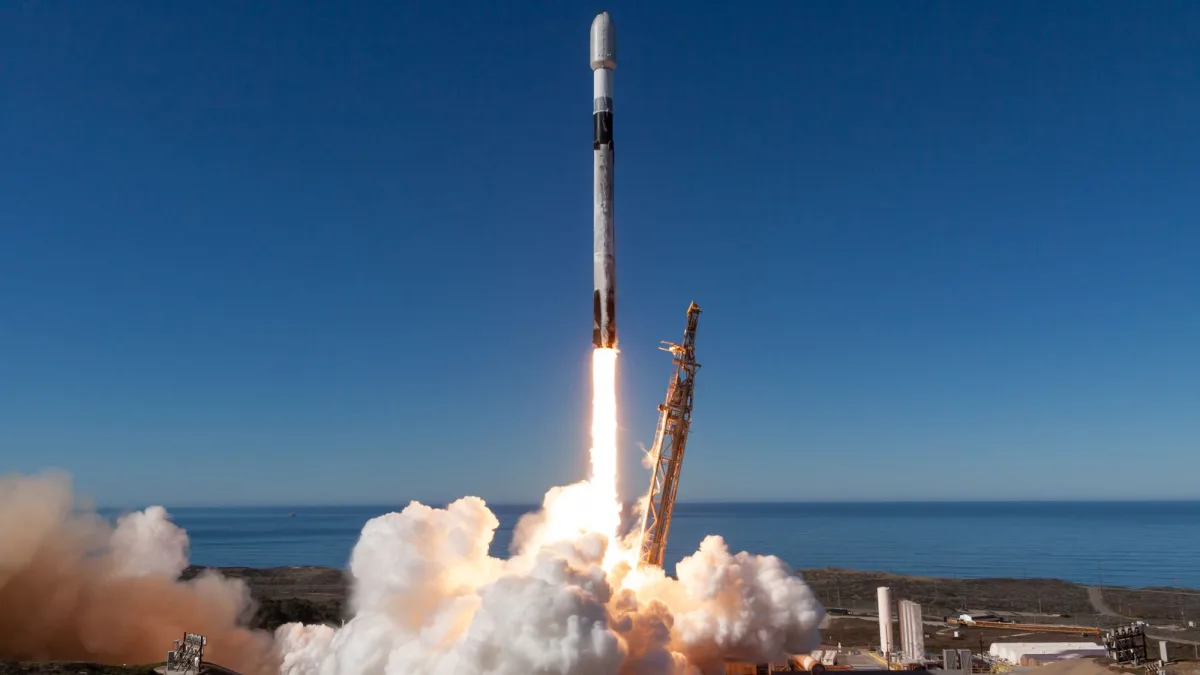
SpaceX is set to execute its Transporter-16 rideshare mission on Monday, March 30, sending 119 distinct payloads into low Earth orbit. The massive deployment highlights the aerospace company's continued dominance in commercial spaceflight, offering cost-effective orbital access for dozens of international and commercial clients.
A Falcon 9 rocket will lift off from Vandenberg Space Force Base in California during a 57-minute launch window that opens precisely at 6:20 a.m. EDT (1020 GMT; 3:20 a.m. local Pacific time). The diverse manifest for this mission includes cubesats, microsats, hosted payloads, and a dedicated reentry vehicle. Additionally, the rocket will carry orbital transfer vehicles designed to deploy eight of the payloads at a later time, according to the official mission description.
Following stage separation, the Falcon 9's first-stage booster will attempt a landing approximately 8.5 minutes after launch on the autonomous droneship "Of Course I Still Love You," stationed in the Pacific Ocean. This marks the 12th flight and landing attempt for this specific booster, further cementing SpaceX's rapid reusability metrics. The upper stage will continue its ascent, initiating the complex payload deployment sequence about 55 minutes after liftoff.
How to Watch the Transporter-16 Launch Live
Space enthusiasts and payload operators can monitor the entire mission in real-time. Here is how to tune in:
- Official Stream: The live broadcast will be available directly via SpaceX.
- Timing: Coverage typically begins 15 minutes prior to the targeted 6:20 a.m. EDT liftoff.
- Deployment Tracking: The stream will likely continue through the initial payload deployment phase, which starts nearly an hour into the flight.
The Scale of SpaceX's Rideshare Program
Transporter-16 is the 16th dedicated flight under SpaceX's primary rideshare series. Alongside its newer "Bandwagon" program - which has completed four missions to date - the company has successfully delivered over 1,600 payloads to orbit. Despite the impressive 119-satellite manifest of Transporter-16, the all-time single-launch record remains held by the Transporter-1 mission, which deployed 143 spacecraft in January 2021.
My Take: The Economics of Orbital Access
The Transporter-16 mission perfectly illustrates how SpaceX has fundamentally altered the economics of the space industry. By bundling 119 payloads onto a single flight-proven Falcon 9 booster, the company drastically lowers the barrier to entry for universities, startups, and smaller nations wanting to test hardware in low Earth orbit. The inclusion of orbital transfer vehicles on this flight is particularly noteworthy, as it shows a maturing ecosystem where "last-mile" delivery services in space are becoming standard practice.
Furthermore, flying a booster for the 12th time while landing it on the "Of Course I Still Love You" droneship demonstrates a level of operational routine that competitors are still struggling to achieve. As the Bandwagon and Transporter programs continue to scale, traditional launch providers will face immense pressure to match this cadence and pricing model, likely accelerating the shift toward fully reusable launch architectures across the global market.
This article was written by AI from reporting by app.buzzsumo.com.