Space-time-coding metasurfaces are revolutionizing wireless communications by enabling high-dimensional multiplexing through a single, compact aperture. Published on March 9, 2026, in the journal Light: Science & Applications, a breakthrough study introduces a dual-polarized asynchronous space-time-coding metasurface (DASM) designed to manipulate orbital angular momentum (OAM). This development directly addresses the long-standing integration and scalability challenges that have hindered conventional OAM-based systems, which traditionally rely on complex optical components and redundant radio frequency chains.
This research is highly relevant for telecommunications engineers, quantum physicists, and wireless network architects. By synergistically combining OAM, polarization, and frequency division multiplexing, the DASM framework provides a practical pathway to exponentially increase wireless communication capacity. For industry professionals, this means the ability to design ultra-fast networks that support multiple independent data streams with minimal crosstalk, entirely eliminating the need for bulky, complicated external modulators.
The DASM Architecture and OAM Manipulation
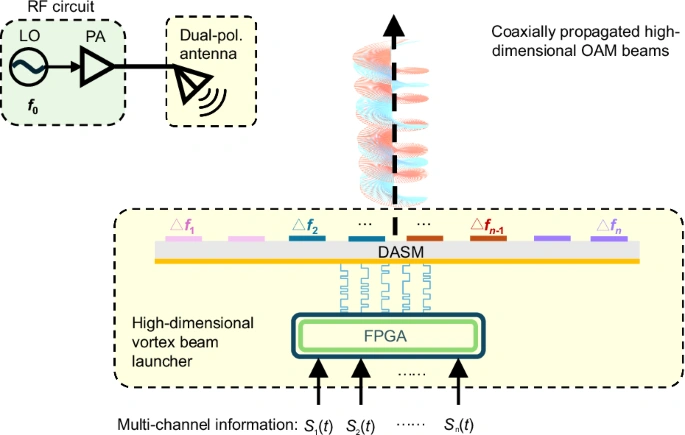
The core of the proposed high-dimensional communication framework relies on a meticulously engineered 12 × 12 array of reflective meta-atoms. According to the research team, led by Chenfeng Yang and colleagues, two positive-intrinsic-negative (PIN) diodes are mounted in the slots of the top metal pattern of each meta-atom. This specific hardware configuration allows for the independent control of electromagnetic (EM) waves along both x- and y-polarizations. For each polarization, the reflection phase state can be dynamically switched between "0" and "π" while maintaining a consistent amplitude, driven by external voltage excitations.
To achieve independent beam manipulation across multiple frequencies, the researchers partitioned the metasurface aperture into two distinct regions. Each partition operates as an independent EM wave modulator, generating separate groups of frequency harmonics. This asynchronous control mechanism successfully overcomes the inherent challenge of frequency entanglement in standard metasurfaces, allowing the concurrent transmission of vortex beams at different carrier frequencies. The system utilizes space-time-coding sequences implemented via an FPGA to synthesize these multi-mode OAM beams in real-time.
The practical viability of this technology was demonstrated through rigorous testing. The experimental results confirmed that the DASM enables complex wavefront manipulation to dynamically generate vortex beams with numerous OAM modes at different linear polarization (LP) states. Furthermore, the team successfully demonstrated that the DASM supports multiple channels of Quadrature Phase Shift Keying (QPSK) communications, proving its capability to directly encode phase and amplitude information onto the beams.
My Take
The introduction of the DASM represents a critical inflection point for high-dimensional multiplexing. By successfully integrating a 12 × 12 array with dual PIN diodes to manage phase states of "0" and "π" across partitioned frequencies, this research moves OAM technology from theoretical physics into practical engineering. The ability to support multiple QPSK communication channels without external modulators is the most significant signal here; it proves that future 6G and beyond networks can achieve massive data rates using significantly smaller, more energy-efficient hardware footprints. As the demand for spectral efficiency grows, programmable metasurfaces will likely become the foundational hardware for next-generation telecommunications infrastructure.
Frequently Asked Questions
What is orbital angular momentum (OAM) in this context?
OAM is a fundamental property of electromagnetic waves characterized by a helical phase front. Different OAM modes are mutually orthogonal, allowing them to carry independent data streams without interfering with each other.
How does the DASM handle different frequencies simultaneously?
The metasurface is physically partitioned into two distinct regions. Each region acts as an independent modulator controlled by asynchronous sequences, allowing the generation of separate frequency harmonics without entanglement.
What are the phase states used by the PIN diodes?
The PIN diodes switch the reflection phase state between "0" and "π" for both x- and y-polarizations, enabling precise control over the electromagnetic waves.