Saturn's Small Moon Packs Outsized Electromagnetic Punch
An international team of researchers has fundamentally revised our understanding of Enceladus, Saturn's icy moon. Using 13 years of data from NASA's Cassini spacecraft, scientists discovered that this relatively small celestial body exercises electromagnetic influence across a staggering distance of more than 504,000 kilometersmore than 2,000 times the moon's own radius.
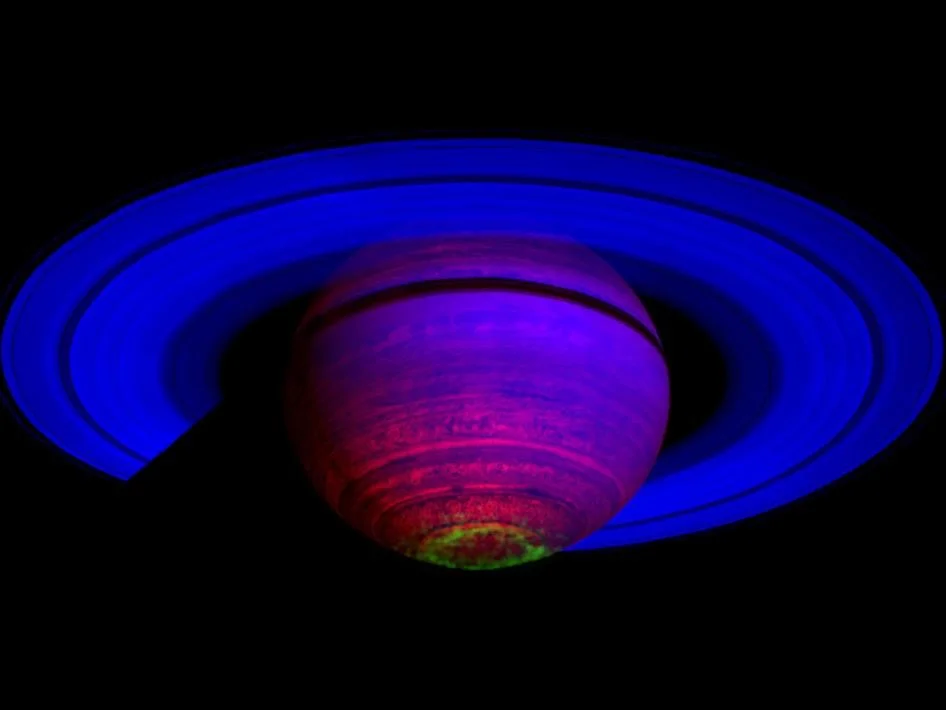
The study, published in the Journal of Geophysical Research: Space Physics, reveals a complex lattice-like structure of wave patterns that flow downstream from Enceladus in Saturn's equatorial plane while simultaneously reaching toward the planet's high northern and southern latitudes. This discovery transforms how scientists view Enceladus's role within the Saturnian system.
Understanding Alfvén Wings: Nature's Electromagnetic Highways
At the heart of this phenomenon lie structures called "Alfvén wings"wave patterns that travel along magnetic field lines like vibrations on a string, connecting Enceladus directly to Saturn's poles. The initial main Alfvén wing bounces back and forth between Saturn's ionosphere and the plasma torus encircling Enceladus's orbit, creating an intricate, structured system of electromagnetic activity.
What makes this discovery particularly significant is the fine-scale structure researchers identified within these waves. Turbulence teases the waves into filaments within the main Alfvén wing, and this fine-scale structure enables the waves to bounce off Enceladus's plasma torus and reach high latitudes in Saturn's ionosphere where auroral features associated with the moon form.
Why This Matters for Planetary Science
For decades, Enceladus has captured scientific attention primarily because of its water geysersjets of water vapor erupting from its icy surface. However, this new analysis demonstrates that the moon's actual impact and interaction with Saturn extends far beyond what researchers previously understood. The electromagnetic coupling between Enceladus and Saturn reveals how small moons can circulate energy and momentum throughout a giant planet's space environment.
This finding has broader implications for how scientists study planetary magnetospheres across the solar system and beyond. Understanding these electromagnetic interactions helps researchers comprehend the dynamic processes occurring around gas giants, which dominate our solar system and are common around other stars.
A Multi-Instrumental Breakthrough
The research team employed a sophisticated multi-instrumental approach, analyzing data from four different instruments aboard Cassini collected over the spacecraft's 13-year mission. This comprehensive methodology allowed researchers to map the complete electromagnetic architecture surrounding Enceladus with unprecedented detail and accuracy.
The discovery underscores how technological advances in space instrumentation enable scientists to detect subtle but profound phenomena. Without Cassini's sophisticated sensors and the team's innovative analytical approach, the true extent of Enceladus's electromagnetic influence would have remained hidden.
Looking Forward: New Questions About Moon-Planet Interactions
This research opens new avenues for investigating how moons throughout the solar system influence their parent planets' magnetospheres. Scientists now recognize that even relatively small moons can play outsized roles in shaping planetary environmentsa principle that may apply to moons orbiting Jupiter, Uranus, and Neptune as well.
As humanity plans future missions to the outer solar system, understanding these electromagnetic interactions becomes increasingly important. The data from Cassini, which ended its mission in 2017, continues to yield discoveries that reshape planetary science decades after the spacecraft's final transmission.
This article was written by AI from reporting by sci-news.com.