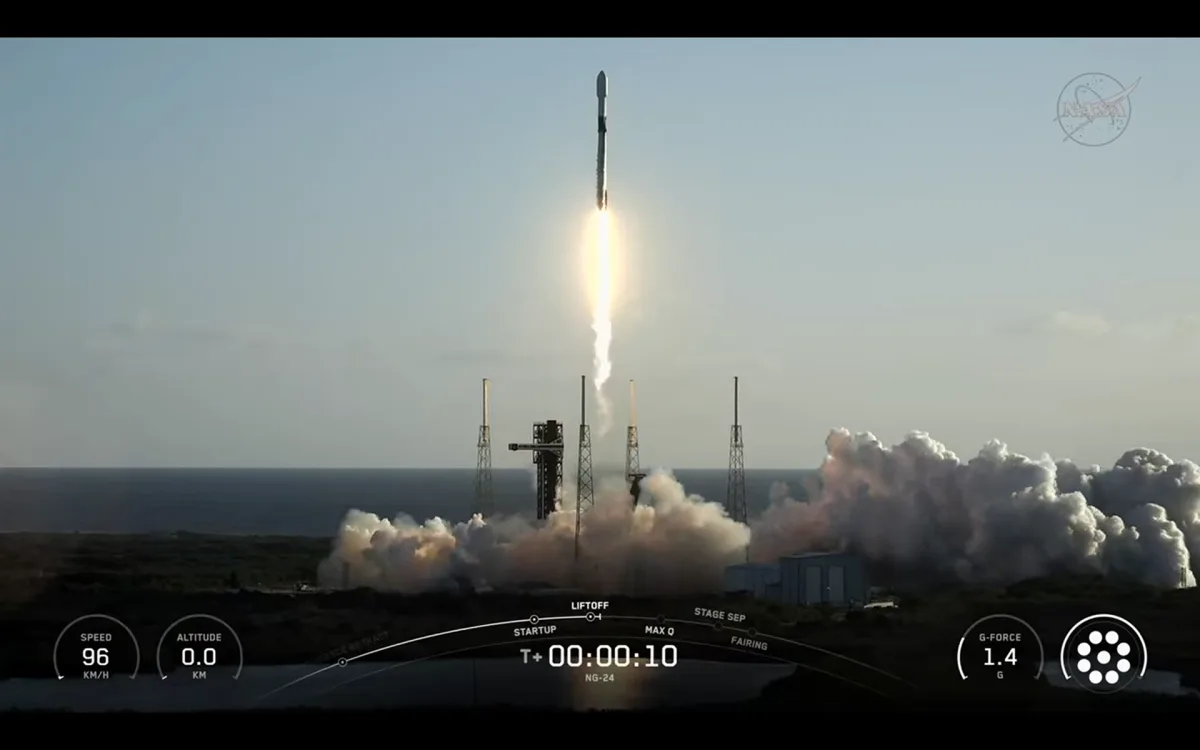
The latest SpaceX Cygnus XL launch has successfully delivered over 11,000 pounds of vital science equipment and supplies to astronauts aboard the International Space Station. This mission provides aerospace industry watchers and space enthusiasts with a clear look at the current cadence of orbital logistics, ensuring that critical research operations continue uninterrupted in low Earth orbit. A SpaceX Falcon 9 rocket lifted off into a clear blue sky over Cape Canaveral Space Force Station in Florida at 7:41 a.m. EDT on Saturday, April 11.
The flight, officially designated as the NG-24 mission, marks Northrop Grumman's 24th commercial resupply run to the orbiting laboratory for NASA. Just over 14 minutes after liftoff, the massive cargo ship separated from the Falcon 9 upper stage to enter its initial orbit, deploying its solar arrays shortly after to begin its multi-day pursuit of the station.
The S.S. Steven R. Nagel and Cygnus XL Upgrades
This specific spacecraft was named the S.S. Steven R. Nagel in honor of the late NASA astronaut who logged over 720 hours in space across four space shuttle missions. Nagel, a former Air Force test pilot who served as a mission specialist, pilot, and commander, passed away in 2014 at the age of 67, according to NASA.
The freighter will deliver approximately 4,990 kilograms of payload, a significant upgrade that highlights the capabilities of the XL variant. The original version of the Cygnus spacecraft, which completed more than 20 missions to the ISS, maxed out at a payload capacity of about 8,500 pounds (3,856 kg). This marks only the second flight of the expanded XL model, following its inaugural launch last September.
Falcon 9 Booster Recovery and ISS Arrival
Saturday's mission marked the seventh successful flight for this specific Falcon 9 first-stage booster, which returned to Earth about eight minutes after liftoff for a smooth touchdown at a SpaceX landing pad at Cape Canaveral. This veteran booster previously supported Northrop Grumman's NG-23 cargo flight, NASA's Crew-11 astronaut mission, the Axiom Space Ax-4 private astronaut flight, and three Starlink missions, according to a SpaceX description.
The robotic Cygnus XL is scheduled to arrive at the International Space Station on Monday, April 13. Upon its approach, it will be grappled by the station's Canadarm2 robotic arm at exactly 12:50 p.m. EDT, where it will remain attached for several months before eventually departing to burn up safely in Earth's atmosphere.
The Future of ISS Resupply Missions (My Take)
The Northrop Grumman vehicle is currently one of four robotic cargo spacecraft servicing the ISS, operating alongside Japan's HTV-X, Russia's Progress, and SpaceX's own Dragon capsule. Notably, the Dragon remains the only reusable freighter in the fleet, while the other three are designed for destructive re-entry, serving a dual purpose by disposing of station waste at the end of their missions.
The reliance on a Falcon 9 rocket to launch a competitor's cargo ship underscores SpaceX's absolute dominance in the current launch market. As the International Space Station approaches its final years of operation, the increased 11,000-pound capacity of the Cygnus XL becomes strategically vital; it allows NASA to consolidate payloads and reduce the total number of required launch vehicles, maximizing logistical efficiency in low Earth orbit.
This article was written by AI from reporting by app.buzzsumo.com.