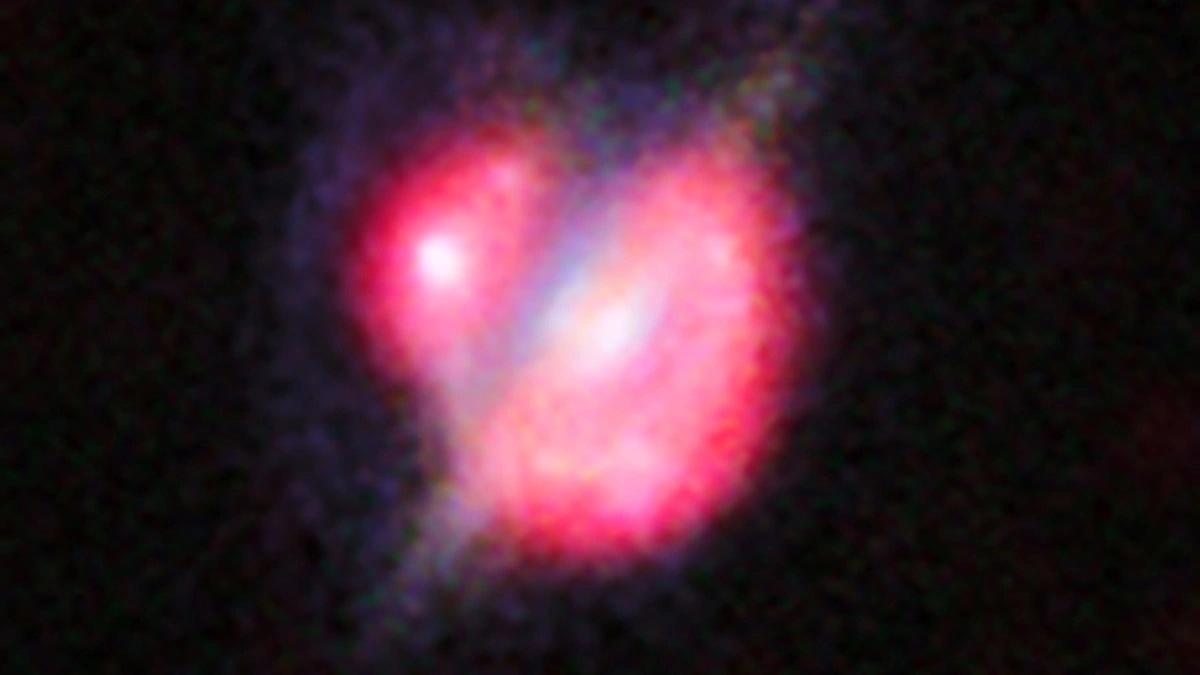
Astronomers have detected a record-breaking space laser, officially known as a gigamaser, originating an astonishing 7.82 billion light-years from Earth. Discovered using the MeerKAT radio telescope in South Africa, this colossal microwave emission emerges from a violent galactic collision that compresses gas and triggers massive star formation. The unprecedented observation provides researchers with a rare glimpse into the extreme cosmic forces shaping the early universe.
This discovery is highly significant for astrophysicists, cosmologists, and space enthusiasts tracking the evolution of galaxies. By studying this amplified microwave emission, scientists can better understand the mechanics of galactic mergers and the rapid star-forming periods that dictate how massive cosmic structures mature over billions of years.
Natural astrophysical masers, which are the microwave equivalents of lasers, typically occur in star-forming regions or around supermassive black holes. However, the newly identified object, designated HATLAS J142935.3002836, falls into the ultra-rare gigamaser category. These phenomena are billions of times brighter than standard masers, requiring the unfathomable energy of two galaxies smashing together to stimulate hydroxyl molecules into releasing intense, synchronized radio waves.
The Role of Gravitational Lensing
The detection of this distant gigamaser was made possible through a serendipitous cosmic alignment. As the radio waves traveled toward Earth, they passed behind a perfectly aligned, unrelated foreground galaxy. According to Thato Manamela, an astrophysicist at the University of Pretoria, this intervening galaxy acted as a gravitational lens. Its immense mass curved local space-time, magnifying the gigamaser's signal much like a water droplet on a window pane.
This natural amplification allowed the MeerKAT radio telescope to capture the emission, shattering the previous distance record of 5 billion light-years. The findings, accepted for publication in the Monthly Notices of the Royal Astronomical Society Letters, highlight the advanced capabilities of modern radio astronomy. The researchers noted that the MeerKAT observatory is uniquely positioned to investigate high-redshift hydroxyl megamasers and gigamasers, serving as valuable tracers for exploring galaxy outflows and the complex dynamics of merging cosmic bodies.
Frequently Asked Questions
What is a gigamaser?
A gigamaser is an extremely powerful, naturally occurring emission of amplified microwave radiation, often triggered by massive cosmic events like colliding galaxies.
How far away is the newly discovered space laser?
The gigamaser, known as HATLAS J142935.3002836, is located 7.82 billion light-years away, breaking the previous record of 5 billion light-years.
How did astronomers detect it?
Scientists used the MeerKAT radio telescope in South Africa, aided by gravitational lensing from a foreground galaxy that naturally magnified the signal.
My Take
The discovery of HATLAS J142935.3002836 is a testament to the compounding power of next-generation observatories and natural cosmic phenomena. The fact that this gigamaser was detected at a staggering distance of 7.82 billion light-yearsshattering the previous 5-billion-light-year recorddemonstrates how gravitational lensing can effectively upgrade our current technological limits. As the MeerKAT array continues its deep-sky surveys, we can expect a significant increase in the detection of high-redshift galactic mergers, ultimately providing a clearer timeline of how the universe's most massive galaxies assembled during its formative epochs.