Astronauts aboard the International Space Station have successfully activated the newly upgraded NASA Cold Atom Lab, a facility designed to cool atoms to nearly absolute zero. By leveraging the microgravity environment of low Earth orbit, this minifridge-sized laboratory allows scientists to manipulate matter in ways fundamentally impossible on Earth. "At the coldest temperatures, matter behaves drastically different from anything we have experienced," explained Jason Williams, project scientist at JPL. "The wavelike nature of matter dominates."
For quantum physicists and aerospace engineers, this fourth major upgrade to the facility represents a critical step toward next-generation technologies. The ability to sustain and observe a Bose-Einstein condensate (BEC) in space paves the way for ultra-precise quantum sensors. These advancements could eventually revolutionize deep space navigation, Earth science missions, and our fundamental understanding of gravity.
How the Cold Atom Lab Manipulates Matter
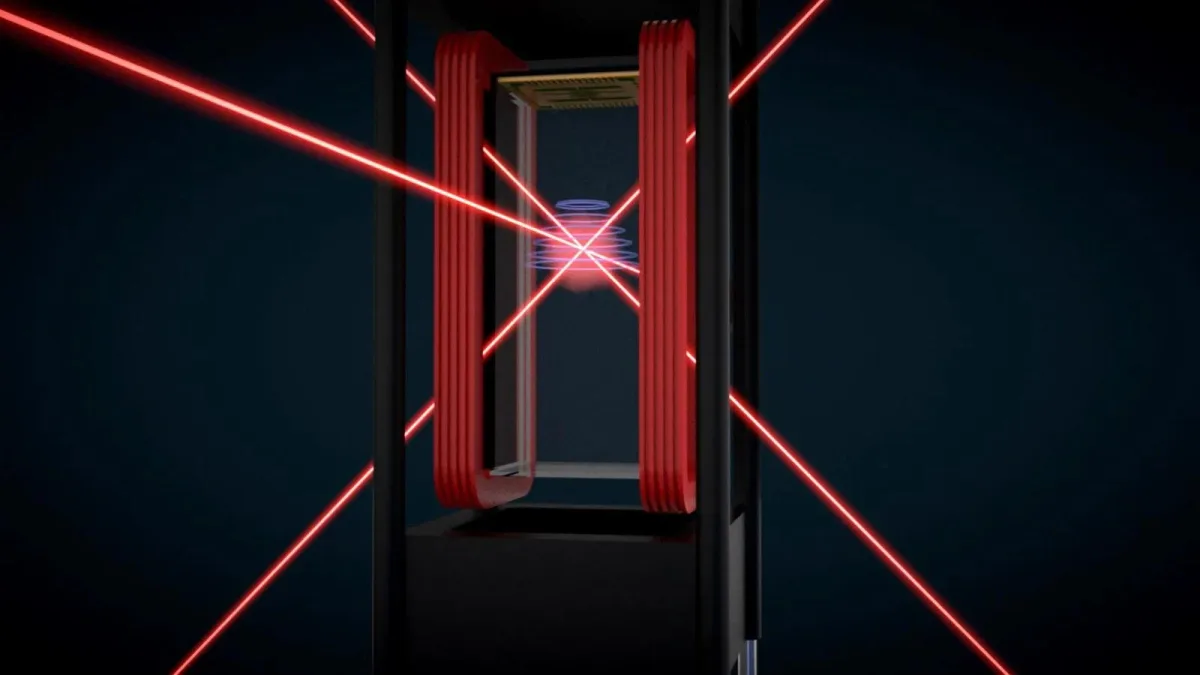
The core of the NASA Cold Atom Lab relies on a highly miniaturized science module that condenses an entire room of lasers and mirrors into a single ISS rack. The process begins by heating a strip of rubidium or potassium metal to 750 degrees Fahrenheit (400 degrees Celsius) to create a gas inside a vacuum chamber.
Scientists then fire precisely tuned lasers to slow the atoms down, drastically dropping their temperature to below minus 459 degrees Fahrenheit (minus 237 degrees Celsius). A magnetic trap captures the nearly motionless atoms, forming a Bose-Einstein condensate. In the microgravity of space, these quantum gas clouds can grow larger and be observed for significantly longer durations than in terrestrial laboratories.
As the first project to create Bose-Einstein condensates in orbit, we’re demonstrating that we can make quantum technology work reliably in space. We’re performing quantum 2.0 - direct manipulation of large quantum states - and we hope for similar gains in quantum tech by advancing this science in orbit.
- Ethan Elliott, Deputy Project Scientist, JPL
The Fourth Orbital Upgrade
The latest hardware, which arrived via a Commercial Resupply Services mission on April 11, introduces a redesigned magnetic trap. This crucial modification allows researchers to actively alter the shape of the quantum gas clouds, unlocking new methods to investigate the fundamental properties of ultracold atoms.
Additionally, engineers installed redesigned metal strips that serve as improved sources for generating the initial gas clouds. According to Kamal Oudrhiri, the project manager at JPL, these enhancements push the boundaries of controlling the quantum world, ensuring the facility remains a premier testing ground for five international research teams.
The Next Era of Space-Based Sensors
The continued evolution of the NASA Cold Atom Lab is about much more than abstract physics; it is laying the groundwork for the next generation of spacecraft instrumentation. By mastering matter-wave interferometers in orbit, NASA is actively maturing the technology required for GPS-independent navigation in deep space.
When spacecraft travel beyond the Moon or toward Mars, traditional timing and positioning systems become strained. Quantum sensors developed from these ISS experiments could provide unprecedented gravity sensing and autonomous navigation capabilities. Ultimately, the ability to reliably manipulate the fifth state of matter in microgravity bridges the gap between theoretical quantum mechanics and practical, mission-critical aerospace engineering.