

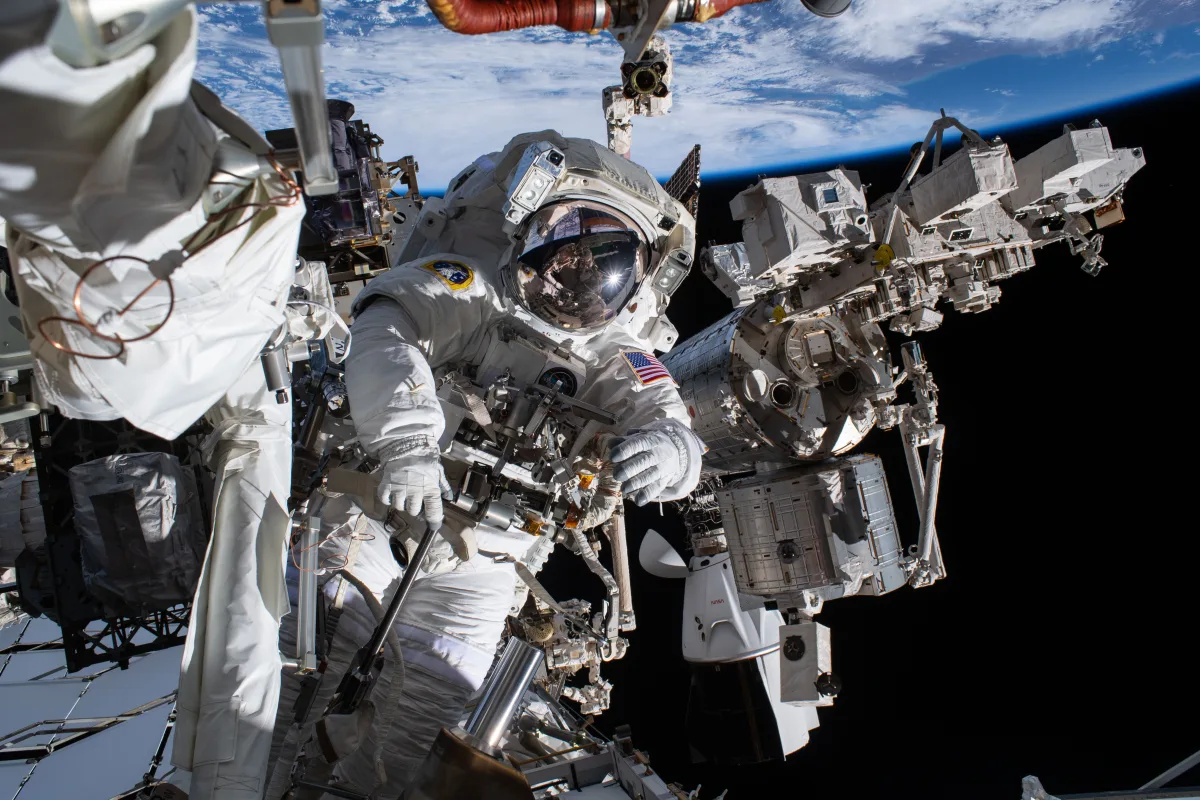
After an eight-month deployment aboard the International Space Station (ISS), NASA astronaut Chris Williams is preparing for his return to Earth. His inaugural spaceflight goes far beyond routine maintenance, heavily focusing on microgravity research that promises to accelerate commercial semiconductor manufacturing and targeted cancer therapies.
The mission highlights a growing trend in low Earth orbit operations: utilizing the unique environment of space to manufacture materials and medicines that are physically impossible to produce with the same quality on Earth. Williams's work also lays critical groundwork for future deep-space missions to the Moon and Mars.
Pioneering Cancer Treatments in Microgravity
During his time in orbit, Williams collaborated with ESA astronaut Sophie Adenot to process DNA-inspired materials aimed at advancing cancer treatments. In the microgravity environment, these rod-shaped constructs form more evenly and consistently than they do on Earth. This research, part of the DNA Nano Therapeutics-3 project, is designed to create targeted therapies that penetrate deep into solid tumors.
By releasing medicine in a highly controlled manner, these space-developed treatments aim to minimize the systemic side effects common in traditional therapies. Additionally, Williams contributed to the ADSEP-PIL-10 project, which focuses on growing protein crystals for pharmaceuticals. Because protein crystals form higher-quality structures in space, researchers can better understand disease targeting.
This specific project aims to develop a new, orally administered cancer treatment formula. Growing these complex protein structures in orbit opens the door for commercial pharmaceutical companies to leverage orbital laboratories for future drug development.
Next-Generation Semiconductors and Robotics
Beyond medicine, Williams conducted experiments to grow semiconductor crystals in space. The SUBSA-InSPA-SSCug investigation demonstrates that microgravity allows for the production of larger, higher-quality crystals than terrestrial manufacturing methods. These space-grown components offer enhanced performance for high-performance computing, artificial intelligence systems, and advanced medical devices.
To support the future of automated space research, Williams also tested the performance of small robotic arms through the TUSK facility. Because microgravity can significantly impact delicate mechanical operations, refining these robotic systems is essential. Improved automation will allow future automated systems to handle precise, repetitive tasks while astronauts focus on critical mission objectives.
Station Upgrades and Deep Space Preparation
Williams's mission also included critical infrastructure upgrades and deep-space preparation. He completed two spacewalks, including repairs to the Canadarm2 robotic arm and preparatory work for the final set of International Space Station Roll Out Solar Arrays (IROSA). Once fully installed, these arrays will boost the station's power generation by approximately 30%, utilizing the same technology that powered NASA's Double Asteroid Redirection Test.
Inside the station, Williams managed the MELFI ultra-cold freezer, preserving biological samples to study the long-term effects of spaceflight on the human body. He also tested the GULBI ultraviolet light system, which aims to prevent microbial biofilms from contaminating water systems and equipment. This is a crucial sanitation technology for long-duration missions that reduces reliance on chemical disinfectants.
The Commercialization of Orbital Laboratories
The conclusion of Williams's eight-month mission underscores a fundamental shift in how space agencies utilize the ISS. The station is no longer just a proving ground for human endurance; it has transformed into a highly specialized incubator for commercial manufacturing. The success of growing superior semiconductor crystals and high-quality protein structures in microgravity proves that orbital manufacturing is moving from a theoretical concept to a practical industrial strategy.
As NASA prepares for the Artemis missions and eventual crewed flights to Mars, the technologies tested during this deployment - specifically the UV biofilm inhibition and the IROSA power systems - will be foundational. However, the most immediate impact will be felt on Earth. By proving that space-based pharmaceutical and electronic manufacturing yields better results than terrestrial factories, this mission provides a clear financial and scientific incentive for private companies to invest heavily in the next generation of commercial space stations.
