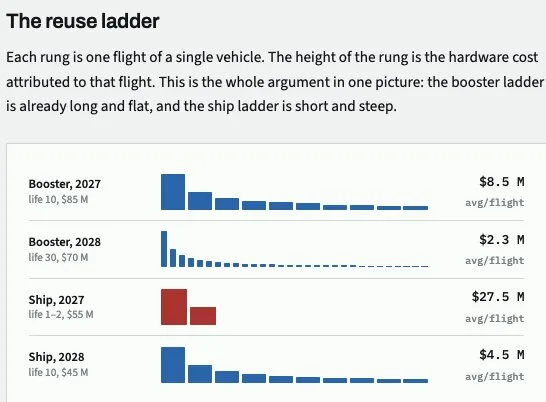
SpaceX is rapidly approaching a financial tipping point where the Starship cost per kilogram could drop to $100, making space-based AI data centers cheaper to operate than their terrestrial counterparts. As the company prepares for a massive fleet-building phase in 2027, the economics of orbital launches are shifting from experimental testing to industrial-scale logistics. The quantitative model relies heavily on scaling booster life from 5 to 30 flights and ship life from 1 to 10 flights.
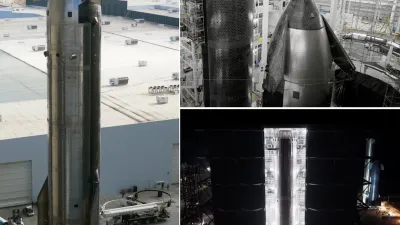
Following the milestones of Flight 13, where the booster was caught repeatedly and the upper stage survived reentry intact despite broken tile corners and ablator streaks, SpaceX is refining its reuse strategy. The thermal protection system remains a bottleneck, but the company can now trade refurbishment costs against landing odds. Rebuilding an entire damaged heat shield costs approximately $4 million, allowing SpaceX to refly upper stages with minor or no repairs if they are treated as expendable on their final flight.
The narrative: HEaT sHiElD TiLEs ArE a DeAd EnD. The reality: SpaceX can trade off refurbishment costs against landing odds.
- Brett Winton
The year 2027 will be dominated by capital expenditure, with SpaceX projected to build 8 to 15 new boosters and 50 to 100 new ships. Even with the SLC-37 pad online and ships being caught and reflown twice, the marginal cost is expected to land between $390 and $550 per kilogram. When factoring in a $1.8 billion annual fixed base spread over 100 to 140 flights, the fully-loaded cost sits near $500 to $730 per kilogram.
To achieve the ultimate goal of a $100 per kilogram launch cost, SpaceX must push booster reuse to 20 or 40 flights - mirroring the success of the Falcon 9 - and secure 5 to 10 reuses for the upper stage. The introduction of the Version 4 Starship in late 2027 is critical to this equation, as it aims to increase the reusable payload capacity to 200 tonnes.
The Orbital AI Arbitrage
The projection that $100 per kilogram makes space-based AI data centers cheaper than Earth-based ones is the most disruptive detail in this economic model. Terrestrial AI data centers are currently constrained by massive power grid limitations, land acquisition costs, and complex liquid cooling demands. By moving compute to orbit, companies could theoretically harness unmitigated solar energy and natural vacuum cooling.
If the Version 4 Starship hits its 200-tonne payload target and achieves rapid reusability, the space economy will pivot from simple satellite deployment to heavy orbital infrastructure. This cost crossover point forces a reevaluation of how tech giants plan their next-generation AI investments, as launching servers into low Earth orbit may soon become a standard infrastructure play rather than a science fiction concept.