

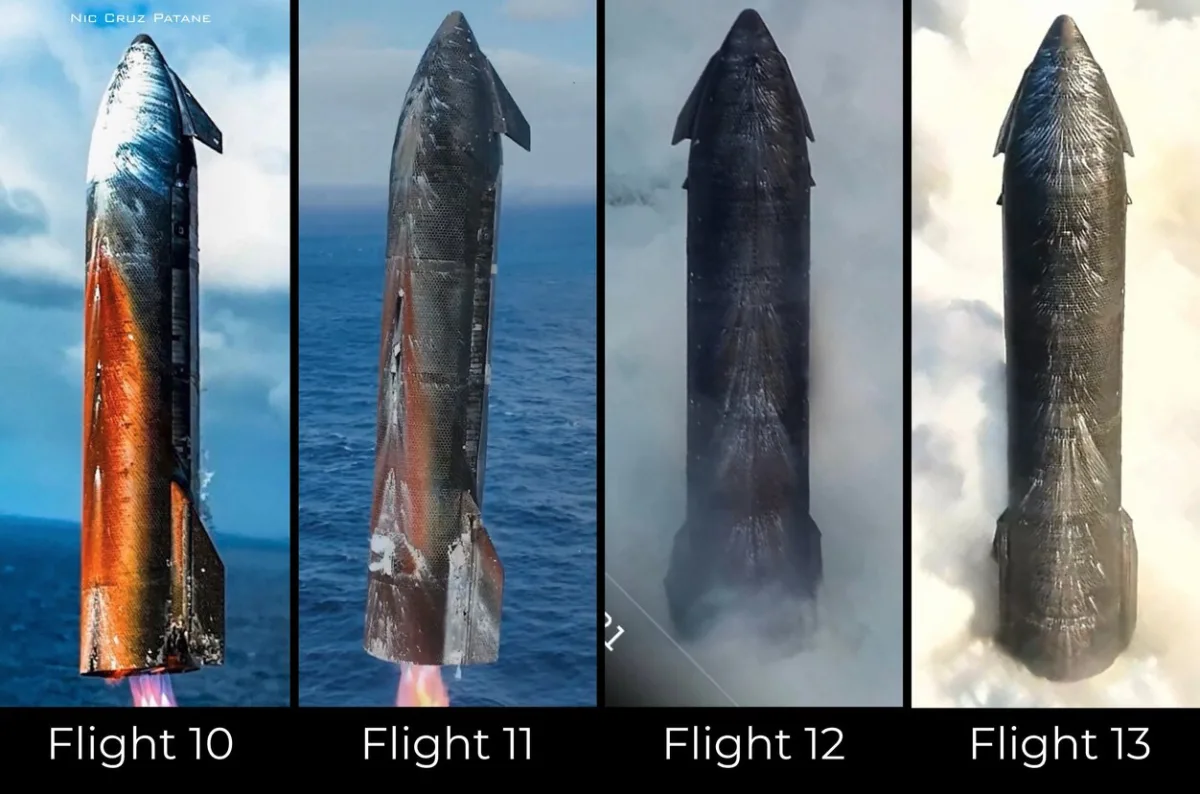
SpaceX is aggressively pushing the limits of its thermal protection systems, using data from a brutal reentry profile to drive the upcoming Starship Flight 14 upgrades. While the upper stage successfully survived its high-stress return with minimal tile damage, a partial landing burn failure on Booster 20 has forced engineers to overhaul the Raptor 3 engine relight software. The aerospace company deliberately flew a higher-dynamic-pressure reentry profile on its recent July 24 flight to stress the system far beyond a normal return trajectory.
The gamble paid off for the upper stage. The vehicle survived the intense plasma heat, executed its flip maneuver, and completed a soft splashdown in the Indian Ocean while remaining completely intact and transmitting telemetry. Multiple independent views, including onboard cameras and pre-reentry imaging from six Starlink V3 satellites, confirmed that the vast majority of the approximately 18,000 hexagonal tiles remained firmly attached.
We got all the heat shield data we needed and then some.
- Elon Musk, SpaceX
Where minor tile loss did occur, the underlying ablative layer successfully protected the ship's structure, preventing any cascading burn-through. Observers, including Ryan Hansen Space, noted that white streaks visible on the hull were deposits from this ablative material burning off to protect exposed areas. SpaceX has no plans to physically recover the test article from the ocean, relying instead on the massive volume of high-resolution remote data to refine edge tapering and robotic adhesive applications for future flights.
Booster 20's Hard Splashdown
While the upper stage triumphed, the Super Heavy booster (B20) encountered significant issues during its descent. The ascent and boostback phases were flawless, with all 33 Raptor 3 engines firing perfectly. For the first time on a V3 booster, the high-thrust portion of the boostback burn successfully utilized the entire 33-engine cluster.
However, the landing phase suffered a partial failure. Out of the planned 13-engine landing burn configuration, only about 8 engines successfully relit. This resulted in a harder-than-intended splashdown in the Gulf of Mexico. This anomaly is a continuation of the engine relight problems observed during Flight 12, compounded by lessons learned from a July 16 pad abort where moisture froze inside the liquid oxygen (LOX) turbopumps.
The Complexity of Raptor 3 Relights
To understand the upcoming Starship Flight 14 upgrades, it is crucial to understand the mechanics of the Raptor 3. It is a full-flow staged combustion (FFSC) methalox engine, representing the most complex operational rocket cycle currently flying. Because there is no separate main-chamber igniter, the engine relies on superheated exhaust gases from two separate preburners to spontaneously ignite the main chamber at extreme pressures of 300 to 350 bar.
The in-flight relight sequence is incredibly sensitive to thermal conditions and propellant states. The standard startup sequence follows these precise steps:
- Propellant Settling: Cold-gas thrusters settle the liquid propellants, and tanks are pressurized.
- Chill-down: Cryogenic LOX and liquid methane flow through the lines and turbopumps to reach the correct operating temperature.
- Turbopump Spin-up: Tank pressure forces propellant through the pumps to initiate rotation.
- Preburner Ignition: Torch igniters light the fuel-rich and oxidizer-rich preburners in a carefully timed sequence.
- Main Chamber Light: Hot, high-pressure gas flows into the main chamber and ignites spontaneously.
- Ramp to Full Thrust: Valves precisely control the mixture ratio as the engine accelerates to operating pressure in well under one second.
Expected Fixes for Booster 21
In-flight relights are notoriously difficult because the engines may be thermally soaked from previous burns or cold from a long coast, and residual propellant can be an unpredictable mix of liquid and vapor. To ensure Booster 21 (B21) succeeds where B20 struggled, SpaceX is implementing several targeted Starship Flight 14 upgrades.
Booster 21 has already rolled out for cryogenic testing and will incorporate the following critical improvements:
- Refined Startup Sequencing: Software updates will introduce tighter timing robustness to handle the variability of multi-engine interactions during the landing phase.
- LOX Conditioning Improvements: Enhanced drying and purging procedures, alongside potential hardware tweaks like upgraded seals or heaters, will prevent the turbopump freezing seen during the July 16 abort.
- Updated Abort Logic: Engineers are tuning the engine health monitoring and propellant management systems to better condition residual fuel before the landing burn commits.
The Final Hurdle to Rapid Reusability
The data from Flight 13 marks a fundamental shift in the Starship program's risk profile. For the past year, the primary existential threat to the vehicle was whether the heat shield could survive the extreme thermal dynamics of orbital reentry without melting the ship's structural integrity. With the ablative underlayer proving its worth and tile loss dropping to manageable levels, that specific structural hurdle has largely been cleared.
Now, the critical path to rapid reusability rests entirely on software and fluid dynamics. The Raptor 3's multi-engine relight reliability is the final boss of the Super Heavy booster program. SpaceX cannot risk attempting a mechanical tower catch with the 'Mechazilla' arms until the 13-engine landing burn is flawlessly consistent. If the software and purging upgrades on Booster 21 successfully deliver a controlled, soft splashdown, the aerospace industry should expect SpaceX to attempt a historic launch tower catch on the very next flight.
