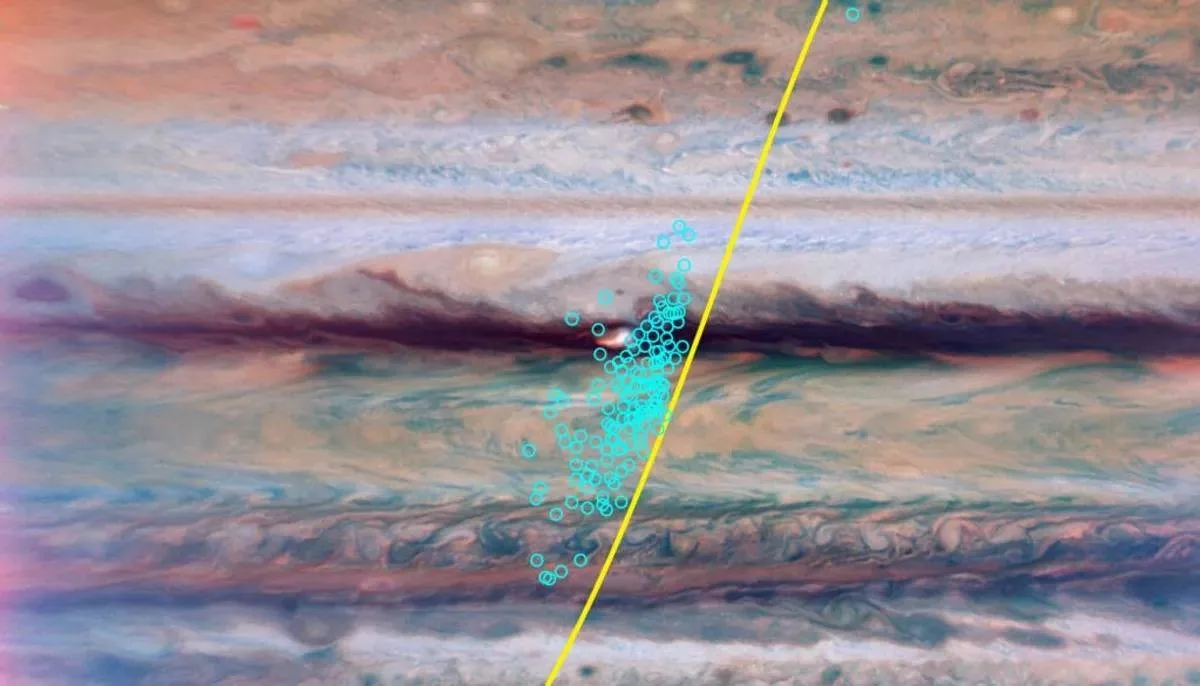
Extraterrestrial lightning storms recorded by NASA spacecraft are proving to be significantly more violent than anything experienced on Earth, with some flashes capable of illuminating areas the size of the United States. The phenomenon of lightning, which generates temperatures hotter than the surface of the sun, is not exclusive to our home planet. Decades of planetary exploration have revealed that these intense electrical discharges are a common, yet highly varied, feature across the solar system.
The first major breakthrough occurred in 1979 when the Voyager 1 spacecraft flew past Jupiter. Its imaging cameras captured massive regions of the gas giant's clouds illuminated by lightning strikes. During this mission, physicist Don Gurnett from the University of Iowa utilized onboard instruments to detect radio waves known as "whistlers," which serve as a definitive acoustic signature of lightning activity.
Jupiter and Saturn: The Gas Giant Storms
Subsequent missions have provided even deeper insights into Jovian weather. The New Horizons spacecraft detected lightning flashes on Jupiter that were ten times more powerful than any recorded on Earth. More recently, the Juno spacecraft, which has flown closer to Jupiter than any previous mission, discovered a fundamental difference in how the planet's storms operate. Unlike Earth, where lightning predominantly strikes over landmasses and peaks near the equator, Juno found that Jupiter's lightning is heavily concentrated around its high latitudes.
Despite this geographical difference, Juno recorded peak rates of four flashes per second, a frequency remarkably similar to terrestrial storms. The underlying mechanism also shares similarities with Earth. Deep within Jupiter's atmosphere, gases including water vapor rise and freeze. Convection currents then separate the ice particles from liquid water droplets, generating an electrical charge that eventually discharges as a massive lightning strike.
Saturn, another gas giant, exhibits similarly violent electrical activity. During flybys in 1980 and 1981, the Voyager spacecraft detected radio signals termed "sferics," which, much like whistlers, indicate lightning. The Cassini spacecraft later recorded similar emissions, revealing that during Saturn's most severe storms, lightning can strike at an astonishing rate of up to ten times per second.
The Venus and Mars Debate
While gas giants clearly host massive storms, the search for lightning on rocky planets has yielded conflicting results. Venus features a scorching, dry atmosphere composed mostly of carbon dioxide and laced with sulfuric acid. When the Cassini spacecraft performed two flybys of Venus in 1998 and 1999, Gurnett used a highly sensitive radio instrument to search for atmospheric lightning. The instrument detected absolutely nothing, despite easily picking up Earth's lightning during a flyby just two months later.
However, the European Space Agency's Venus Express orbiter later detected bursts of electromagnetic waves that some scientists attribute to whistlers. This conclusion remains highly debated, as critics argue the instrument's frequency range was too low to definitively identify standard whistler forms.
A similar mystery surrounds Mars. Gurnett utilized the radar receiver on the Mars Express spacecraft to conduct a comprehensive five-year search for lightning within Martian dust storms, ultimately finding no evidence. Conversely, images captured by the Mars Global Surveyor have shown bright flashes within these dust storms. Furthermore, some researchers point to specific craters on the Martian surface as potential physical evidence of ancient or recent lightning strikes.
My Take
The ongoing study of extraterrestrial lightning is far more than a meteorological curiosity; it is a critical diagnostic tool for understanding planetary thermodynamics. The stark contrast between Earth's equator-driven lightning and Jupiter's pole-driven storms perfectly illustrates how different energy sources dictate atmospheric behavior. Earth's weather is primarily driven by solar radiation hitting the equator, whereas Jupiter's weather is largely fueled by internal heat escaping from its core, pushing convection currents toward the poles.
Furthermore, the conflicting data regarding Venus and Mars highlights the limitations of our current orbital instruments. The fact that the Cassini spacecraft found nothing on Venus, while the Venus Express detected anomalous waves, suggests that if lightning does exist on these rocky neighbors, it operates on frequencies or mechanisms entirely alien to terrestrial physics.
For future missions targeting the atmospheric entry of probes - such as upcoming missions to Venus or the ice giants Uranus and Neptune - understanding these electrical hazards is not just academic; it is a matter of spacecraft survival. Engineers must account for the possibility of encountering discharges ten times more powerful than Earth's, making these historical datasets from Juno and Cassini invaluable for next-generation spacecraft design.
This article was written by AI from reporting by albayan.ae.