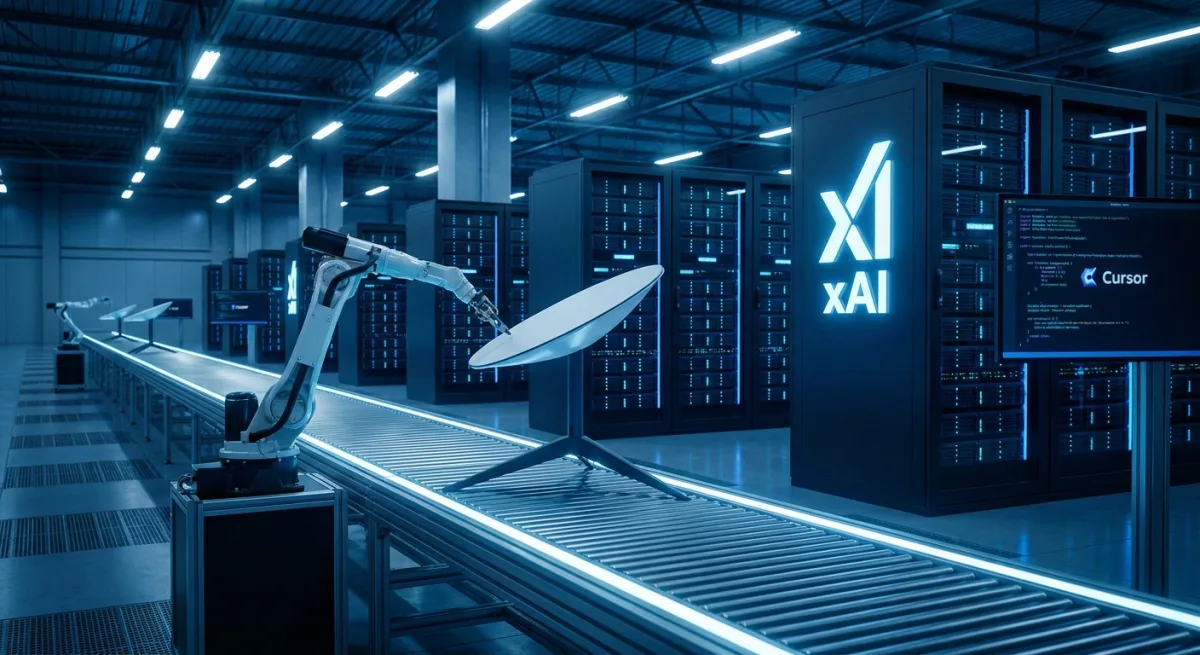
SpaceX is aggressively scaling its hardware manufacturing, pushing Starlink dish production toward 50,000 units per day, up from its recent rate of roughly 25,000 daily units. This massive manufacturing ramp-up is designed to support a projected subscriber base of 20 to 25 million users by the end of 2026, before doubling to approximately 50 million in 2027. For enterprise developers and rural internet users alike, these parallel expansions signal a major disruption in both global connectivity and software development.
Combined with its lucrative launch operations, SpaceX is on track to generate between $25 billion and $30 billion in total revenue by the end of 2026. If the subscriber growth holds, that figure could scale to an impressive $40 billion to $50 billion in 2027. However, the company's ambitions extend far beyond aerospace and telecommunications.
The xAI and Cursor Acquisition Strategy
Beyond satellite internet, the Elon Musk ecosystem is making aggressive moves in the artificial intelligence sector. The strategic deal involving SpaceX, xAI, and the AI coding platform Cursor is positioned to resolve critical infrastructure bottlenecks. Cursor, which boasts 1 million developer users and tens of thousands of enterprise customers, recently built its own model but found itself severely compute-starved.
Despite generating an impressive $2.7 billion in annual run-rate revenue, Cursor has struggled with profitability due to the high costs of relying on third-party models from Anthropic and OpenAI. By integrating with xAI's infrastructure and potentially shifting users to a proprietary Large Language Model (LLM) or Grok Code, Cursor can drastically reduce its cost of goods sold and achieve immediate profitability.
The demand for AI-assisted coding currently outpaces available supply across the tech industry. Cursor was already on track to reach $6 billion in revenue by the end of 2026. With the massive compute resources provided by the xAI ecosystem to train and serve models, the platform's growth is expected to accelerate significantly, potentially unlocking a $10 billion to $30 billion annual run-rate.
The Synergy of Compute and Connectivity
The acquisition of Cursor by the SpaceX and xAI network highlights a brilliant vertical integration strategy. By bringing a compute-starved, high-revenue platform like Cursor in-house, xAI instantly secures a massive, paying developer base for Grok Code. This move directly undercuts competitors by removing the need to pay premium API fees to outside AI labs.
Meanwhile, Starlink's jump to 50,000 dishes produced daily proves that SpaceX is no longer just an aerospace company; it is a consumer hardware juggernaut. If Cursor successfully transitions its 1 million developers away from Anthropic and OpenAI, it will not only achieve immediate profitability but also establish xAI as the dominant foundational layer for enterprise software development.