Researchers have unveiled a computational framework for continuously reprogramming Totimorphic structures - zero-stiffness mechanical lattices - to autonomously adapt their physical and optical properties for deep space applications. Authored by Dominik Dold, Amy Thomas, Nicole Rosi, Jai Grover, and Dario Izzo, the newly updated research demonstrates how these materials could enable self-configuring space telescope mirrors and self-repairing spacecraft components. The study, recently revised on March 13, 2026, outlines a differentiable approach that guarantees valid configurations throughout the optimization process.
This breakthrough is highly relevant for aerospace engineers, astrophysicists, and satellite designers looking to overcome the physical limitations of traditional spacecraft. By utilizing these reprogrammable materials, space agencies can drastically reduce the payload weight and mechanical complexity of future missions. This enables a single physical structure to adapt to multiple operational needs in harsh, resource-constrained environments without requiring manual intervention or replacement parts.
Deep space exploration presents extreme challenges, primarily because environments are unforgiving and resources are strictly limited. Traditional spacecraft rely on rigid, single-purpose structures that cannot adapt if mission parameters change or if components sustain damage. The introduction of Totimorphic lattices addresses this critical vulnerability by providing a lightweight model for endowing physical systems with autonomous self-configuration and self-repair capabilities.
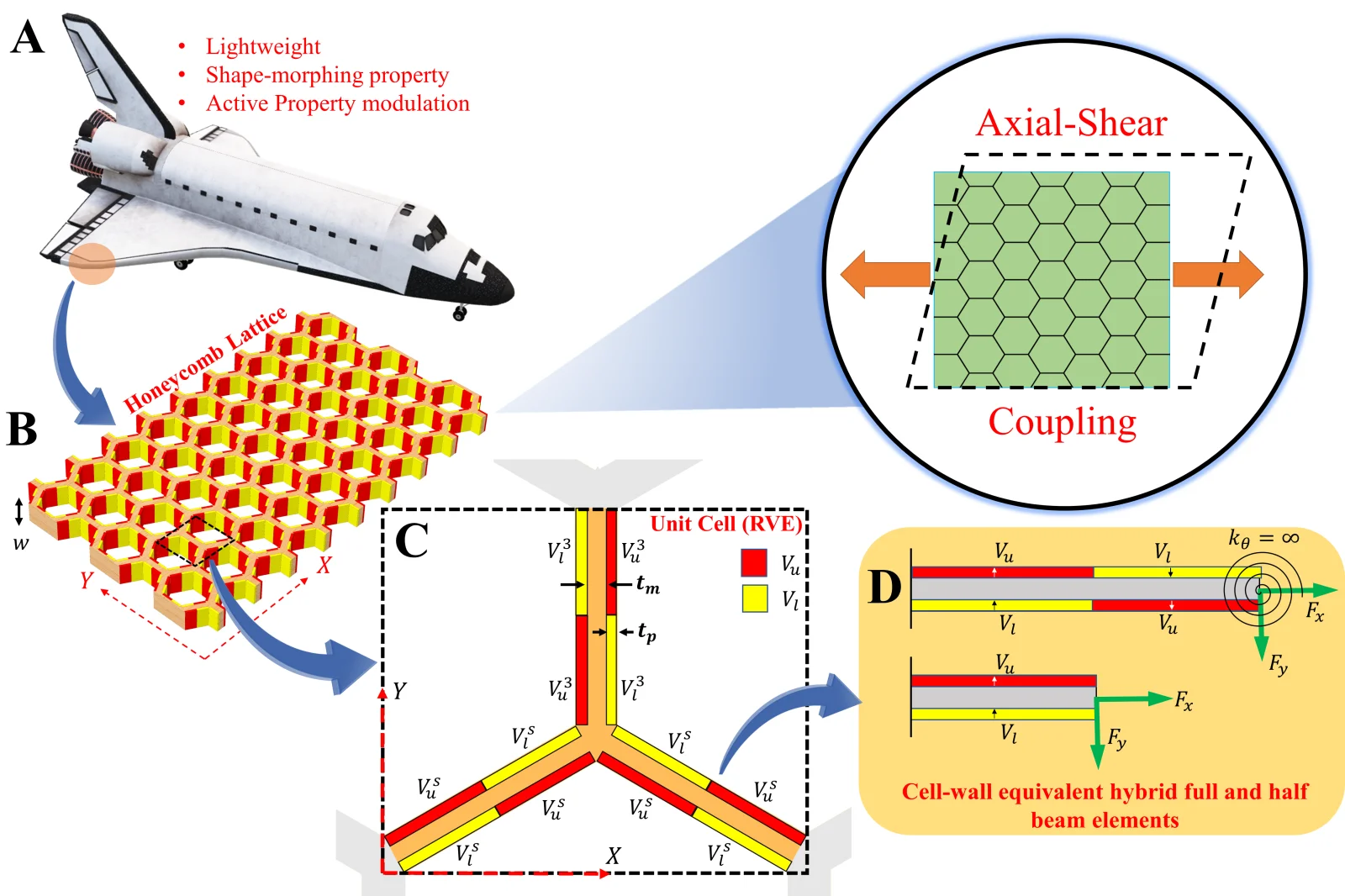
At the core of this innovation is a class of mechanical lattices characterized by their zero-stiffness, reconfigurable nature. The computational framework introduced by the research team allows for the continuous reprogramming of the effective properties of these lattices, including their mechanical and optical behavior. This is achieved entirely through geometric changes, which the team successfully demonstrated using advanced computer simulations.
The technical execution relies on a highly sophisticated control mechanism. The framework provides not only the target states with the desired properties but also continuous trajectories in the configuration space that connect them. Actuators within the reprogrammable structures are controlled via automatic differentiation based on an objective-dependent cost function, allowing the lattice to continuously adapt to achieve a specific goal.
Concrete Space Applications and Proof of Concept
To validate their computational framework, the researchers presented two distinct proof-of-concept scenarios tailored for deep space operations. The first scenario involves a reprogrammable disordered lattice material. This application showcases how a seemingly chaotic structural arrangement can be systematically reorganized to alter its mechanical properties on demand, offering unprecedented flexibility for spacecraft hulls or internal supports.
The second, and perhaps most visually striking, scenario is the development of a space telescope mirror with an adjustable focal length. Traditional space telescopes, like James Webb, rely on complex, rigid mirror segments that must be perfectly aligned. A Totimorphic mirror could physically alter its geometry in orbit to change its focal length, allowing a single instrument to perform multiple types of astronomical observations.
The underlying code for this framework is open for the scientific community. Researchers and engineers can access the tools via the official LattyMorph repository, indicating strong ties to European Space Agency (ESA) initiatives. This open-source approach is expected to accelerate the adoption of differentiable, zero-stiffness structures in upcoming aerospace projects.
My Take
The transition from rigid, single-use spacecraft components to software-defined physical structures represents a paradigm shift in aerospace engineering. Based on the successful simulation of the space telescope mirror with an adjustable focal length, it is clear that future deep space observatories will likely abandon static mirrors in favor of these dynamic, Totimorphic lattices. Furthermore, the fact that the code is hosted on an ESA-linked repository suggests that major space agencies are already laying the groundwork for autonomous, self-repairing satellites. As automatic differentiation becomes more integrated into physical actuation, we will see a new era of spacecraft that can literally reshape themselves to survive the harsh realities of the cosmos.
Frequently Asked Questions
What are Totimorphic structures?
They are a class of mechanical lattices featuring zero-stiffness, reconfigurable designs that can change their physical and optical properties through geometric shifts.
How do these structures change shape autonomously?
They use a computational framework where actuators are controlled via automatic differentiation on an objective-dependent cost function, allowing continuous adaptation.
What are the main applications for this technology?
The primary focus is on deep space applications, specifically demonstrated through reprogrammable disordered lattice materials and space telescope mirrors with adjustable focal lengths.