A NASA lunar fire test is officially in the works to address one of the most terrifying threats to future crewed missions: uncontrollable combustion in partial gravity. On Earth, gravity-driven convection currents can actually extinguish marginally flammable materials through a phenomenon known as blowoff, where hot gases rise rapidly and draw in cool oxygen. However, the Moon's unique environment presents a much deadlier scenario for astronauts.
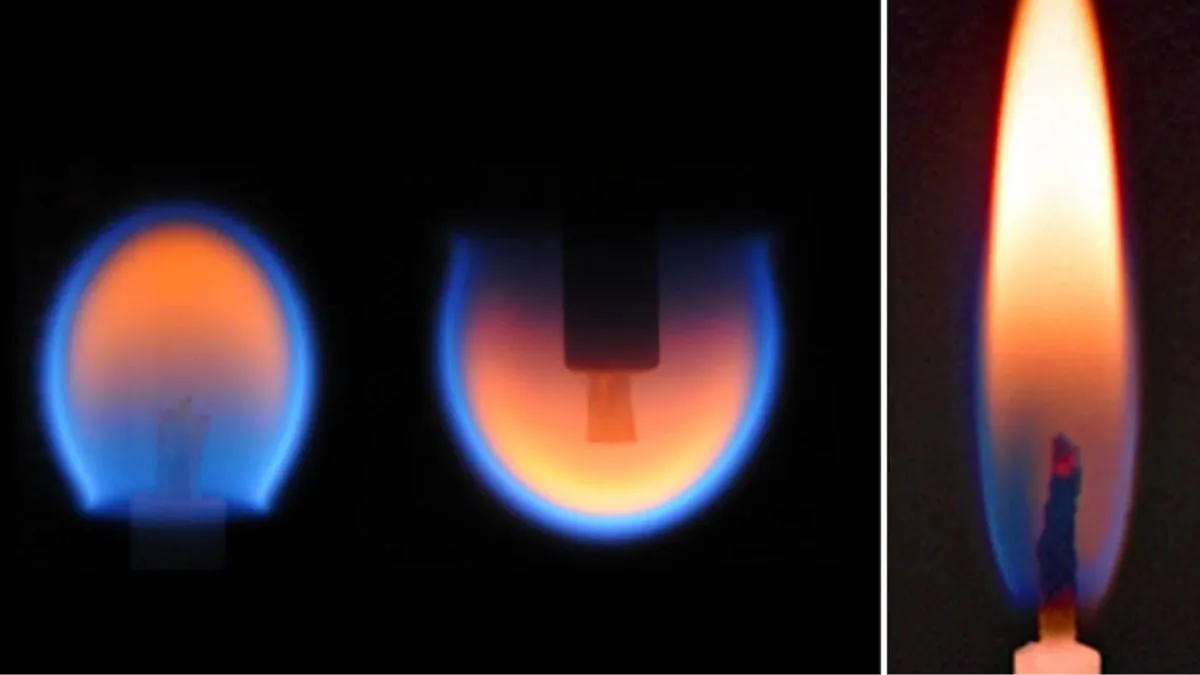
In lunar gravity, the flow of oxygen still exists but moves at a significantly slower pace. This sluggish convection continuously resupplies oxygen to a flame without creating enough vapor movement to trigger a blowoff condition. As a result, materials that might be considered safe or non-flammable on Earth could burn indefinitely inside a lunar habitat, prompting mission planners to study flames in space before establishing a permanent crewed presence.
The Limits of NASA-STD-6001B and Microgravity Testing
For decades, aerospace engineers have relied on a standard known as NASA-STD-6001B to screen materials for flight. This Earth-bound test involves holding a six-inch flame to the bottom of a vertically mounted material; if it burns more than six inches upward or drips burning debris, it fails. The critical flaw in this standard is that it relies on Earth's convective currents and a strict up-and-down orientation, neither of which apply to orbital or lunar environments.
In microgravity, fires do not point upward. Instead, they form spherical blobs of flame that spread slowly outward, fed almost entirely by a spacecraft's ventilation systems. To understand this, researchers previously lit 1,500 small fires on the International Space Station (ISS). However, to avoid risking the habitable station, NASA transitioned to the Spacecraft Fire Safety (Saffire) experiments. These tests were conducted inside an uncrewed Cygnus cargo capsule before it burned up in Earth's atmosphere.
During the Saffire tests, researchers ignited large sheets of cotton, fiberglass, and acrylic. They discovered bizarre physics, including flames spreading in the opposite direction of airflow and burning hotter on thinner materials. While drop towers provide 5 seconds of weightlessness and parabolic plane flights offer 25 seconds, neither method provides the long-term data required to understand sustained combustion in partial gravity.
Inside the Flammability of Materials on the Moon (FM2) Mission
To bridge the gap between theoretical models and actual lunar conditions, the agency is preparing the Flammability of Materials on the Moon (FM2) experiment. Launching as part of a Commercial Lunar Payload Service (CLPS) mission, FM2 will conduct the first-ever controlled combustion tests directly on the lunar surface.
The experiment features a self-contained chamber that will burn four distinct solid fuel samples under actual lunar gravity. This setup is currently impossible to replicate anywhere on Earth or in orbit. To capture the physics in real time, the chamber will be heavily instrumented with high-resolution cameras, radiometers, and oxygen sensors.
Crucially, the FM2 mission will provide minutes of continuous combustion data, a massive upgrade over the fleeting seconds gathered from drop tests. This extended observation window will finally connect the observed flame behaviors in 1G (Earth) and zero-gravity (ISS) with the theoretical models of partial gravity.
Redefining Space Habitat Safety
The transition from Earth-bound testing to actual lunar surface data represents a critical bottleneck for the Artemis program. Relying on the legacy NASA-STD-6001B standard is a gamble when the physics of lunar convection actively encourage sustained burning. If the FM2 experiment proves that standard aerospace materials are highly flammable in one-sixth gravity, it will force an immediate paradigm shift in how we build off-world infrastructure.
This data will likely trigger a costly but necessary redesign of lunar habitat interiors, spacesuit fabrics, and life-support ventilation systems. While launching a self-contained fire chamber to the Moon is an expensive endeavor, the cost of a catastrophic fire in a permanent lunar outpost would be immeasurable. The results of FM2 will ultimately dictate the safety protocols for humanity's next major outpost in the solar system.