New imagery and data from the European Space Agency's (ESA) Jupiter Icy Moons Explorer (Juice) have provided a fresh look at the interstellar Comet 3I/ATLAS, offering critical insights into its composition and behavior. Although the comet made its closest approach to the Sun in late October 2025, the data captured during that period has only recently been fully processed and analyzed. The latest release features an image taken by the spacecraft's JANUS camera on November 6, 2025, just a week after the comet's perihelion. This visual evidence, combined with spectral data, is helping astronomers piece together the origins of this visitor from beyond our solar system.
Capturing a Fleeing Visitor
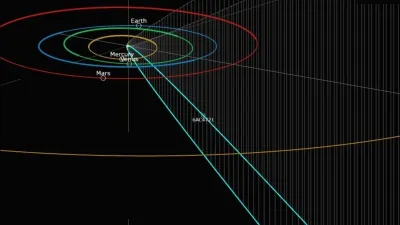
The Juice spacecraft, originally launched in April 2023 to explore Jupiter and its ocean-bearing moons, successfully pivoted its scientific instruments to observe Comet 3I/ATLAS as it traversed the inner solar system. At the time the image was captured, Juice was positioned approximately 66 million km (41 million miles) away from the comet. The resulting image clearly displays the comet's nucleus enveloped in a bright comaa cloud of gas and icy dustalong with a distinct tail extending away from the solar wind. In the upper left corner of the processed image, ESA scientists have mapped the comet's trajectory (indicated in blue) relative to the Sun's position (indicated in yellow), confirming its movement patterns post-perihelion.
Transmitting this data back to Earth presented a unique engineering challenge. The spacecraft was forced to utilize its smaller medium-gain antenna for the transmission because its main high-gain antenna was being deployed as a heat shield to protect the probe from solar radiation. Despite this bandwidth constraint, the JANUS camera managed to capture over 120 images of the comet. These visuals are complemented by data from four other onboard instruments: the Moons and Jupiter Imaging Spectrometer (MAJIS), the Sub-millimeter Wave Instrument (SWI), the Particle Environment Package (PEP), and the UV imaging spectrograph (UVS).
Chemical Anomalies and Future Analysis
While the comet's physical movement mirrors that of typical solar system comets, its chemical composition suggests a far more exotic origin. Preliminary analysis of the data, supported by pre-print reports in the Astrophysical Journal Letters, indicates that Comet 3I/ATLAS possesses an unusually high abundance of nickel but lacks iron. Furthermore, the ratio of carbon dioxide to water within its coma is exceptionally high, distinguishing it from the standard dirty-snowball composition of local comets. These chemical signatures are key to understanding the environment in which the comet formed before being ejected into interstellar space.
The scientific community is now preparing for a major convergence of findings. All instrument teams at the ESA are scheduled to meet in late March 2026 to synthesize the data collected by Juice and other observatories. This collaborative effort aims to resolve the lingering mysteries of 3I/ATLAS, particularly regarding its formation history and the mechanics of its outgassing processes.
My Take
The opportunistic observation of Comet 3I/ATLAS by the Juice mission highlights the incredible versatility of modern deep-space probes. While Juice was built for the Jovian system, its ability to pivot and capture high-fidelity data on a transient interstellar object demonstrates the value of equipping planetary missions with flexible, multi-purpose instrumentation. The chemical anomalies detectedspecifically the nickel-rich, iron-poor profilecould rewrite our understanding of planetary formation in other star systems. As we await the full report in late March, it is becoming clear that interstellar objects are not just rare curiosities, but essential keys to unlocking the chemical diversity of the galaxy.
This article was written by AI from reporting by discovermagazine.com.