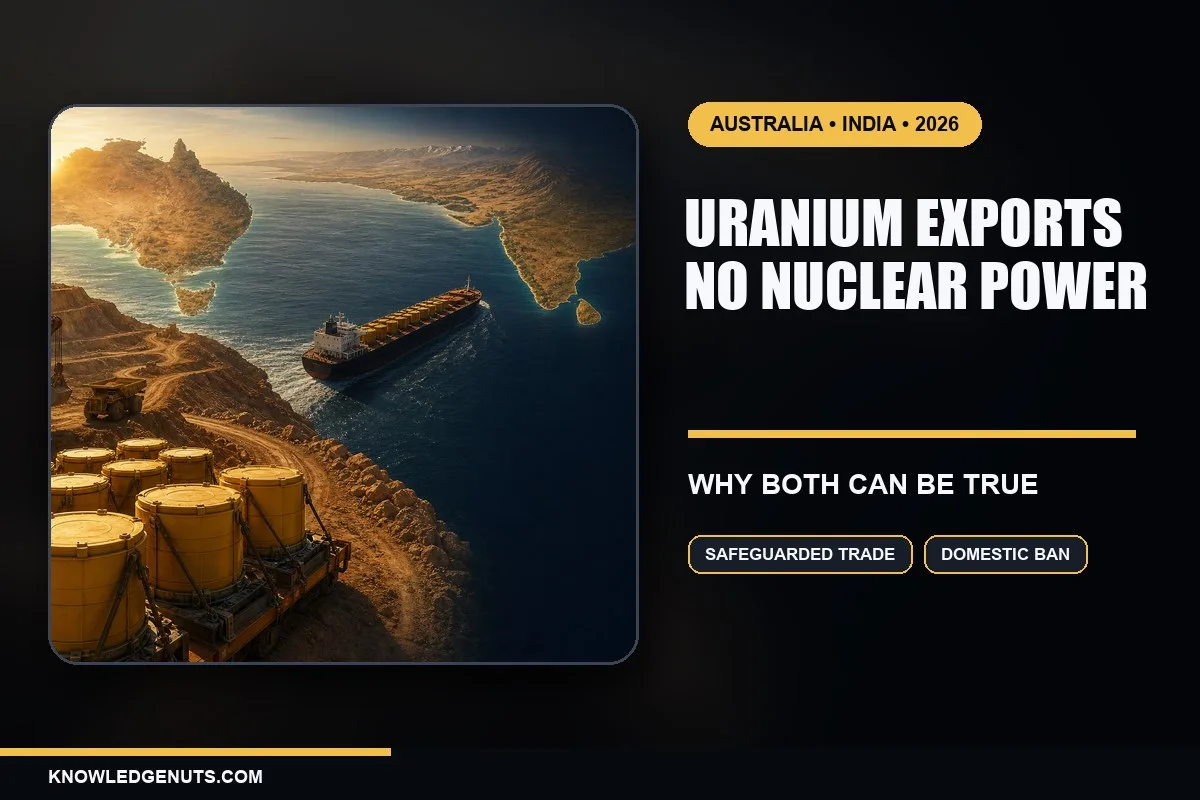
Australia holds the world’s largest identified economic uranium resources, yet a strict federal ban prevents the country from generating a single watt of commercial nuclear power. This stark policy contrast was highlighted on July 9, 2026, when Australia and India signed a new administrative arrangement allowing Australian uranium to be supplied to India for peaceful purposes. The deal, building on a 2015 nuclear cooperation agreement, opens a massive export market while leaving Australia’s domestic electricity grid entirely untouched.
The paradox exists because uranium mining and commercial nuclear power generation operate as two entirely separate industries. Australia exports an average of 5,910 tonnes of uranium per year, capitalizing on massive deposits like the Olympic Dam. However, extracting uranium-bearing ore and processing it into exportable concentrate does not equate to a domestic energy program.
The Missing Nuclear Infrastructure
Building a commercial nuclear fleet requires a vast, highly specialized industrial chain that Australia has never developed. Beyond raw fuel, a nuclear power program demands domestic enrichment services, licensed reactor designs, specialized operators, and permanent high-level radioactive waste facilities. Establishing this infrastructure would represent a monumental national project, completely separate from the existing mining sector.
Federal law explicitly blocks this development. The Australian Radiation Protection and Nuclear Safety Act 1998 and the Environment Protection and Biodiversity Conservation Act 1999 prohibit the approval of specified nuclear installations. While a 2026 Senate bill proposing the removal of these restrictions remained "Before Senate" as of July 13, 2026, repealing the ban would only solve the legal hurdle.
The OPAL Research Exception
Despite the commercial ban, Australia does operate one tightly regulated nuclear facility. The OPAL research reactor at Lucas Heights operates at 20 megawatts thermal, producing neutrons and radioisotopes for medical, research, and industrial applications. Because OPAL does not generate electricity for the national grid, it remains legally permissible and distinct from a commercial power sector.
The Economic Reality Beyond the Ban
Even if the Australian Parliament repeals the federal prohibition on nuclear power, the economic barriers remain formidable. Nuclear plants require massive initial capital investments and face notoriously long construction timelines. In contrast, competing energy sources like gas, wind, and solar have consistently offered shorter deployment periods and more predictable costs across OECD markets.
Lifting the ban would merely shift the debate from a legal prohibition to a brutal economic reality check. Investors and the government would still need to build a long-term business case for a first-of-its-kind plant in a market already heavily saturated with cheaper renewable alternatives. Until that financial equation changes, Australia will remain a global uranium heavyweight that refuses to consume its own product.
This article was written by AI from reporting by knowledgenuts.com.