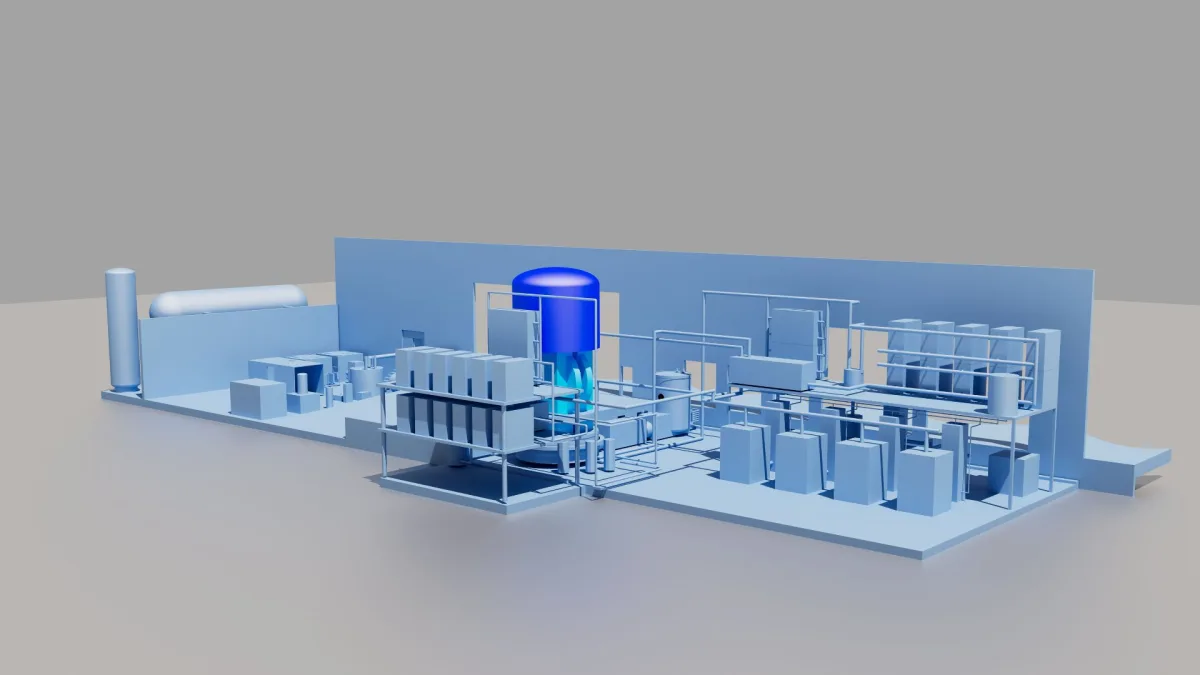
General Atomics has secured a $20 million California Competes Tax Credit to advance the development of its new Blanket Component Test Facility (BCTF) in San Diego. This General Atomics fusion facility aims to solve one of the most significant engineering bottlenecks in commercializing nuclear power: capturing energy and generating tritium fuel directly inside the reactor vessel.
This development is critical for energy researchers, policymakers, and the clean tech industry, as it provides a shared testing ground to validate the systems required for operational power plants. By establishing a dedicated facility for blanket technology, the project accelerates the transition from theoretical physics to practical, grid-scale energy production.
The BCTF will focus on testing full-scale fusion blanket components. These critical systems line the interior of a reactor vessel, where they must withstand extreme conditions to capture the energy released by reactions. Crucially, these blankets are responsible for generating tritium fuel to sustain the continuous reaction process, a mandatory requirement for any viable commercial plant.
Nuclear fusion mimics the process that powers the sun by smashing light atomic nuclei together to release massive amounts of energy. Unlike conventional nuclear fission, this method produces no long-lived radioactive waste and has the potential to deliver practically limitless, carbon-free electricity.
The project builds on a recent collaboration between General Atomics and the US Department of Energy on concept designs. The initiative includes partnerships with the Idaho National Laboratory, UC San Diego, and various academic institutions. General Atomics has been a leader in US research since 1957 and currently operates the DIII-D National Fusion Facility in San Diego, the largest magnetic fusion user facility in the country.
State officials view the $20 million grant, awarded through the Governor's Office of Business and Economic Development (GO-Biz), as a strategic economic investment. Dee Dee Myers, senior advisor to Gov. Gavin Newsom, stated that the funding ensures California remains a global leader in transformative technologies. This aligns with recent state legislative efforts, including Senate Bill 80, which established the California Fusion Research and Development Innovation Initiative, and SB 86, which extended tax exclusions to related technologies.
The Tritium Bottleneck and the Race for Commercialization
The focus on blanket technology at the new General Atomics fusion facility highlights a critical shift in the industry's trajectory. While achieving net-energy gain (ignition) has dominated headlines, the actual commercial viability of a reactor hinges entirely on its fuel supply chain. Tritium is exceptionally rare and expensive; a commercial plant must be able to breed its own tritium continuously using these specialized blanket components to remain operational.
By directing $20 million specifically toward component testing rather than general plasma physics, California is signaling that fusion is entering its industrial engineering phase. This investment proves that state-level economic engines are now treating the technology as an impending sector that requires localized infrastructure, supply chain validation, and workforce development, rather than just a distant scientific experiment.