

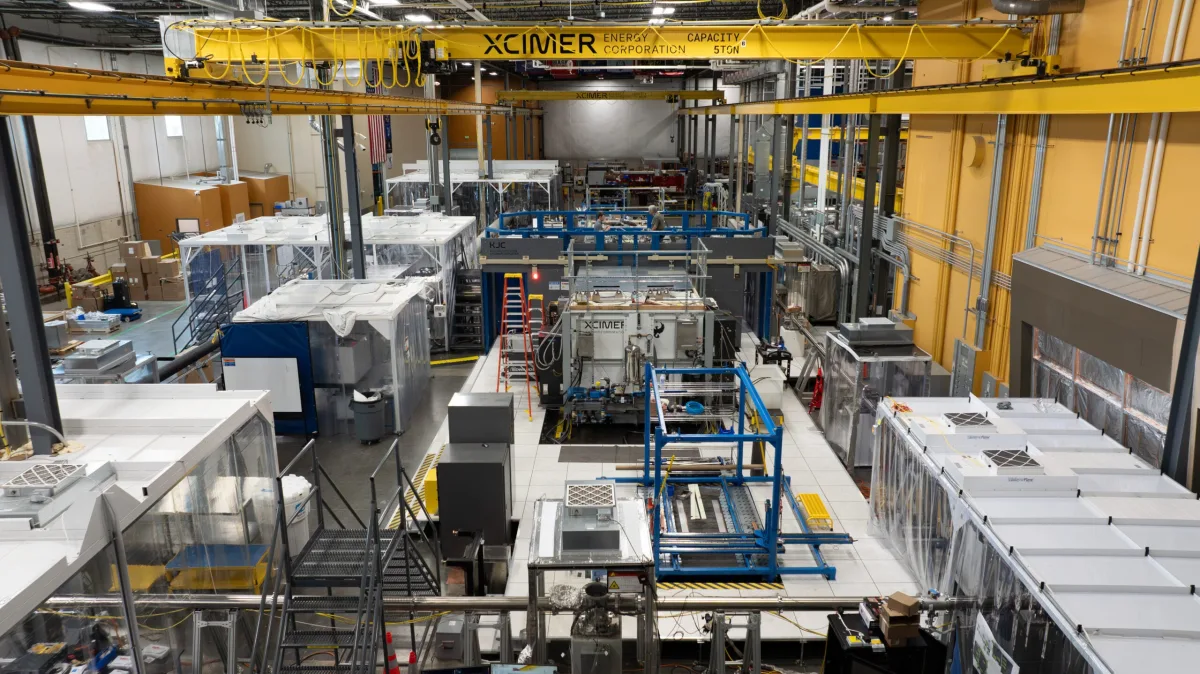
The dream of limitless, clean energy has long been bottlenecked by the sheer cost and complexity of traditional fusion reactors. Xcimer Energy is tackling this hurdle head-on with the activation of Phoenix, the world’s largest privately owned laser system, designed to make commercial laser fusion a viable reality. Housed in a 74,000-square-foot facility in Denver, Colorado, the prototype serves as a critical proof of concept for an unconventional approach to continuous grid-scale electricity generation.
Unlike traditional solid-state glass lasers, Phoenix utilizes a krypton fluoride (KrF) excimer laser paired with Stimulated Brillouin Scattering (SBS). This architecture compresses a microsecond-long pulse into the nanosecond timescales required to trigger a fusion reaction. On June 3, the company confirmed that Phoenix successfully demonstrated the integrated operation of both excimer amplification and SBS pulse compression, marking a significant technical milestone.
We had to rebuild an industrial capability the United States largely abandoned after the Cold War, restoring specialized supply chains, recruiting many of the last engineers with direct experience in these systems, and transferring that knowledge to a new generation. Phoenix represents both a technical milestone and the reindustrialization of high-energy excimer lasers in America.
- Conner Galloway, CEO, Xcimer Energy
The push for commercialization comes on the heels of major scientific breakthroughs at the National Ignition Facility (NIF). In 2022, NIF achieved net energy gain, and by 2025, it successfully produced 8.6 megajoules of fusion energy from just 2 megajoules of laser input. However, NIF was built strictly as a research facility, utilizing 192 highly complex beamlines that are too expensive and maintenance-intensive for economical power generation.
Xcimer’s approach drastically simplifies this model. By relying on KrF excimer lasers, the company’s architecture requires only two beamlines, offering higher efficiency, lower thermal stress, and compatibility with industrial-scale manufacturing. Alexander Valys, co-founder and president of Xcimer, noted that their participation in the U.S. Department of Energy’s Milestone-Based Fusion Development Program helped accelerate the construction of the prototype. "Our thesis is that commercial laser fusion becomes possible only if the laser system itself becomes dramatically simpler, cheaper, and more manufacturable," Valys explained.
The Roadmap to Grid-Scale Power
With Phoenix operational, Xcimer has outlined a clear, multi-phase roadmap to bring fusion energy to the commercial grid over the next decade. The company's upcoming milestones include:
- Anvil (2028): A commercial-scale excimer amplifier designed to deliver 200 kilojoules on target using a complete two-sided beamline.
- Vulcan (early 2030s): A massive 4 - 12 megajoule laser system targeting wall-plug breakeven, which will also support high-energy-density and national-security applications. Site selection is expected this year.
- Athena (mid-2030s): The ultimate goal - a commercial-scale laser fusion power plant engineered for continuous grid-scale electricity generation.
The Two-Beam Bet on the Future of Energy
The activation of Phoenix highlights a critical pivot in the fusion industry: the transition from proving the physics to solving the economics. NIF’s 2025 achievement of 8.6 megajoules proved that laser fusion works, but scaling a 192-beamline glass laser system for daily, continuous grid use is an engineering nightmare. Xcimer’s gamble on a two-beamline KrF excimer architecture directly addresses the fatal flaw of thermal stress and maintenance downtime that plagues traditional setups.
If the upcoming Vulcan system can achieve true wall-plug breakeven in the early 2030s, it will fundamentally disrupt the timeline for renewable energy adoption. By reviving Cold War-era excimer technology and adapting it for modern commercial manufacturing, Xcimer isn't just building a reactor; they are attempting to build an entirely new, scalable supply chain for the next generation of global power infrastructure.
