Researchers have shattered conventional solar energy limits by achieving an unprecedented 130% quantum yield, utilizing a novel process that splits a single incoming light photon into two distinct energy packets. For renewable energy developers, materials scientists, and climate technology advocates, this breakthrough provides a concrete pathway to bypass traditional efficiency bottlenecks. By maximizing the energy harvested from every absorbed photon, this development could eventually lead to next-generation solar panels that drastically reduce our reliance on fossil fuels.
The core of this advancement relies on a quantum-level mechanism known as singlet fission. Unlike standard solar cells that often lose excess high-energy light as heat - a restriction defined by the Shockley-Queisser limit, which caps overall efficiency around 33% - this new approach captures that energy. According to chemist Yoichi Sasaki from Kyushu University, singlet fission generates two excited states, or excitons, from a single photon. This means the system achieves a 130% efficiency rate specifically in terms of how often an excitation event occurs per photon absorbed, rather than the overall electrical output of the panel.
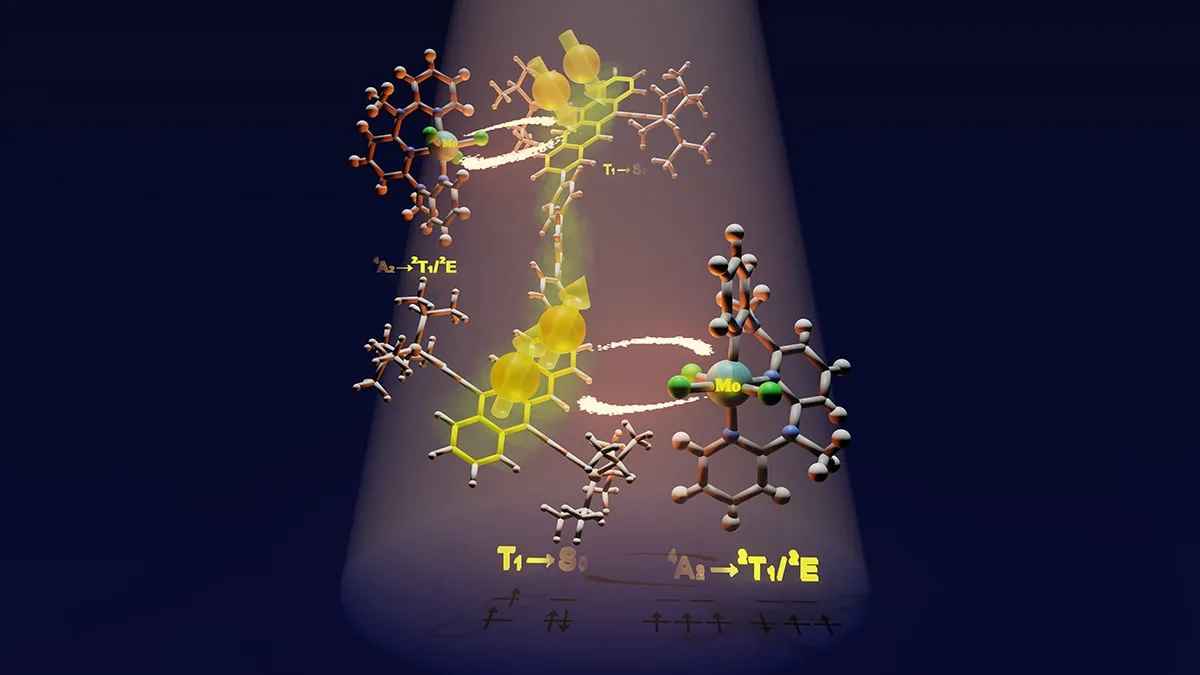
To execute this complex split, the international research team combined an organic molecule called tetracene with the metallic element molybdenum. Tetracene acts as the primary splitting material, dividing one high-energy packet into two lower-energy packets through electron excitation. However, previous singlet fission experiments struggled to utilize this energy before it dissipated. To solve this, the team integrated molybdenum to act as a spin-flip emitter at the quantum level.
The molybdenum compound effectively catches the split excitons before the energy can be lost to a mechanism known as Förster resonance energy transfer (FRET). By locking in the energy and utilizing a quantum spin-flip, the invisible states are converted into light, resulting in 1.3 molybdenum-based metal complexes excited per absorbed photon. This selective capture ensures the multiplied triplet excitons are preserved after the initial fission process.
Currently, these experiments - detailed in the Journal of the American Chemical Society - are confined to liquid solutions in early laboratory tests. The next major engineering hurdle involves converting this liquid solution into a stable solid form that can be reliably integrated into commercial solar panels. Researchers must also refine the decay process to ensure the molybdenum complexes retain the harvested energy long enough for practical electrical conversion.
The Future of Exciton Amplification in Solar Tech
The achievement of a 130% quantum yield represents a paradigm shift in how the energy industry approaches the Shockley-Queisser limit. While a 33% overall efficiency cap has long dictated the economic models of solar farms, successfully transitioning this singlet fission process from a liquid solution to a solid-state material could fundamentally alter the return on investment for solar infrastructure. If developers can stabilize the molybdenum complexes in commercial panels, we could see a new tier of premium, high-efficiency solar products designed for environments where space is at an absolute premium, such as urban rooftops or orbital satellites.
Furthermore, this research highlights the growing intersection of quantum mechanics and macro-scale energy production. By proving that transition-metal complexes can effectively capture multiplied triplet excitons without falling victim to FRET energy theft, the Kyushu University team has provided a viable blueprint for exciton and photon amplification. The true test will be the timeline for solid-state commercialization, but this proof-of-concept undeniably accelerates the timeline for next-generation, ultra-efficient renewable energy grids.
This article was written by AI from reporting by sciencealert.com.