A new sub-5 nm energy-efficient memristor architecture has been developed to solve the unpredictable behavior of conductive filaments in oxide-based memory devices. Published in Nature Communications on March 18, 2026, this breakthrough utilizes an elemental oxygen reservoir layer to stabilize oxygen vacancy migration. This advancement paves the way for highly reliable, low-power neuromorphic computing applications.
For hardware engineers and artificial intelligence researchers, the erratic formation and rupture of conductive filaments have long been a bottleneck in scaling down memristors. By confining the switching mechanism within an ultra-thin space, this new design offers a predictable and highly efficient alternative for next-generation artificial synapses. The research demonstrates that atomic-level material engineering can overcome the physical limitations of traditional memory storage.
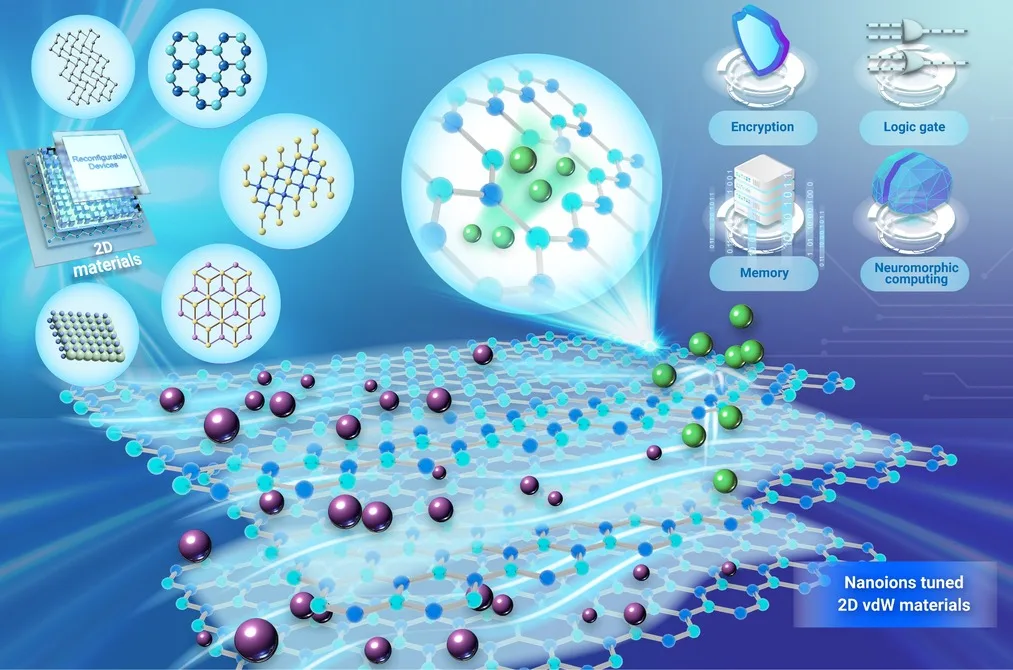
The device features an atomically flat 4.5 nm hafnium oxide (HfOx) switching layer paired with a 3.5 nm elemental oxygen reservoir (EOR) layer. These critical components are precisely confined between two-dimensional HfS2 and MoS2 layers. This unique sandwich structure ensures a homogeneous electric field distribution across the entire device.
The electroneutral EOR layer actively interacts with oxygen vacancies within the HfOx layer. Together with the HfOx tunnel layer located above the HfS2, the EOR layer forms a robust barrier. This barrier effectively suppresses the high-resistance state current, which is crucial for maintaining strict energy efficiency.
Performance Metrics and Capabilities
The controlled migration and redistribution of oxygen vacancies within this ultrathin switching layer directly enable highly stable memristive behavior. The research team recorded exceptional operational metrics that highlight the commercial viability of this architecture for processing-in-memory systems.
| Performance Metric | Recorded Value |
|---|---|
| Set Transition Speed | 8 ns |
| Reset Transition Speed | 15 ns |
| Reliable Endurance | Up to 100,000 cycles |
| Data Retention | Up to 100,000 seconds |
| Recognition Accuracy | 97.0% |
My Take
The achievement of a 97.0% recognition accuracy alongside 8-nanosecond switching speeds signals a major leap for neuromorphic hardware. By successfully mitigating the random migration of oxygen vacancies - a persistent flaw in traditional oxide-based memristors - this sub-5 nm architecture proves that atomic-level confinement is viable for commercial scaling. As AI models demand increasingly efficient processing-in-memory solutions, this HfOx-based design could become a foundational blueprint for future low-power AI accelerators.
Frequently Asked Questions
What is the main advantage of the new memristor design?
It stabilizes oxygen vacancies using an elemental oxygen reservoir (EOR) layer, preventing the unpredictable behavior of conductive filaments found in older oxide-based devices.
What materials are used in this sub-5 nm memristor?
The device utilizes an atomically flat hafnium oxide (HfOx) switching layer, an EOR layer, and two-dimensional HfS2 and MoS2 confinement layers.
How fast is the transition speed of this memory device?
The memristor achieves highly efficient set and reset transition speeds of 8 nanoseconds and 15 nanoseconds, respectively.