Deep learning for nanoclusters has taken a significant leap forward as researchers led by Keizo Tsukamoto and Atsushi Nakajima have successfully developed a framework to determine the exact number of constituent atoms in metallic structures. Published on February 27, 2026, in npj Computational Materials, this study addresses a longstanding challenge in material science: accurately identifying the atomicity of platinum nanoclusters (NCs) directly from high-resolution imaging. By leveraging advanced neural networks, the team has automated a process that previously relied on manual, error-prone interpretation, paving the way for autonomous workflows in nanotechnology.
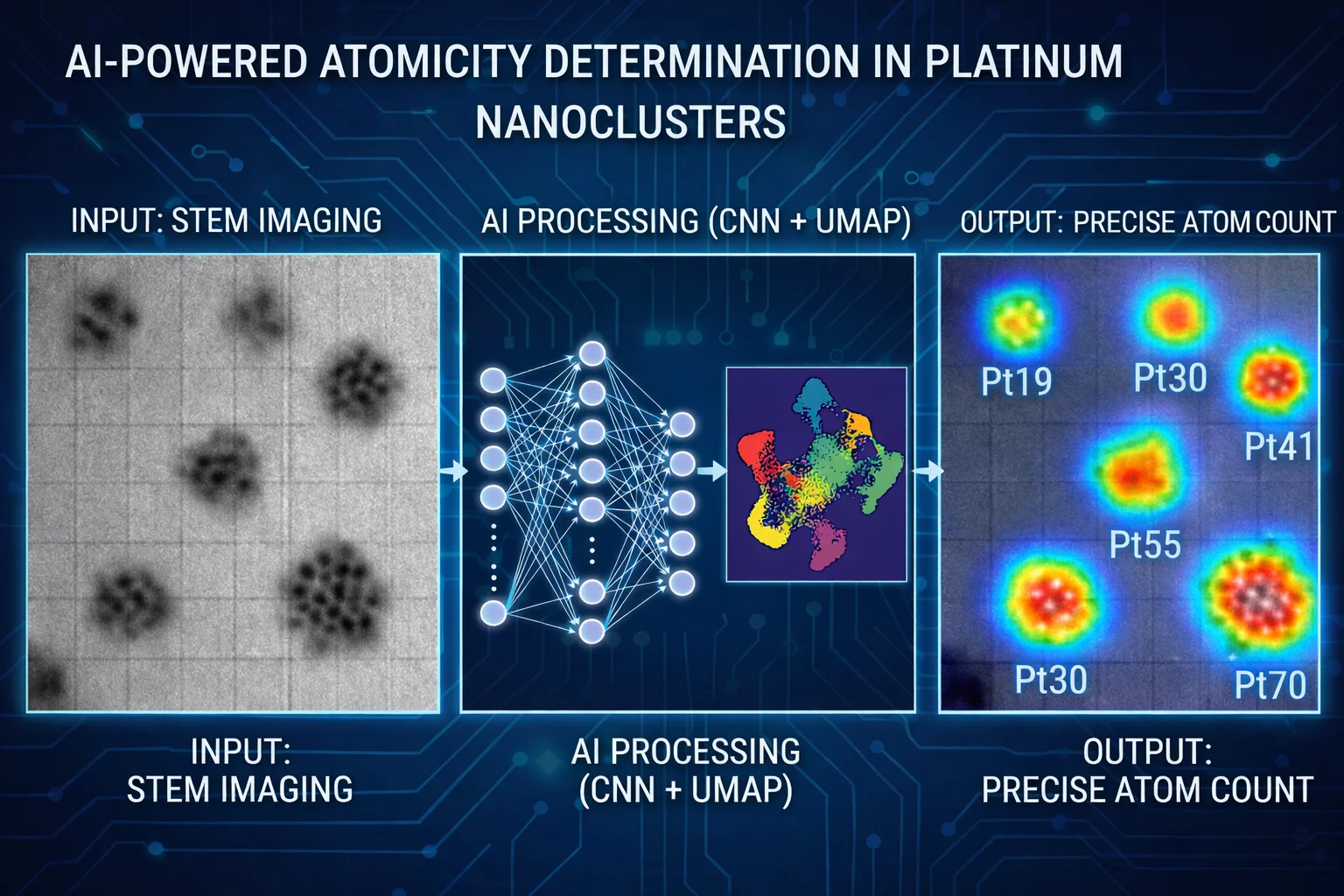
This breakthrough is particularly vital for researchers and material scientists focusing on catalysis and quantum properties, where the specific number of atoms governs the size-dependent behavior of materials. The study utilizes Scanning Transmission Electron Microscopy (STEM) images, which capture real-space data down to the atomic scale. However, extracting precise structural features such as projected shape and contrast distribution has historically been difficult due to noise and complexity. The new AI-driven approach solves this by classifying Platinum NCs ($Pt_n$) with specific atomic counts of 19, 30, 41, 55, and 70, transforming how we analyze atomic structures.
The AI Framework and Methodology
The core of this innovation lies in a specialized Convolutional Neural Network (CNN) designed to extract structural features from aberration-corrected STEM images. To ensure the model is not a "black box," the researchers employed UMAP (Uniform Manifold Approximation and Projection) space to separate features distinctively. Furthermore, they integrated Grad-CAM (Gradient-weighted Class Activation Mapping) to visualize exactly where the model focuses within the image, providing interpretability that is crucial for scientific validation. This dual approach allows the system to identify specific atomicity classes even when analyzing mixed samples containing varying cluster sizes, such as $Pt_{19}$, $Pt_{41}$, and $Pt_{70}$, on a shared substrate.
Precision and Real-World Application
To combat the common issue of domain shift in imaging data, the team applied fine-tuning techniques using high-confidence pseudo-labels, which significantly recovered performance during testing. A standout feature of their methodology is the dual-channel model that integrates Local Contrast Normalization (LCN) filtering. This addition proved superior to traditional size-based classification methods, achieving a coefficient of determination of $R^2 = 0.94 \pm 0.03$. This high level of precision confirms that the model can reliably distinguish between nanoclusters with very similar atomic counts, a task that is notoriously difficult for human analysts. The datasets and code for this study have been made available via Zenodo to ensure reproducibility across the scientific community.
My Take
This development marks a pivotal moment for computational materials science. By successfully combining interpretable deep learning with high-resolution microscopy, the researchers have moved beyond simple image recognition to precise quantitative analysis at the atomic level. The use of Grad-CAM to validate the AI's focus points addresses the critical need for trust in AI-driven scientific discovery. As this technology matures, we can expect to see it integrated into microscope software for real-time analysis, allowing scientists to characterize materials instantly during experiments rather than waiting for post-processing.
This article was written by AI from reporting by nature.com.