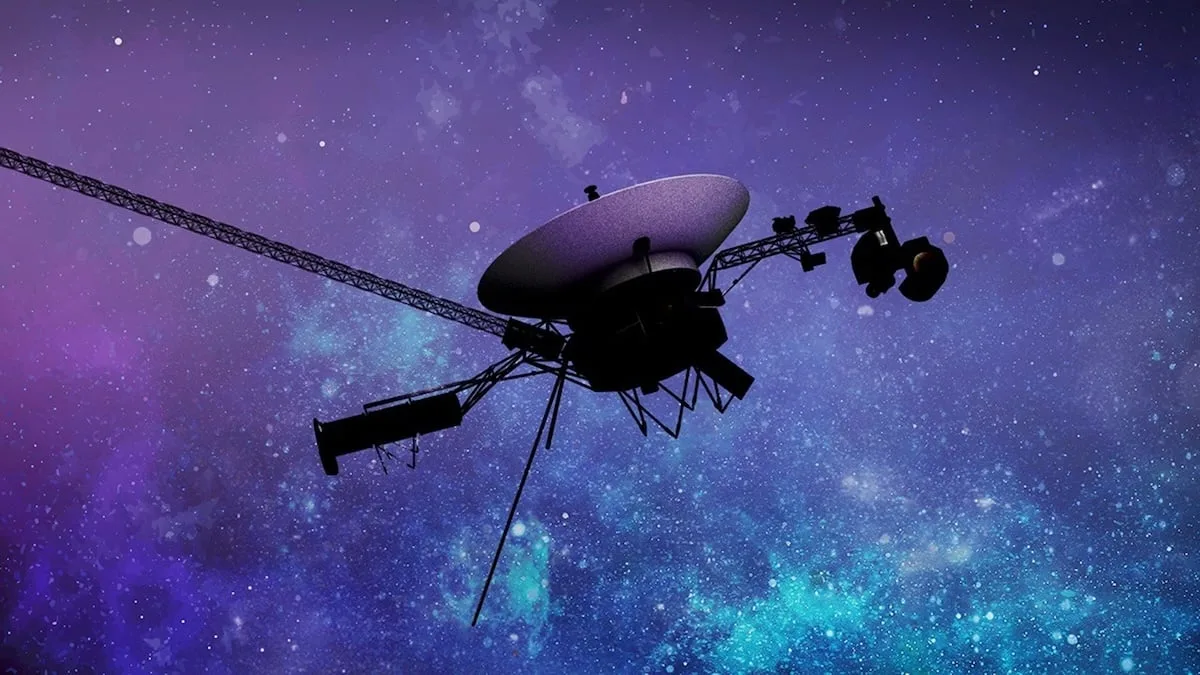
The Voyager 1 spacecraft has officially powered down another critical scientific instrument as NASA fights to keep the historic probe alive in interstellar space. Facing a rapidly depleting power supply, engineers were forced to sacrifice the Low-energy Charged Particles (LECP) experiment to prevent the 48-year-old spacecraft from freezing or going completely dark.
On April 17th, engineers at NASA's Jet Propulsion Laboratory (JPL) transmitted the shutdown command across the cosmos. Because the probe is currently 25 billion kilometers (15 billion miles) from Earth, the signal took roughly 23 hours to reach its destination, requiring an additional three hours to complete the sequence. This difficult decision follows an unexpected power drop on February 27th during a planned roll maneuver, which threatened to trigger the probe's automated undervoltage fault protection system.
The core issue lies in the spacecraft's aging Radioisotope Thermoelectric Generators (RTGs). These devices, which convert heat from decaying Plutonium-238 into electricity, have been operating continuously since the 1977 launch. Their power output is currently declining by about 4 watts per year, leaving the probe with less than half of its original electrical capacity as of April 2026.
The Legacy of the LECP Experiment
Before its deactivation, the Low-energy Charged Particles experiment provided humanity with unprecedented data about the interstellar medium (ISM). It successfully detected pressure fronts and variations in particle density beyond the heliosphere, the protective magnetic bubble created by solar wind. While the LECP was previously shut off on Voyager 2 in March 2025, a small motor that spins the Voyager 1 sensor remains active, leaving the door open for reactivation if power margins improve.
According to Kareem Badaruddin, Voyager mission manager at JPL, shutting down science instruments is never the preferred choice, but it remains the best available option. Voyager 1 still operates two functional instruments dedicated to listening to plasma waves and measuring magnetic fields. These remaining tools continue to transmit invaluable data from a region of space untouched by any other human-made object.
The "Big Bang" Strategy for Survival
To secure the future of Voyager 1, NASA is preparing a high-stakes power management strategy internally dubbed the "Big Bang." This ambitious plan involves simultaneously deactivating a group of powered devices and switching to low-power alternatives to maintain the spacecraft's thermal stability. By executing this maneuver, engineers hope to stabilize the razor-thin power margins without letting the vital fuel lines freeze.
The mission team will first test this strategy on Voyager 2 during May and June of this year, taking advantage of its slightly better power reserves and closer proximity to Earth. If these trials succeed, the "Big Bang" protocol will be implemented on Voyager 1 no earlier than July. This calculated risk highlights a broader shift in deep-space mission management, where extreme resource conservation now takes precedence over continuous data collection, ensuring these interstellar pioneers survive well into their fifth decade of flight.