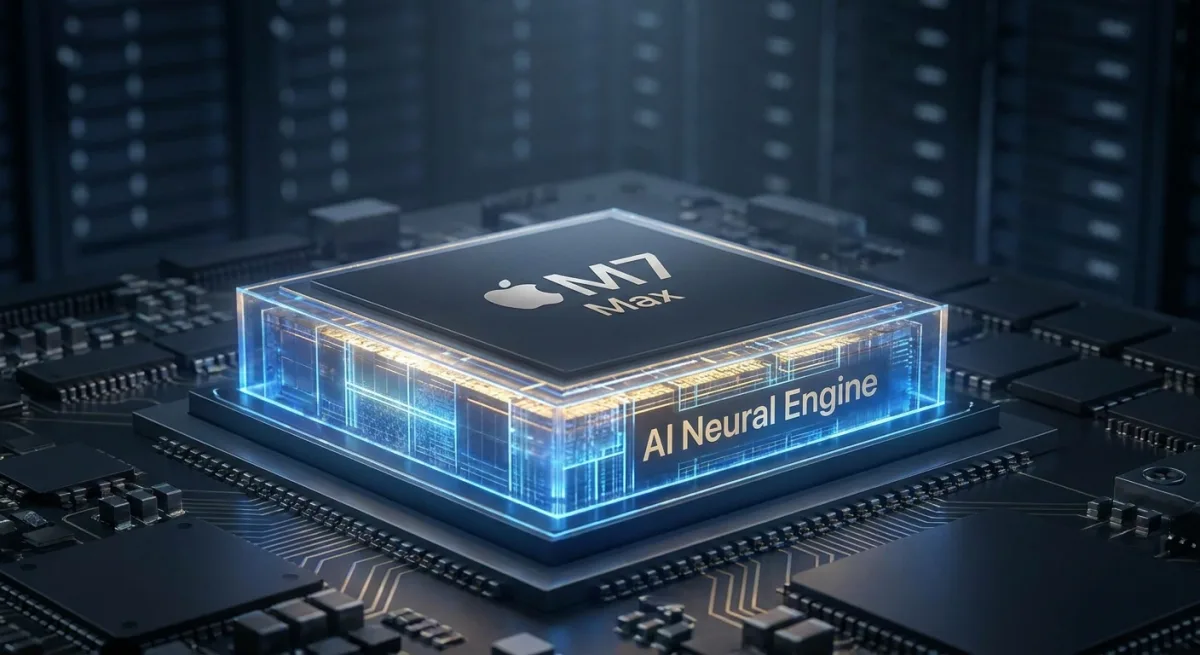
Apple is radically restructuring its Apple silicon roadmap to prioritize artificial intelligence, reportedly canceling the high-end M6 Pro and M6 Max processors entirely. Instead, the company will leapfrog directly to the M7 generation for its premium machines, accelerating the deployment of chips specifically engineered for heavy on-device AI workloads.
According to a new report from Bloomberg, the standard M6 chip is still slated for a late 2026 release, targeting entry-level devices like the MacBook Pro, Mac mini, iMac, and upcoming iPad models. However, this marks the first time Apple will not release Pro or Max variants for a mainline chip generation. The M7 lineup will take their place, with the base M7 arriving in the first half of 2027.
The updated Apple silicon launch timeline is currently projected as follows:
- M5 Ultra: Late 2026
- M6: Late 2026
- M7: First half of 2027
- M7 Pro: End of 2027
- M7 Max: End of 2027
- M7 Ultra: 2028
The base M6 processor is expected to be Apple's first chip built on a new 2-nanometer process node. It will feature an upgraded Neural Engine, a redesigned GPU with up to 12 cores, and approximately 200GB/s of memory bandwidth - a notable jump from the M5's 153GB/s. Meanwhile, power users will not be left waiting; Apple plans to launch an M5 Ultra chip for a refreshed Mac Studio as soon as late 2026. This powerhouse will reportedly boast 36 CPU cores, 80 GPU cores, and support for a staggering 768GB of unified memory.
The accelerated push toward the M7 architecture, which could feature 240GB/s of memory bandwidth, is driven by the need for superior GPU performance and on-device AI processing. This timeline shift complicates rumors surrounding the highly anticipated "MacBook Ultra" - an OLED, touchscreen-enabled laptop previously expected in late 2026. With the M7 Pro and Max delayed until late 2027, Apple may have to equip this flagship device with an M5 Max or M5 Ultra if it intends to meet the original launch window. This strategic pivot also follows a recent wave of price hikes across the entire Mac and iPad lineup.
The AI Arms Race Forces Apple's Hand
The decision to scrap the M6 Pro and Max is a glaring admission that Apple's traditional iterative upgrade cycle is no longer fast enough to keep pace with the broader industry's AI demands. By jumping straight to the M7 architecture for its high-end machines, Apple is likely re-architecting the silicon from the ground up to handle massive local language models, rather than just bumping CPU clock speeds.
However, this creates a bizarre fragmentation in the Mac lineup for 2026 and 2027. Professional users looking to upgrade their MacBook Pros will be stuck waiting an extra year for the M7 Pro, or forced to buy an M5 Ultra Mac Studio in the interim. Coupled with the recent price hikes across the Mac ecosystem, Apple is asking its most demanding users to pay more while waiting longer for true next-generation performance.