Selecting the optimal processing unit dictates the entire power budget, physical footprint, and performance ceiling of any custom electronic hardware. Hardware developers frequently overspend on complex processing chips for simple tasks, or conversely, bottleneck their devices by selecting inadequate memory configurations. Understanding the fundamental architectural differences between a microprocessor and a microcontroller is the critical first step in eliminating hardware redundancy and optimizing power consumption.
Microprocessors: High-Performance Computational Cores
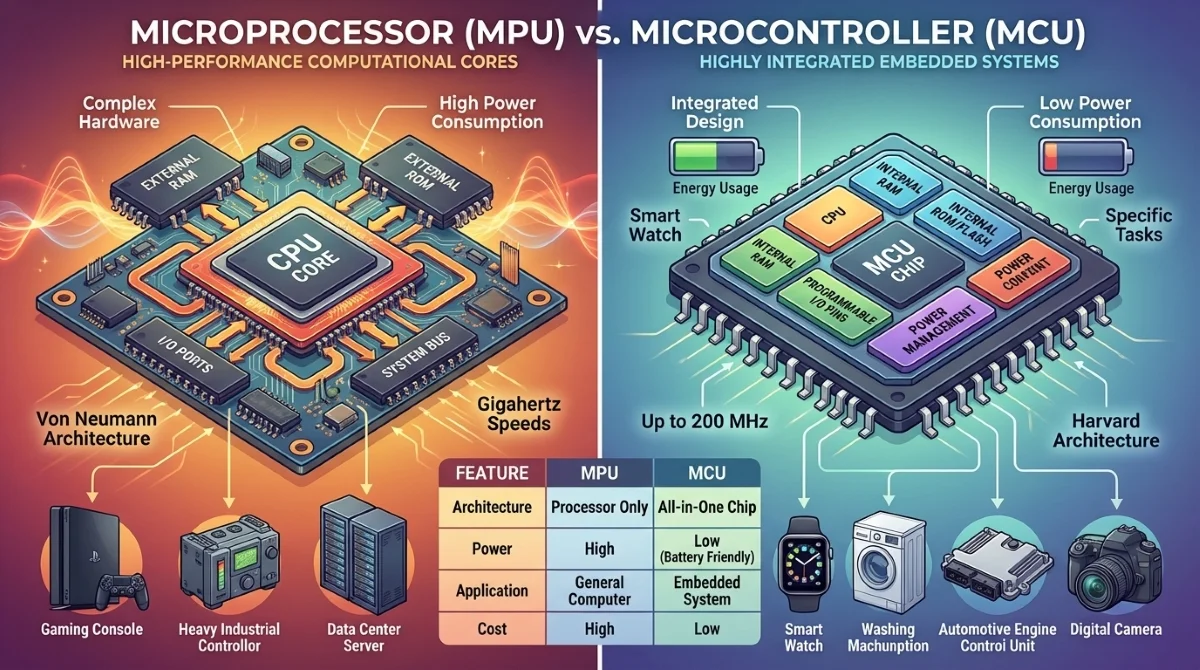
A microprocessor (MPU) functions as the central controlling brain of a microcomputer, housed entirely within a single integrated circuit. It strictly executes Arithmetic Logic Unit (ALU) operations and communicates with external peripherals. Because it lacks built-in RAM, ROM, and input/output (I/O) ports, developers must connect these components externally via a system bus.
The historical trajectory of MPUs began when Fairchild Semiconductors invented the first integrated circuit in 1959, leading to the foundation of Intel in 1968. By 1971, the Intel 4004 debuted as the first-generation MPU operating at a 108 kHz clock speed. Subsequent evolutions introduced 8-bit processors between 1973 and 1978, including the Motorola 6800 and Intel 8085, eventually culminating in powerful 32-bit and 64-bit architectures by the 1980s and 1990s.
Modern MPUs encompass various types, including Complex Instruction Set Computers (CISC), Reduced Instruction Set Computers (RISC), Application-Specific Integrated Circuits (ASIC), and Digital Signal Processors (DSP). These chips offer advanced features like built-in monitor/debugger programs, interrupt handling, and massive instruction sets designed for parallel I/O and external memory interfacing.
Microcontrollers: Highly Integrated Embedded Systems
In contrast, a microcontroller (MCU) is a highly optimized, all-in-one silicon chip designed to execute a singular, specific application within an embedded system. It integrates the CPU, programmable I/O pins, and volatile memory directly onto a single circuit. This localized architecture significantly reduces physical space requirements and overall power consumption.
The MCU evolution achieved a major milestone in 1975 with the release of the Intel 8048. Later, in 1993, Atmel introduced the first iterations featuring integrated EEPROM and Flash memory. MCUs are categorized by their data bus width, primarily spanning 8-bit, 16-bit, and 32-bit architectures, alongside specific embedded and external memory variants. They feature built-in processor reset controls, robust RAM mapping, and central processor cycle timing mechanisms.
Direct Head-to-Head Architectural Comparison
| Feature | Microprocessor (MPU) | Microcontroller (MCU) |
|---|---|---|
| Core Function | The heart of a general computer system. | The heart of an embedded system. |
| Architecture | Strictly a processor; requires external memory and I/O. | Includes processor, internal memory, and I/O on one chip. |
| Circuit Footprint | Large circuit due to multiple external components. | Small internal circuit due to built-in components. |
| Application Scope | Unsuitable for compact or tight physical systems. | Ideal for compact, integrated embedded systems. |
| Financial Cost | High overall system cost. | Low overall system cost. |
| Power Consumption | High power draw; unsuitable for battery operation. | Low power draw; perfectly suited for battery-powered devices. |
| Power Management | Lacks built-in power-saving features. | Features dedicated power-saving standby modes. |
| Programming | Fewer registers; highly dependent on external memory. | More registers; making software development easier. |
| Underlying Model | Utilizes Von Neumann architecture. | Utilizes Harvard architecture. |
| Clock Speed | Operates at extremely high gigahertz speeds. | Operates up to 200 MHz depending on the architecture. |
| Data Handling | General-purpose; processes massive data loads. | Application-specific processing. |
| Complexity | Complex hardware with a vast instruction set. | Simple hardware with fewer instructions to process. |
Primary Use Cases and Industry Applications
This architectural divergence directly dictates where these chips are deployed across consumer and industrial hardware sectors.
- Microprocessor Applications: MPUs are deployed in computing environments that process massive, unpredictable data loads. Examples include advanced calculators, complex accounting systems, gaming consoles, heavy industrial controllers, traffic light management systems, data control centers, military applications, and national defense networks.
- Microcontroller Applications: MCUs are deployed in compact, power-efficient systems performing predictable, dedicated tasks. Common use cases include mobile phones, automotive engine control units, CD/DVD players, washing machines, digital cameras, security alarm systems, keyboard controllers, microwave ovens, digital watches, and MP3 players.
Strategic Hardware Selection and Power Efficiency
The fundamental divide between these two technologies ultimately boils down to the distinction between the Von Neumann and Harvard structural models. The microprocessor's reliance on an external memory bus and the Von Neumann model allows for massive computational scalability, which is precisely why it powers complex, data-heavy systems like gaming consoles and defense networks. However, this external communication drastically inflates thermal output and power consumption.
Conversely, the microcontroller's Harvard architecture physically separates data and instruction memory on a single chip. This inherently reduces the instruction cycle time and slashes energy usage. For engineers developing modern smart home appliances or wearable IoT devices, the integrated design of the MCU, combined with its dedicated low-power standby modes, offers an unbeatable economic and thermal advantage over traditional MPUs.