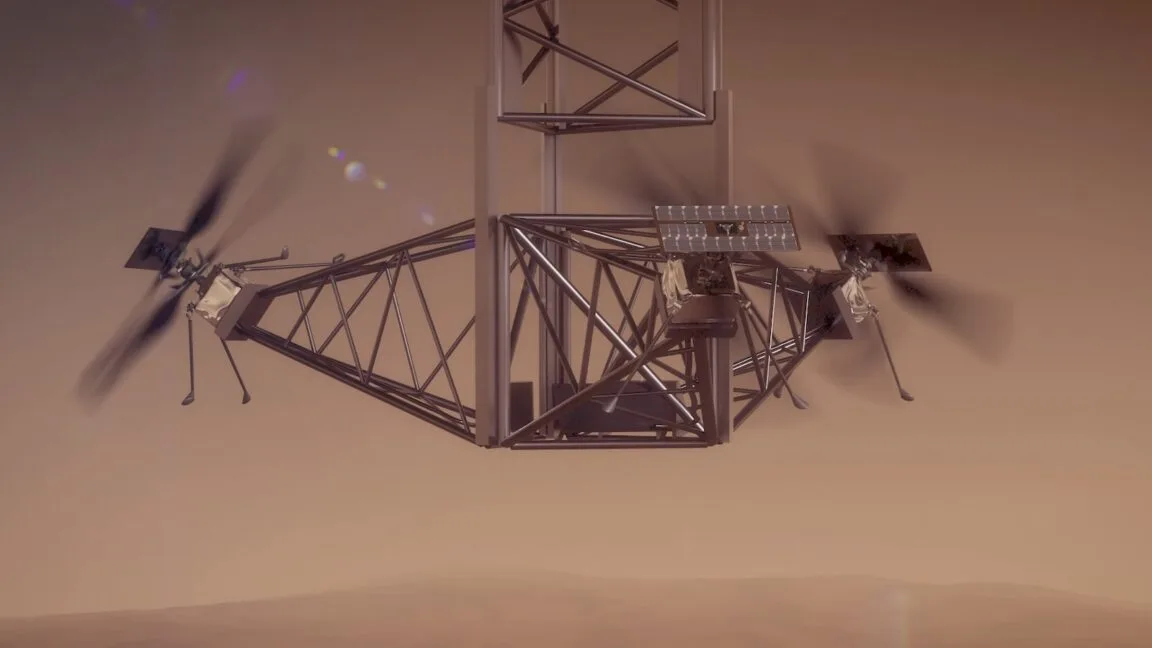
NASA engineers have successfully pushed the rotor blades of the upcoming NASA SkyFall Mars helicopter past the speed of sound, solving a critical aerodynamic hurdle for exploring the red planet. In a specialized test chamber at the Jet Propulsion Laboratory (JPL), the next-generation carbon-fiber blades reached a top speed of Mach 1.08. This supersonic milestone yields a 30 percent boost in lift capability, allowing future aerial vehicles to carry heavier scientific payloads through an atmosphere that is just one percent as dense as Earth's at sea level.
The breakthrough comes as the agency prepares for the ambitious SkyFall mission, which aims to send three advanced helicopters to Mars as early as late 2028. These aircraft will hitch a ride aboard Space Reactor-1 (SR-1), a nuclear-powered spacecraft recently announced by NASA Administrator Jared Isaacman. Unlike their predecessor, the tissue-box-sized Ingenuity helicopter that concluded its historic 72-flight run in January 2024, the SkyFall units will be significantly larger and heavier.
To generate enough lift in the rarefied Martian air, helicopters must spin their blades incredibly fast. Ingenuity operated at 2,700 rpm, but engineers intentionally capped its speed at Mach 0.7 to prevent the blades from shattering. "If Chuck Yeager were here, he’d tell you things can get squirrely around Mach 1," explained Jaakko Karras, the rotor test lead at JPL. Karras noted that while Ingenuity was designed to avoid going supersonic even in heavy headwinds, the team needed to know if the next-generation rotors could safely exceed that limit to deliver higher performance.
Pushing the Limits of Martian Aerodynamics
Partnering with AeroVironment, the JPL team lined their Mars-simulating test chamber with sheet metal to protect the facility in case the blades disintegrated. As NASA announced Thursday, the engineers watched from a nearby control room as the dual-bladed rotor system spun up to 3,750 rpm, reaching Mach 0.98. They then activated internal fans to blast the spinning blades with simulated headwinds, successfully pushing the rotor tips to Mach 1.08 without any structural failure.
This 30 percent increase in lift is a game-changer for planetary exploration. The original Ingenuity could only carry two lightweight cameras and relied entirely on the Perseverance rover as a communication base station. The heavier SkyFall helicopters will operate independently, requiring larger batteries for extended flights and direct-to-Earth communication links or orbital relays. They will also carry advanced sensors capable of searching for subsurface ice.
We thought we’d be lucky to hit Mach 1.05, and we reached Mach 1.08 on our last runs. We’re still digging into the data, and there may be even more thrust on the table.
- Shannah Withrow-Maser, Aerodynamicist, NASA Ames Research Center
While NASA is also developing the massive, ton-heavy Dragonfly rotorcraft for Saturn's moon Titan, that mission benefits from an atmosphere thicker than Earth's. Mars presents a unique aerodynamic extreme, making the structural integrity of these supersonic blades a mandatory foundation for the 2028 launch window.
The End of the Rover Dependency Era
The success of these supersonic rotor tests signals a fundamental shift in how humanity will explore Mars over the next decade. By unlocking a 30 percent increase in lift, NASA is not just upgrading a helicopter; they are severing the aerial vehicle's reliance on slow-moving ground rovers. Ingenuity was a brilliant scout, but it was ultimately tethered to Perseverance for its survival and data transmission.
With the ability to carry heavier batteries and independent communication arrays, the NASA SkyFall Mars helicopter fleet will be able to cover vast, treacherous terrains that wheeled vehicles could never navigate. This transition from ground-based crawling to rapid, autonomous aerial surveying means future missions can map resource-rich zones - like subsurface ice deposits - at an unprecedented pace, laying the crucial groundwork for eventual crewed missions.