Over a Century After Titanic, Aluminum Tubes Defy Sinking
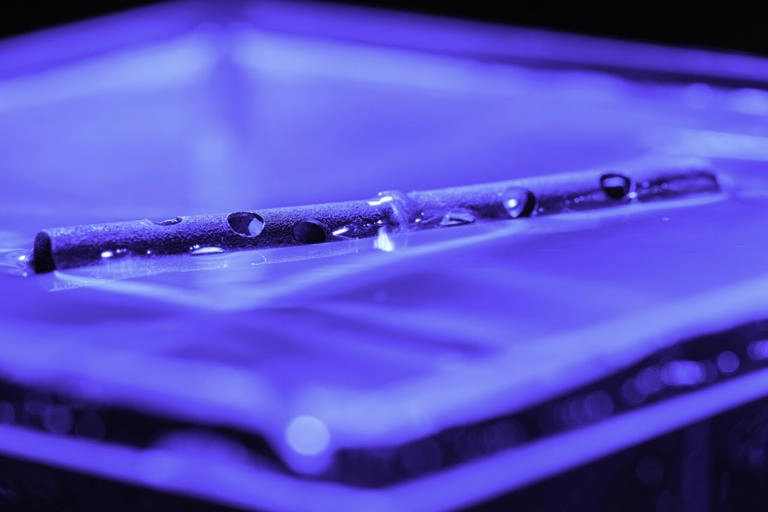
More than 114 years after the RMS Titanic sank on its maiden voyage, killing over 1,500 people, researchers at the University of Rochester have achieved a milestone toward truly unsinkable ships. On January 30, 2026, the team published details of ordinary aluminum tubes engineered to float indefinitelyeven when submerged vertically for extended periods or riddled with holes. By treating the metal's surface to repel water superhydrophobically, these tubes trap a stable air bubble inside, preventing water ingress and ensuring buoyancy in conditions mimicking ocean turbulence.
How the Superhydrophobic Surface Works
The core innovation lies in modifying aluminum's surface texture and chemistry to create extreme water repellency. Water beads up and rolls off like on a lotus leaf, but amplified: contact angles exceed 150 degrees, minimizing wetting. A critical addition is a central divider inside each tube, which anchors the air pocket even under vertical compression. Lead researcher Chunlei Guo explains: "Importantly, we added a divider to the middle of the tube so that even if you push it vertically into the water, the bubble of air remains trapped inside and the tube retains its floating ability."
Laboratory tests submerged tubes up to half a meter long, simulating deep dives. Unlike prior 2019 designs using sealed water-repelling diskswhich faltered at extreme tiltsthe tube structure offers superior stability. In wave-like agitation, tubes maintained buoyancy, with air pockets intact despite perforations from simulated damage.
Scaling to Real-World Ships and Platforms
Buoyancy isn't just lab curiosity. Multiple tubes link into rafts capable of supporting heavy loads. Researchers connected arrays to form stable platforms, tested under load in basins replicating sea states. Guo notes scalability: "The design can be scaled up to sizes large enough to support heavy loads." Imagine modular hulls where damaged sections self-isolate, air-trapping tubes redistributing buoyancy dynamically.
- Key Advantages: Simpler than double-hull designs; resilient to punctures from collisions or warfare; lower material costs using common aluminum.
- Historical Context: Post-Titanic regulations mandated watertight compartments, yet the ship sank due to cascading failures. These tubes address that by inherent, passive flotation.
- Load Capacity: Half-meter prototypes bore weights exceeding steel benchmarks proportionally; full-scale could underpin supertankers.
Beyond Ships: Wave Energy and Floating Infrastructure
The tech extends to energy harvesting. Rafts from these tubes undulate with waves, converting motion to electricity via integrated generators. Lab demos captured kinetic energy from oscillating water, hinting at offshore power farms. Funded by the National Science Foundation, Bill & Melinda Gates Foundation, and University of Rochester's Goergen Institute, applications span disaster relief platforms to Arctic bases.
Challenges remain: Long-term durability in saltwater corrosion; biofouling resistance; regulatory hurdles for maritime adoption. Yet prototypes endured months submerged without degradation, outperforming coatings like Teflon.
Impact on Maritime Safety and Industry
Global shipping moves 90% of trade; sinkings claim hundreds yearly despite tech advances. This could slash losses: unsinkable modules evacuate crews automatically. Militaries eye stealthy, damage-resistant vessels. Environmentally, fewer spills from grounded wrecks.
Compared to alternatives like foam-filled hulls, superhydrophobic tubes self-heal air pockets post-breach. Peer-reviewed in Applied Physics Letters, the work builds on Guo's femtosecond laser texturing for hydrophobicity, now optimized for marine extremes.
As 2026 unfolds, this January 30 announcement positions Rochester at the forefront. Prototypes head to ocean trials; commercialization partnerships form. The Titanic's legacyhubris meets physicsyields to engineered defiance of sinking.