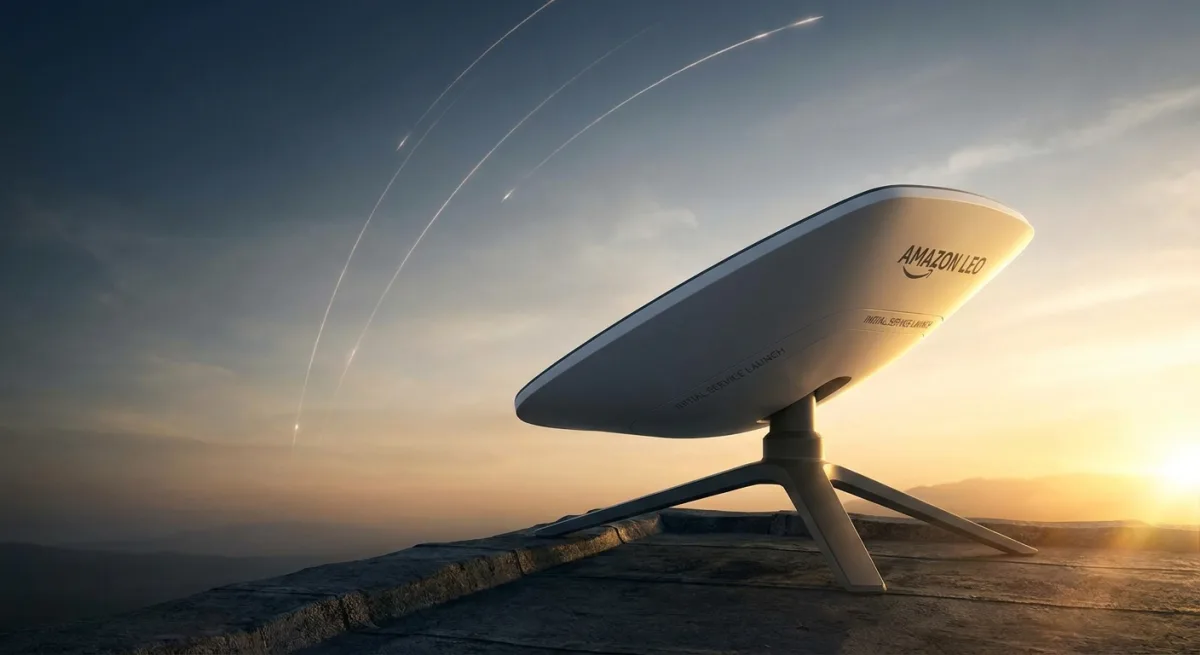
Amazon is officially ready to flip the switch on its long-awaited satellite internet service, Amazon Leo, after successfully deploying 396 satellites into low-Earth orbit. While this milestone puts the company on track for a mid-2026 commercial launch, early adopters should brace for a bumpy ride as the network takes its first steps against SpaceX's dominant Starlink.
According to Chris Weber, Amazon Leo’s vice president of business and product, the current constellation is now large enough to support continuous service across initial latitudes. However, the sheer numbers highlight the massive gap Amazon still needs to close. When SpaceX launched its "Better than nothing" beta in 2020, it already had nearly 900 satellites in orbit - more than double Amazon's current fleet.
Those early Starlink users experienced frequent service drops and high sensitivity to physical obstructions, a reality Amazon Leo customers will likely share during the initial rollout. The current satellite broadband landscape is vastly different than it was four years ago. SpaceX now operates a massive constellation of over 10,000 Starlink satellites, delivering median download speeds of 200Mbps, upload speeds between 10Mbps and 40Mbps, and latency hovering around 25ms across more than 160 countries.
Amazon Leo users can expect much more modest performance on day one, with speeds and reliability gradually improving as the company works toward its final goal of 3,232 deployed satellites. Reaching that final constellation size will take years, and Amazon is already operating behind its original schedule. A significant bottleneck has been the delayed regular operation of Blue Origin’s reusable New Glenn launch vehicle, forcing Amazon to rely on a mixed fleet of rockets to get its payloads off the ground.
The High Cost of Being Late to Orbit
Amazon’s entry into the satellite internet market proves that deep pockets alone cannot buy time in the aerospace industry. Launching a commercial service with just 396 satellites is a necessary psychological win for the company, but it risks alienating early adopters who are now accustomed to Starlink's mature, high-speed performance.
Unlike SpaceX in 2020, Amazon isn't competing against traditional, sluggish satellite providers; it is going head-to-head with a fully realized global network. If Amazon Leo cannot rapidly scale its launch cadence using New Glenn, it may find itself permanently relegated to a backup option rather than a true Starlink alternative.
This article was written by AI from reporting by theverge.com.