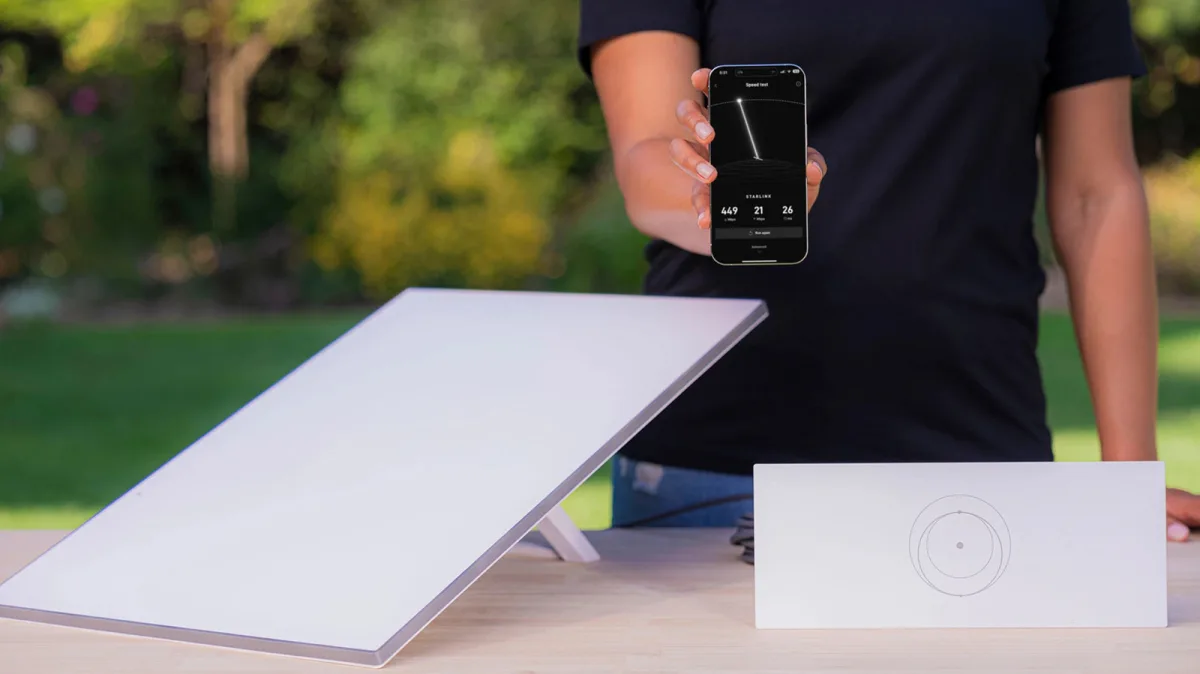
Many users sign up for satellite service expecting blazing-fast 400 Mbps downloads, only to find their daily performance hovering much lower. While the network provides a lifeline for remote areas, understanding the gap between advertised maximums and real-world Starlink internet speed is crucial before paying a premium.
Starlink officially advertises download speeds of up to 400+ Mbps for its home internet service. However, the company's own specifications reveal that most users typically experience between 45 and 280 Mbps. A majority of subscribers consistently see speeds above 100 Mbps, which remains more than sufficient for 4K streaming, video calls, and online gaming. Upload speeds are noticeably slower, generally landing between 10 and 30 Mbps.
The Residential Max Reality
To achieve the highest possible home speeds, users must subscribe to the top-tier Residential Max plan, which costs $130 a month. While this tier promises 400+ Mbps, independent testing by PCMag found that the plan actually averaged between 145 and 170 Mbps. Because the network relies on shared satellite bandwidth, speeds naturally dip as local network congestion increases.
To help set realistic expectations, the company publishes a live speed map. Currently, the map shows peak home speeds of 378 Mbps off the northeast coast of Nova Scotia, proving that near-maximum speeds are possible under the right conditions.
Beyond the Living Room: Aviation and 10 Gbps Gateways
The absolute fastest Starlink connections are currently reserved for the skies. The fastest unlimited regional aviation plan fetches 500 Mbps of speed. However, that capacity can be doubled with the absolute top tier - the Aviation Global Unlimited plan - which promises up to 1 Gbps when paired with a dedicated Performance antenna.
On the ground, the company is also pushing infrastructure limits. In July 2026, Elon Musk announced on X that the network can now sustain a steady 10 Gbps for both downloads and uploads globally. This 10 Gbps capacity is delivered through dedicated ground-station hardware built to feed entire communities, and linking several of these gateways together allows the most remote sites to touch 20 Gbps.
When Will Home Users Get 1 Gbps?
Gigabit speeds for individual households are not available today, but the infrastructure is actively being planned. Starlink currently relies on nearly 11,000 Gen1 and Gen2 satellites in orbit. To reach the next tier of performance, the company has asked the U.S. Federal Communications Commission to approve up to 100,000 new Gen3 satellites.
If deployed, these satellites promise multi-gigabit speeds and latency under 20 ms, rivaling wired fiber connections. However, accessing these future speeds will require customers to purchase entirely new Gen3-compatible dishes and antennas, alongside an expected increase in monthly subscription fees.
The Hidden Cost of the Multi-Gigabit Dream
The push toward a 100,000-satellite Gen3 constellation highlights a looming dilemma for rural internet users. While achieving sub-20 ms latency and multi-gigabit speeds from space is a massive technical milestone, the required hardware swap will likely frustrate early adopters who already invested heavily in Gen1 or Gen2 equipment.
Furthermore, as terrestrial 5G and rural fiber networks continue their aggressive expansion, Starlink's premium pricing model will face intense scrutiny. For the average household, the current baseline of 100 Mbps is already perfectly adequate for daily digital life. Unless the Gen3 hardware is heavily subsidized, the multi-gigabit upgrade may end up being an expensive luxury rather than a practical necessity for most subscribers.
This article was written by AI from reporting by slashgear.com.