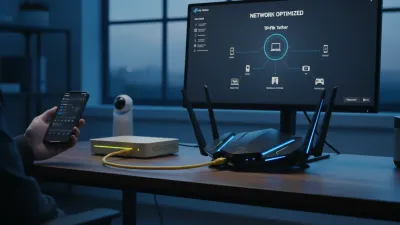
SpaceX is quietly preparing a major networking upgrade for its satellite internet service, with new regulatory documents revealing the company's first-ever Wi-Fi 7 router. The upcoming hardware promises to significantly improve local network capacity for users juggling multiple connected devices.
The unannounced device, carrying the model number UTR-261, was discovered in an FCC filing by a user on Reddit. It appears to be the direct successor to the Router Mini (UTR-251), which received FCC approval in April of last year. The new filing explicitly links the router to the 802.11be standard, operating in EHT20 and EHT40 modes, confirming its Wi-Fi 7 capabilities.
Expanded Connectivity and Power Options
Beyond the wireless upgrade, diagrams within the FCC paperwork reveal a much more capable physical design. The UTR-261 features two Ethernet ports and a USB-C port, doubling the wired connectivity of the single-port Router Mini. It is also engineered to run on Power over Ethernet (PoE) alongside a standard AC adapter.
SpaceX has requested a 180-day confidentiality period for the device's photos and manual, keeping the final design under wraps. However, the documents confirm the router is manufactured in Vietnam and is restricted to indoor use. This aligns with a recent FCC decision granting Starlink a temporary exemption from a ban on new foreign-made routers, clearing the path for US sales.
The V5 Dish Trade-offs
This router development follows the recent launch of the Starlink V5 dish, which introduced a smaller, lighter, and more power-efficient profile compared to the older V4 model. However, the V5 arrived with specific limitations.
- Speed Cap: The V5 tops out at slightly lower speeds of 375+ Mbps.
- Mobility Restrictions: Unlike some previous iterations, it is not designed for use while in motion.
- Missing Features: It launched without Standby Mode, forcing users to either pay full price or cancel entirely rather than maintaining a low-speed active connection.
The Local Network Bottleneck
While a Wi-Fi 7 router might seem like overkill for a satellite connection currently capped at around 400Mbps, this hardware upgrade solves a critical pain point: local network congestion. Wi-Fi 7 will not make the Starlink dish pull data from space any faster, but it drastically reduces latency between devices inside the home.
For households with dozens of smart home devices, phones, and consoles fighting for bandwidth, the UTR-261 will ensure the local network is never the bottleneck. Furthermore, the inclusion of dual Ethernet ports is a massive quality-of-life improvement, eliminating the need for power users to purchase separate, proprietary Ethernet adapters just to hardwire a PC or a third-party mesh system. This router is clearly a foundational step toward SpaceX's long-term goal of delivering gigabit satellite speeds.