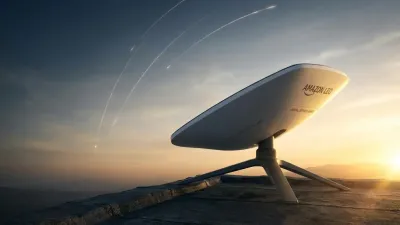
A catastrophic launchpad explosion has severely damaged Blue Origin's primary spaceflight infrastructure, sending shockwaves through the telecommunications and aerospace sectors. The explosive failure of the 322-foot-tall New Glenn rocket during a routine hot-fire test in Florida has physically compromised the company's only viable launch facility. For telecommunications providers and enterprise network architects tracking the satellite broadband market, this hardware anomaly introduces severe structural delays for the primary challenger to the dominant satellite internet infrastructure.
The incident occurred at approximately 9PM at Blue Origin's Florida launch site during a static test meant to fire all seven booster engines while keeping the heavy-lift vehicle secured to the ground. The resulting explosion completely engulfed Launch Complex 36, causing catastrophic structural damage to critical ground infrastructure. Industry analysts note that the transporter-erector and one of the vital lightning towers at LC-36A may be completely unsalvageable, rendering future space internet deployment operations from this site impossible for the foreseeable future.
It’s too early to know the root cause but we’re already working to find it. Very rough day, but we’ll rebuild whatever needs rebuilding and get back to flying. It’s worth it.
- Jeff Bezos, Founder, Blue Origin
The operational fallout hits Amazon's ambitious satellite constellation strategy hardest. The specific New Glenn vehicle that exploded was undergoing final preparations to deploy a crucial batch of 48 Amazon Leo satellites into low-Earth orbit. While the payload itself was not yet integrated onto the booster stage and escaped destruction, the loss of the launch vehicle and the physical destruction of the pad fundamentally breaks Amazon's deployment schedule. The company relied on New Glenn’s massive payload capacity and reusable boosters to catch up on an already compressed timeline.
The regulatory clock is ticking loudly for the digital business and telecom giant. To maintain its federal authorization, Amazon is mandated by the FCC to have 1,618 active satellites functioning in low-Earth orbit by July 30, 2026. To date, Amazon has successfully launched just over 300 satellites into orbit, leaving an immense deployment gap. Although Amazon has officially applied for a regulatory extension to preserve its operating license, this launch failure completely changes its strategic positioning, forcing it to depend on secondary launch providers like United Launch Alliance (ULA) and Arianespace, or turn directly to its direct market competitor, SpaceX.
Simultaneously, the shockwave from the explosion disrupts NASA's immediate lunar logistics. On Tuesday, the agency finalized plans for New Glenn to deploy a critical robotic lunar lander as early as autumn 2026, a schedule that is now mathematically impossible. The vehicle was also scheduled to support the historic Artemis III mission in 2027, where astronauts are slated to interface with commercial lunar landers developed by both SpaceX and Blue Origin to re-establish a human footprint on the moon.
The Broadband Satellite Duopoly Hardens
This structural failure significantly changes the competitive landscape of the global satellite internet market. Amazon's satellite program was designed to create a viable enterprise alternative to SpaceX, preventing a complete monopoly over low-Earth orbit telecommunications. With New Glenn highly unlikely to fly again in 2026, and a realistic recovery window stretching into the mid-2027 timeframe, SpaceX's market dominance will remain completely unchallenged during a critical phase of global corporate network adoption.
For global telecom operators and remote enterprise networks planning their future infrastructure investments, this incident changes the timeline for purchasing and redundancy strategies. Relying on an enterprise-grade secondary network provider is no longer a viable near-term option. Companies looking to deploy high-bandwidth, low-latency satellite arrays must now accept that a true alternative to the incumbent network will remain grounded for at least the next 12 to 18 months, forcing deeper reliance on existing legacy providers and traditional terrestrial networks.
This article was written by AI from reporting by theverge.com.