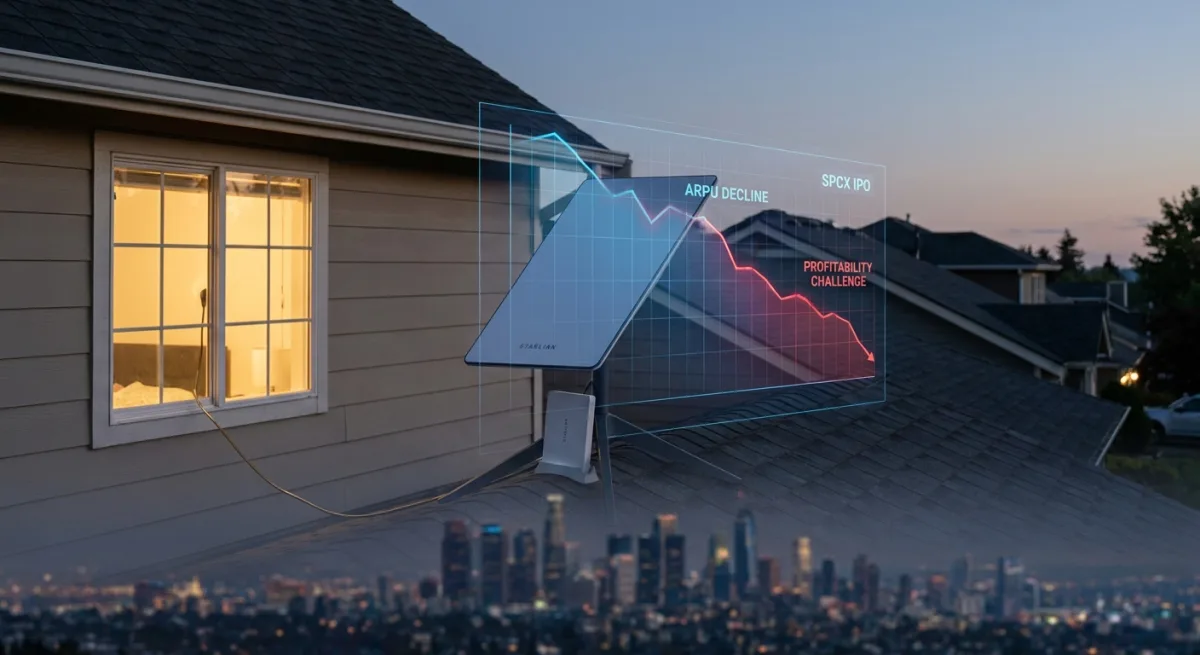
The upcoming $75 billion SpaceX IPO masks a growing profitability challenge for its satellite internet division. While Starlink doubled its subscriber base to 10.3 million in the first quarter of 2026, its average revenue per user (ARPU) plummeted to $66 per month. This financial reality matters heavily for potential retail investors and current users, as the pressure to maintain operating margins has already triggered a $5 to $10 monthly price hike across consumer plans.
The ARPU decline - down from $86 in 2025 and $99 in 2023 - is a direct result of aggressive expansion into price-sensitive markets across Africa, Southeast Asia, and Latin America. While this strategy successfully boosted volume from 4.4 million users a year earlier, Q1 operating income barely moved, rising only slightly from $1.03 billion to $1.19 billion. For the full year 2025, Starlink’s connectivity segment generated $11.39 billion in revenue and $4.42 billion in operating profit, accounting for 61% of total company revenue.
The Terrestrial Battle and Hardware Costs
As Starlink exhausts rural markets, its next growth phase requires competing in suburbs against established fiber and cable providers. This shift introduces severe pricing pressure, especially since Starlink user terminals cost roughly three times as much to produce as terrestrial modems, limiting the company's flexibility on equipment pricing.
People underestimate the ability of terrestrial competitors to respond with pricing, bundling, and the like.
- Tim Farrar, Telecommunications Analyst
To support tens of millions of new users without degrading speeds, SpaceX relies entirely on its V3 satellites, which deliver 1 terabit per second (Tbps) of downlink throughput compared to 80 gigabits (Gbps) on the V2 Mini. However, these massive satellites require the Starship launch vehicle. Despite spending over $15 billion on development and completing a twelfth flight test on May 22, 2026 - the first launch of the V3 variant with Raptor 3 engines - Starship remains in testing. SpaceX only flew five Starship missions in 2025 against a target of 25.
Amazon Leo Enters the Fray
Competition is also intensifying in orbit. Amazon Leo (formerly Project Kuiper) entered enterprise beta in April 2026, targeting commercial availability by mid-2026 with claimed download speeds of 1 Gbps. Amazon has committed $10 billion to the project, signing beta partnerships with Verizon, AT&T, Vodafone, and NASA. Furthermore, Amazon secured an FCC extension until 2029 to deploy 3,232 Gen 1 satellites and agreed to acquire Globalstar for $11.57 billion to add terrestrial spectrum.
Meanwhile, SpaceX secured its own regulatory wins. The FCC approved 7,500 Gen2 satellites in January 2026 and granted a waiver to exceed legacy interference limits. In May, SpaceX acquired 65 MHz of spectrum from EchoStar for direct-to-phone 5G connectivity. However, incumbent operators like SES and Viasat intend to challenge the interference waiver.
The $1.77 Trillion Valuation Trap
SpaceX priced its IPO at $135 per share on June 11, valuing the company at $1.77 trillion ahead of its June 12 Nasdaq debut under the ticker SPCX. This valuation sits at roughly 94 times 2025 revenue, far above Morningstar’s fair-value estimate of $63 per share. The high price factors in aggressive growth across Starlink, Starship, and xAI - the artificial intelligence operation SpaceX absorbed in February 2026, which drove the company from a $791 million net profit in 2024 to a $4.94 billion net loss in 2025.
The historic SpaceX IPO places immense, perhaps unrealistic, pressure on Starlink to fund the company's broader ambitions. With xAI integration costs dragging the balance sheet into a nearly $5 billion net loss, Starlink is currently the only consistently profitable division holding the financial structure together. If Starship delays continue to bottleneck the deployment of V3 satellites, network congestion will inevitably force SpaceX to implement further price hikes.
This creates a dangerous vulnerability just as Amazon Leo enters the market with deep pockets and gigabit speeds. If Amazon successfully poaches the premium suburban subscribers that SpaceX desperately needs, the foundational arithmetic justifying this trillion-dollar valuation could quickly unravel.