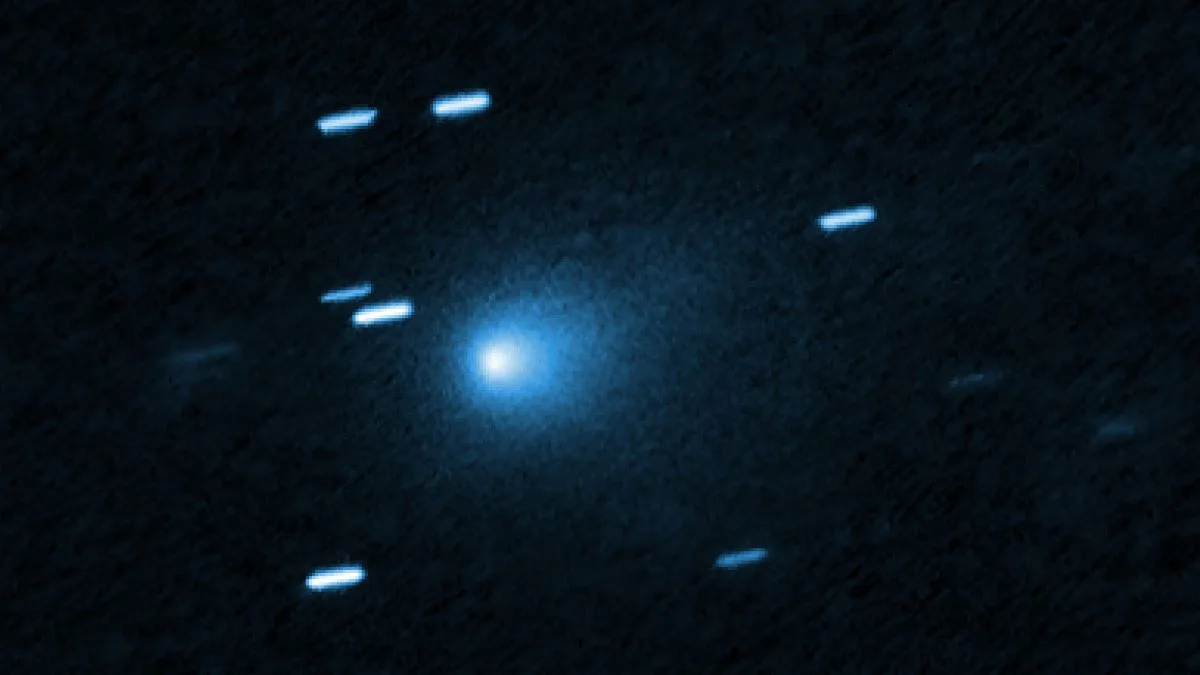
Deep analysis of the interstellar comet 3I/ATLAS reveals that the mysterious object is not just a visitor from beyond our Solar System, but a primordial relic that may be nearly as old as the Universe itself. Following its highly anticipated pass through the inner Solar System last year, scientists have confirmed that 3I/ATLAS is dramatically different from its interstellar predecessors, 1I/'Oumuamua and 2I/Borisov. By studying the ratios of hydrogen and carbon isotopes, researchers have determined that the comet formed in a deeply frozen, pristine environment up to 12 billion years ago.
Humanity first detected 3I/ATLAS on July 1, 2025. While public attention faded after its closest approach to the Sun in late October of that year, astrophysicists continued to analyze the gases it emitted. A team led by molecular astrophysicist Martin Cordiner at the NASA Goddard Space Flight Center utilized high-fidelity JWST observations of 3I/ATLAS, alongside radio data from ALMA, to decode the chemistry taking place within the comet's coma.
"This was a special moment," Cordiner explained. "Amid all the rumors of extraterrestrial technology, a strong scientific narrative was emerging that 3I/ATLAS appeared to closely resemble our typical Solar System comets. However, the isotopic ratios we measured with JWST show that it is not only distinct, but also likely much older than our Solar System."
The Deuterium Anomaly and Deep Freeze Origins
The first major anomaly discovered in 3I/ATLAS is its unusually high concentration of heavy hydrogen, known as deuterium. Cordiner and his colleagues measured a deuterium-to-hydrogen ratio of 0.98 percent in the comet's water. This staggering figure is more than 10 times higher than the deuterium ratios typically found in Solar System comets.
According to established models of ice chemistry, this extreme level of deuterium enrichment only occurs when water forms at temperatures below 30 kelvin (-243 °C, or -406 °F). This preserves the chemical signatures of a deeply frozen environment, indicating that the comet's water formed far away from the warmth of any star.
To get such definitive evidence of a distant origin (in space and time) is enough to turn the scientific narrative around, and show that this object is indeed something scientifically very unique and interesting.
- Martin Cordiner, NASA Goddard Space Flight Center
The carbon isotopes found in 3I/ATLAS reveal an equally fascinating chapter of its history. The comet contains unusually high ratios of carbon-12 to carbon-13. This specific isotopic signature suggests that the comet formed from primordial material that had not yet been heavily enriched by the scattered elements of dying stars.
Carbon Isotopes Point to the Dawn of the Galaxy
Elements heavier than hydrogen and helium only became abundant in the Universe after several generations of stars lived, fused heavier atoms in their cores, and violently exploded. By comparing the carbon measurements of 3I/ATLAS with models tracking the Milky Way's chemical evolution, researchers estimate the comet formed between 11 and 12 billion years ago, when the galaxy was still in its infancy.
However, researchers acknowledge an alternative possibility: the comet may have formed in a highly remote, isolated region of space untouched by stellar dust, giving it a pristine chemical makeup that artificially inflates its apparent age. Tracing its exact origin is nearly impossible. With roughly 200 billion stars in the galaxy, calculating the interacting orbits of interstellar clouds and gravitational pulls limits scientists to tracing the comet's path back only about 10 million years.
Currently, 3I/ATLAS is located 8 astronomical units (au) from the Sun, approaching the orbit of Saturn. It is projected to pass beyond Pluto's orbit in 2029 and will officially exit the heliosphere around 2035, continuing its endless journey across the Milky Way. The full findings of this research have been published in the journal Nature Astronomy.
The Ultimate Interstellar Intercept Mission
The discovery that 3I/ATLAS could be a 12-billion-year-old time capsule fundamentally shifts how space agencies should prioritize interstellar objects. While previous visitors like 'Oumuamua were gone before we could mount a response, 3I/ATLAS is moving on a timeline that technically allows for a chase. Because it won't exit the heliosphere until 2035, a rapidly developed, nuclear-propelled interceptor probe could theoretically catch it.
If the comet truly contains pristine ice from the dawn of the Milky Way, capturing physical samples or even close-up mass spectrometry data would provide unprecedented insights into the primordial building blocks of the galaxy - data that no telescope, not even JWST, can fully replicate from afar. As Cordiner noted, there is still time to catch up with it if the world's resources were thrown at the problem. The scientific return on investment for intercepting a 12-billion-year-old object would easily justify the cost of a flagship mission, potentially answering fundamental questions about the distribution of water and organic chemistry in the early Universe.