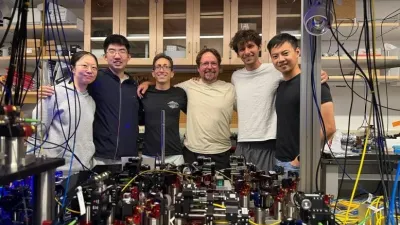
In a landmark achievement for modern physics, an international team of researchers has successfully demonstrated the quantum Hall effect with light, a phenomenon previously thought to be the exclusive domain of charged particles like electrons. Published in the prestigious journal Physical Review X, this breakthrough involves forcing photons to drift in a quantized manner, mimicking the behavior of electrons under strong magnetic fields. This discovery, led in part by Philippe St-Jean of Université de Montréal, promises to revolutionize the fields of metrology and quantum information processing by introducing a new universal reference standard based on optical systems.
From Classical Physics to Quantum Light
To understand the magnitude of this achievement, one must look back to the late 1800s and the discovery of the original Hall effect. Physicists found that when an electric current flows through a conductor while a magnetic field is applied at a right angle, a voltage appears sideways across the material. This occurs because the magnetic field pushes negatively charged electrons to one side, creating a measurable voltage difference.
In the 1980s, this understanding deepened with the discovery of the quantum Hall effect in ultra-thin conductors at extremely low temperatures. Researchers observed that under strong magnetic fields, the sideways voltage did not increase smoothly but rose in sharp, defined steps known as "plateaus." These plateaus are determined solely by fundamental constants of naturethe electron charge and the Planck constantmaking them universal. This phenomenon was so significant that it led to three separate Nobel Prizes in Physics in 1985, 1998, and 2016.
However, replicating this with light was considered extraordinarily difficult. Unlike electrons, photons (particles of light) carry no electric charge and do not naturally respond to magnetic fields. The research team overcame this fundamental barrier by engineering a system where light exhibits a "quantized transverse drift," effectively behaving as if it were charged matter under magnetic influence.
Redefining Metrology and Computing
The implications of controlling light with such precision extend far beyond theoretical physics. Philippe St-Jean, a physics professor at Université de Montréal and co-author of the study, highlighted the potential for this technology to transform metrology, the science of measurement. Currently, the kilogram is defined using an electromechanical device that relies on a universal standard for electrical resistance derived from the quantum Hall effect in electrons.
"The quantum Hall plateaus give us exactly that," St-Jean explained. "Thanks to them, every country in the world shares an identical definition of mass, without relying on physical artifacts."
By achieving this effect with light, optical systems could eventually serve as a parallel or superior universal reference standard. Furthermore, the ability to control the flow of light in quantized steps could lead to more resilient quantum photonic computers. Unlike electronic systems, photonic systems are inherently out of equilibrium and require precise stabilization, making this successful demonstration of quantized drift a massive engineering feat.
Future Applications in Sensing
Beyond computing and standards, the research suggests that even small departures from perfect quantization could be valuable. Tiny deviations in the light's drift could reveal subtle environmental disturbances, paving the way for a new generation of extremely sensitive sensors. The team's work proves that it is possible to design next-generation photonic devices capable of transmitting and processing information in ways that were previously theoretical.
My Take
This discovery represents a pivotal moment where photonics begins to inherit the robust analytical toolset of electronics. By bridging the gap between the charge-free nature of photons and the quantized behavior of electrons, scientists are essentially giving light a "magnetic personality." While the immediate applications are in high-precision metrology, the long-term value lies in quantum computing. If we can manipulate light with the same quantized precision as electrons, we move one step closer to optical computers that are not only faster but fundamentally more stable against noise than their electronic counterparts.
This article was written by AI from reporting by sciencedaily.com.