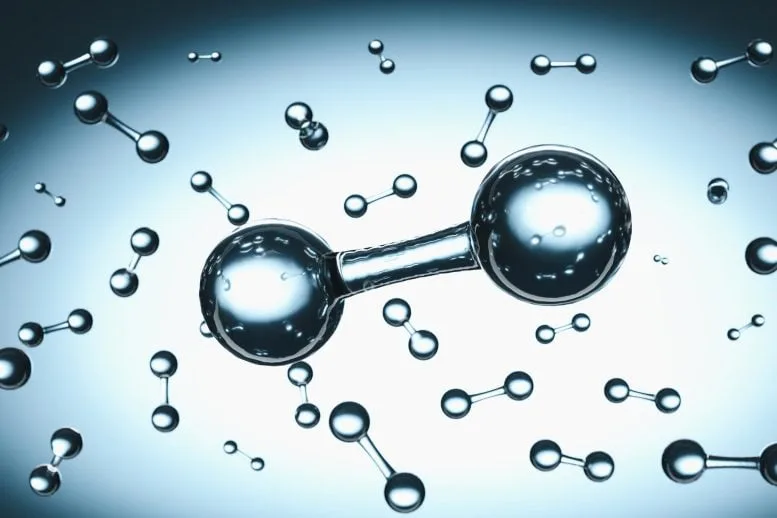
A hidden structural switch inside vanadium crystals determines whether hydrogen behaves like a standard particle or a quantum wave. This breakthrough discovery by researchers at the Institute of Industrial Science at The University of Tokyo could fundamentally change how we design materials for safe and efficient hydrogen storage, a critical hurdle in the global transition to clean energy.
Inside a vanadium crystal, hydrogen can travel in two distinctly different ways. In a classical process, an atom acts as a conventional particle that must acquire enough thermal energy to physically jump over the barrier separating one location from the next. However, quantum mechanics allows for a second, highly efficient route.
Through a phenomenon known as quantum tunneling, hydrogen can behave like a wave, passing directly through energy barriers rather than climbing over them. Until now, the exact mechanism that dictates which route the hydrogen takes remained a mystery.
By combining measurements of hydrogen structure and diffusion with advanced quantum mechanical calculations, the research team discovered that the symmetry of the vanadium crystal is the deciding factor. At low hydrogen concentrations, the vanadium lattice maintains a highly symmetrical structure. Under these conditions, neighboring sites are structurally equivalent, allowing hydrogen atoms to tunnel seamlessly between them and form delocalized quantum states.
"Our results show that crystal symmetry is key to controlling hydrogen’s quantum behavior," explained Takahiro Ozawa, the study's corresponding author. "Highly symmetric structures allow hydrogen to tunnel, while distorted structures suppress this effect."
As more hydrogen is absorbed into the material, the crystal lattice begins to distort. This loss of symmetry effectively shuts down the equivalent pathways required for quantum tunneling. Consequently, the hydrogen is forced to act as a classical particle, relying entirely on thermal energy to move through the material.
Crystal symmetry is the underlying switch that turns quantum behavior on or off. In a symmetric structure, hydrogen finds equivalent pathways that allow it to tunnel between sites. Distort that symmetry - as happens at higher hydrogen concentrations - and tunneling is suppressed.
- Katsuyuki Fukutani, The University of Tokyo
Engineering the Future of Hydrogen Storage
The implications of this discovery extend far beyond theoretical physics. Vanadium is already considered a highly promising candidate for hydrogen storage because it absorbs the element readily and allows atoms to move through its crystal lattice. However, regulating that movement has been a persistent engineering challenge.
By identifying crystal symmetry as the master switch, scientists now have a clear blueprint for atomic control. Researchers can theoretically design new alloys or modify existing materials to maintain their internal symmetry even at higher hydrogen concentrations, thereby keeping the highly efficient quantum tunneling pathways open.
"The ability to control how hydrogen behaves could improve materials used for hydrogen storage and diffusion control," noted Sudhansu Sekhar Das, the study's lead author. He added that these advances could benefit a wide range of technologies involving hydrogen transport and purification. The full findings were published in the journal Nature Communications under DOI: 10.1038/s41467-026-75020-w.
The Quantum Leap for Clean Energy Grids
The transition to a hydrogen-based economy has long been bottlenecked by the physical realities of storage. Storing hydrogen safely requires either extreme compression, cryogenic temperatures, or advanced solid-state materials that absorb the gas like a sponge. This discovery directly addresses the limitations of the latter.
If engineers can manipulate crystal symmetry to sustain quantum tunneling at high capacities, we could see the development of solid-state storage tanks that charge and discharge hydrogen at unprecedented speeds without requiring extreme heat to trigger classical particle hopping. This would drastically lower the energy overhead required to operate hydrogen fuel cells.
Furthermore, understanding how lattice distortion forces hydrogen into classical behavior provides crucial insight into hydrogen embrittlement - a phenomenon where metals become brittle and fracture after absorbing hydrogen. By designing materials that resist this symmetry-breaking distortion, the energy sector could develop safer, longer-lasting pipelines and storage infrastructure for the next generation of clean energy grids.