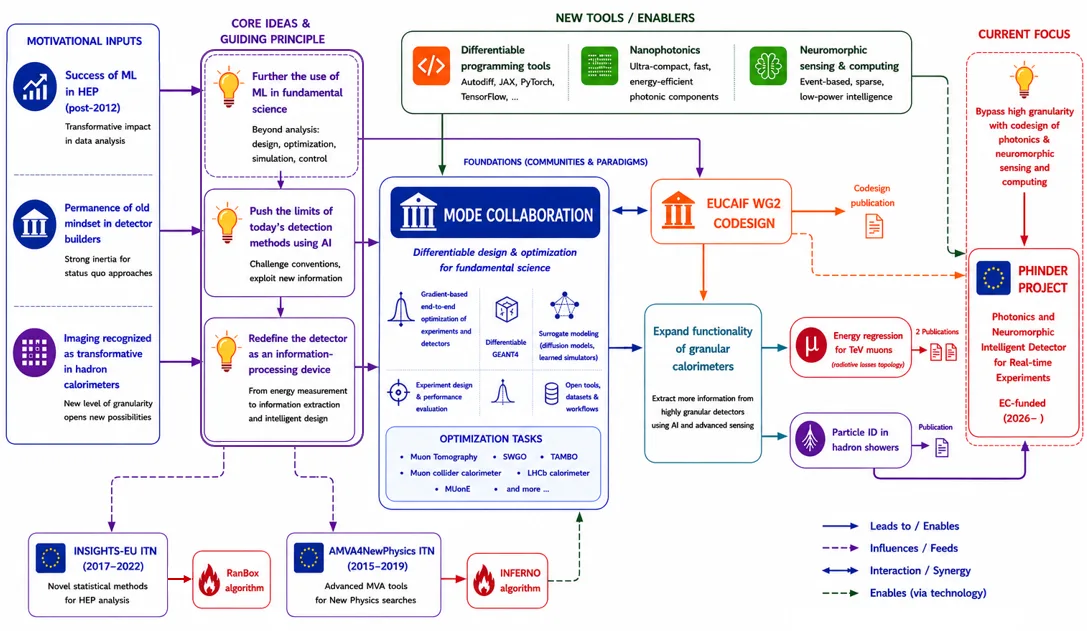
The integration of artificial intelligence into fundamental science has triggered a paradigm shift that extends far beyond basic data analysis. A comprehensive 10-year retrospective, recently prepared for the upcoming MODE Workshop in Crete, highlights how machine learning has fundamentally rewired the field of particle physics. The transformation began in earnest around 2012, when machine learning algorithms were deployed to boost sensitivity in Large Hadron Collider (LHC) searches, playing a pivotal role in the study of the Higgs boson.
Despite these early software successes, the hardware side of fundamental physics initially resisted the AI revolution. Experimental physicists and detector builders largely maintained that machine learning could not significantly improve the physical design of their instruments. However, as algorithms began extracting unprecedented levels of detail from detector outputs, it became clear that the physical instruments themselves needed to be optimized in tandem with the software analyzing their data.
The attitude of expert detector designers was that their job could not be helped much by a machine learning algorithm, let alone taken on entirely. This was shortsighted, especially since those ML tools were already demonstrating how information extraction was being revolutionized.
- Science20 Retrospective Report
This realization sparked a movement toward "codesign," a methodology where hardware and software are developed as a single, unified system. A prime example of this evolution is the reassessment of hadron calorimeters. Once considered the least critical component of a collider detector, these instruments are now recognized as essential for identifying heavy particles like top quarks and W/Z bosons, provided they can capture highly granular energy deposition images.
Key Milestones in AI-Driven Physics
Over the past decade, the push for end-to-end optimization in scientific experiments has been supported by over 9 million euros in European Community funding across three major projects. This investment has yielded several groundbreaking initiatives:
- The INFERNO Algorithm: Developed by researcher Pablo de Castro, this algorithm leveraged differentiable programming to achieve end-to-end optimization of physics analyses, specifically accounting for systematic uncertainties in measurements.
- The MODE Collaboration: Founded in 2019 to expand on INFERNO's concepts, this global initiative now encompasses over 40 institutions across four continents, focusing entirely on the optimization of scientific instrument design.
- EUCAIF Codesign: A working group dedicated to proving that hardware can no longer be optimized in isolation without factoring in the specific AI-driven information extraction procedures it enables.
The PHINDER Project: Neuromorphic Computing Meets Nanophotonics
The drive for higher granularity in particle identification has culminated in the recently launched PHINDER project, an EIC-Pathfinder initiative that began in April. The project aims to bypass traditional, highly complex electronic readout methods by utilizing neuromorphic computing. By integrating nanophotonics into the detector design, researchers are exploring entirely new ways to process particle showers.
Specifically, PHINDER utilizes indium arsenide nanowires to perform dual roles: acting as light-sensitive elements within a scintillating plastic active material, and functioning as neurons in a neuromorphic sensing network. In a radical departure from standard computing, the system uses photons for computation, relying on their time series as the primary vector for information extraction. This allows scientists to gather topological data from particle showers without dividing the calorimeter into millions of independent electronic channels.
The End of Isolated Hardware Design
The trajectory of the last 10 years proves that the era of building static, isolated scientific hardware is over. The success of the MODE Collaboration and the launch of the PHINDER project demonstrate that the physical constraints of a detector must now be treated as tunable parameters within a broader machine learning model. When hardware and software are co-optimized, the entire experimental apparatus becomes a single, cohesive AI system.
Looking ahead, the reliance on neuromorphic computing in particle physics signals a broader trend for high-energy research. As the data output from colliders grows increasingly massive, traditional electronic readouts will inevitably bottleneck. By shifting computation directly to the photonic level, projects like PHINDER are not just solving a data extraction problem; they are laying the groundwork for the next generation of sustainable, ultra-fast scientific instruments.