Physicists have directly observed a strange quantum rotation effect where atomic movements inside a crystal unexpectedly flip direction while still obeying the strict laws of angular momentum conservation. By firing powerful terahertz laser pulses into a solid material, an international team of researchers successfully manipulated these microscopic motions. The resulting discovery provides a groundbreaking look at how angular momentum moves through a crystal lattice, offering crucial insights into the fundamental origins of magnetism.
For over a century, scientists have understood that mechanical rotation and magnetism are deeply connected, a concept first demonstrated by Albert Einstein and Wander Johannes de Haas. However, tracking exactly how angular momentum spreads across the organized arrangement of atoms inside a material has remained a significant challenge. Researchers from the Helmholtz-Zentrum Dresden-Rossendorf (HZDR) and the Fritz Haber Institute of the Max Planck Society have now managed to observe this transfer directly.
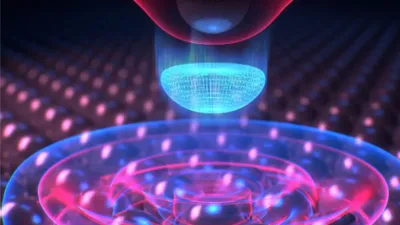
The team focused their experiments on the quantum material bismuth selenide. Using extremely intense terahertz laser pulses, they drove a lattice vibration into a circular motion, while a second ultrafast pulse measured the connected vibrations. Sebastian Maehrlein, leader of the study at HZDR, emphasized the significance of the findings. "We have discovered something fundamentally new that will hopefully make its way into the textbooks," Maehrlein explained.
The "1 + 1 = -1" Umklapp Process
During the transfer between lattice vibrations, the researchers witnessed an unexpected phenomenon: the angular momentum completely reversed its direction. This happens because of the rotational symmetry inherent to the crystal lattice, where some rotational states are physically identical despite spinning in opposite directions. The angular momentum linked to these vibrations combines to create a new rotation with twice the frequency but a reversed path.
The team refers to this unusual behavior as a "1 + 1 = −1" effect, comparing it to an Umklapp process where the crystal's symmetry effectively flips the direction of motion. This marks the first experimental demonstration of such behavior involving lattice angular momentum, which was detailed in a recent study published in Nature Physics.
I find it extraordinarily elegant how the laws of physics are directly dictated by the symmetries of nature.
- Olga Minakova, Fritz Haber Institute of the Max Planck Society
Rewriting the Rules of Quantum Memory
This discovery is far more than a theoretical physics milestone; it carries immediate implications for the future of data storage and quantum computing. By proving that terahertz laser pulses can reliably control and reverse angular momentum in a material like bismuth selenide, researchers have unlocked a potential new mechanism for writing data at unprecedented speeds. Current magnetic memory devices rely on flipping electron spins, a process that is fast but ultimately limited by heat and energy loss.
If engineers can harness this "1 + 1 = -1" Umklapp process, future advanced memory devices could manipulate lattice vibrations directly to store information. This would theoretically allow for data processing that is orders of magnitude faster and vastly more energy-efficient than today's silicon-based standards. As the demand for high-speed quantum materials grows, mastering these hidden symmetries will be the key to building the next generation of information technologies.
This article was written by AI from reporting by scitechdaily.com.