Highly Stable Cu₄₅ Superatom Achieves Record CO₂ Conversion Efficiency
Scientists at Tsinghua University in Beijing have synthesized the first stable copper superatom, designated Cu₄₅, marking a major advance in electrocatalysis for carbon dioxide reduction. Published January 2026 in the Journal of the American Chemical Society, this nanocluster demonstrates over 80% efficiency in converting CO₂ to ethylene (C₂H₄), outperforming all prior copper-based catalysts.
What is a Superatom?
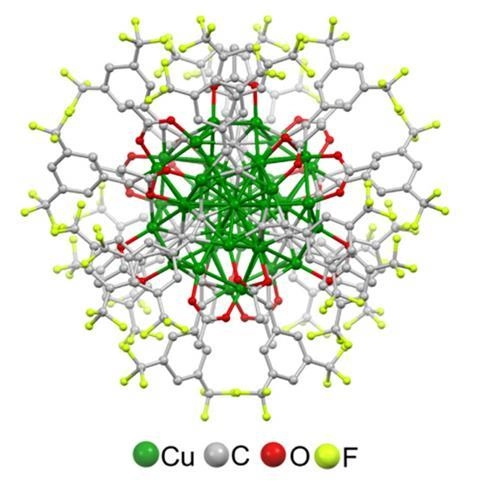
A **superatom** consists of a cluster of atoms behaving as a single atom with enhanced stability, mimicking noble gases like neon or argon. Previous attempts to create copper superatoms failed due to instability, as clusters disintegrated without protective shells. The Cu₄₅ features 45 copper atoms in a closed-shell electron configuration, wrapped in organic ligands that prevent decomposition.
This structure ensures the cluster withstands harsh electrocatalytic conditions, including high voltages and aqueous environments. Traditional copper catalysts degrade quickly, limiting their industrial viability. Cu₄₅'s robustness addresses this, enabling repeated cycles without performance loss.
Record-Breaking Electrocatalysis Performance
In experiments, researchers applied electricity to split CO₂ molecules, allowing Cu₄₅ to recombine carbon atoms into ethylene. Ethylene, a cornerstone of the petrochemical industry, produces plastics, antifreeze, and synthetic rubbers. Global demand exceeds 150 million tons annually, mostly from fossil fuels. This process offers a sustainable alternative by recycling atmospheric CO₂.
- 80%+ Faradaic efficiency for CO₂ to C₂H₄, far exceeding typical copper catalysts (20-50%).
- Operates at mild potentials, reducing energy input.
- Maintains stability over extended operation, unlike nanoparticle alternatives.
"Cu45 is the first well-defined Cu superatom electrocatalyst used for CO₂-to-C₂H₄ electrocatalysis, which exhibits outstanding performance... surpassing all known copper cluster catalysts," the researchers stated.
Technical Details: Structure and Mechanism
The Cu₄₅ core adopts an icosahedral-like geometry, with electrons delocalized in shells (1S² 1P⁶ 1D¹⁰ 2S² 1F¹⁴ 2P⁶ 2D¹⁰ configuration), conferring inertness. Ligands such as phosphines or thiols shield the cluster from aggregation. During catalysis, CO₂ adsorbs on undercoordinated copper sites, undergoing proton-coupled electron transfer to form *CO intermediates. These dimerize to *COCO, then reduce to ethylene.
Compared to bulk copper foil (low selectivity) or Cu nanoparticles (instability), Cu₄₅'s atomic precision tunes active sites, boosting C-C couplinga key bottleneck in CO₂ electroreduction.
Broader Implications for Carbon Recycling
This breakthrough could transform carbon capture and utilization (CCU). Pairing Cu₄₅ with renewable electricity enables direct air capture-to-chemicals, closing the carbon loop. Potential applications include:
- Producing green ethylene for plastics without oil.
- Scaling to modular electrolyzers for industrial sites.
- Inspiring superatom catalysts for other reductions (e.g., CO₂ to ethanol, methane).
The team notes: "This work provides new insights into the design of robust Cu nanoclusters for electrocatalytic applications, enabling their broader application in future research and technology development."
Challenges and Path Forward
Scaling remains key: Current yields are lab-scale (micromoles). Industrial reactors demand gram-scale production and flow-cell integration. Cost analysis shows copper's abundance favors viability over precious metals like gold or silver catalysts. Ongoing work explores alloyed superatoms (e.g., Cu-Au) for selectivity tuning.
Published amid rising climate pressures, this January 2026 discovery aligns with global net-zero goals. Tsinghua's achievement positions superatoms as a frontier in sustainable chemistry, potentially accelerating the shift from fossil carbon to recycled sources. As electrocatalysis matures, Cu₄₅ exemplifies precision nanotechnology's role in decarbonization.