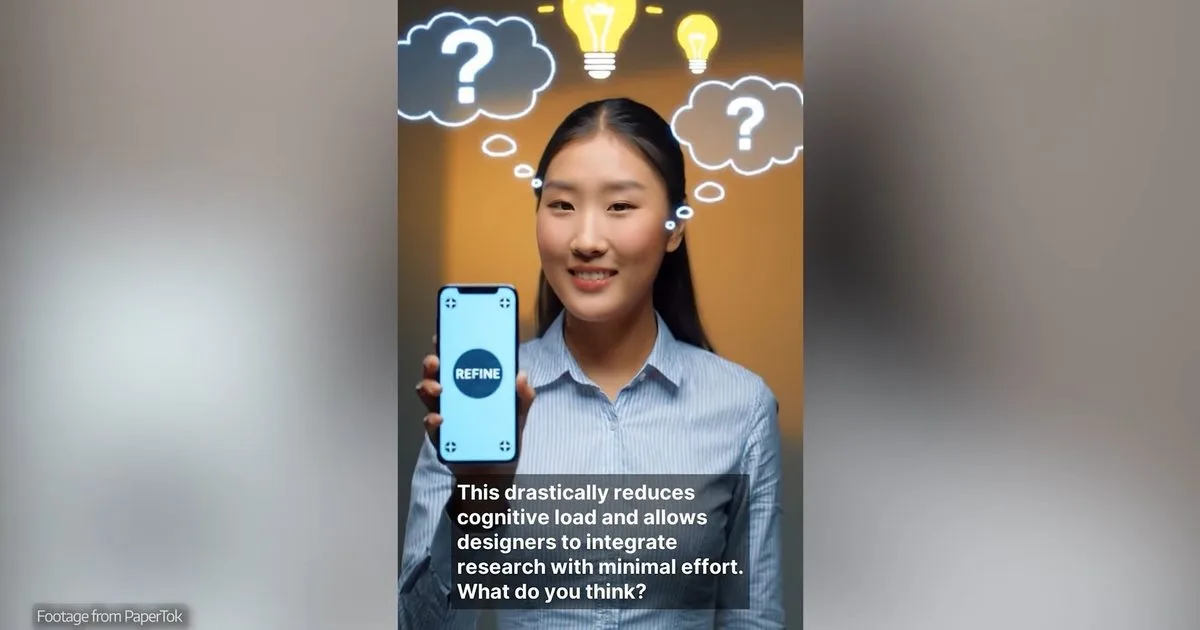
Academic papers are notoriously dense, often packaged as intimidating PDFs that test the willpower of even the most dedicated readers. To bridge the gap between complex research and everyday audiences, a team of researchers at the University of Washington has developed PaperTok. This new AI system transforms lengthy academic documents into engaging, 45-second short-form videos designed for platforms like TikTok.
Unlike fully automated AI video generators that often lead non-experts to spread misinformation, PaperTok is built around a human-in-the-loop philosophy. It empowers the actual scientists to control the narrative, ensuring that the resulting social media content remains factually accurate while still being highly accessible. The tool is currently limited to users with a paid Google Gemini subscription.
How to Convert Research Papers with PaperTok
Because PaperTok is designed to keep researchers actively involved in the content creation process, it requires a structured workflow rather than a simple one-click generation.
- A paid Google Gemini subscription.
- A PDF copy of the academic paper you wish to convert.
- Upload the academic document to the PaperTok platform. This allows the integrated Google Gemini AI to analyze the dense text and extract key findings.
- Select one of the generated hooks provided by the system. This ensures your video captures attention in the crucial first few seconds, a vital metric for short-form content.
- Edit the AI-generated transcript and adjust the tone. This enables researchers to correct any oversimplifications and tailor the language for a general audience.
- Review the storyboard and generate visual clips section by section. This breaks the script into manageable scenes, allowing for precise visual storytelling.
- Publish the final 45-second video with automatically added credits. This guarantees that the original authors and the video creator receive proper attribution for their work.
The Credibility Trap of AI Visuals
In testing with 118 participants - comprising 100 online users and 18 academics - PaperTok outperformed two competing PDF-to-video generators in both ease of use and audience engagement. However, the technology is not flawless. Users noted that some outputs suffered from strange visual artifacts and nonsense text, which are common hallmarks of generative AI.
While PaperTok brilliantly solves the text-density problem of academic research, its reliance on AI-generated visuals introduces a new risk. If a science communication video looks too obviously artificial - complete with warped graphics or misspelled background text - it can actively undermine the credibility of the peer-reviewed research it aims to promote.
The University of Washington team's plan to add deeper customization for generated scenes is not just a feature update; it is a mandatory step. Ensuring that visual hallucinations do not overshadow factual data will be the deciding factor in whether PaperTok becomes a standard tool for scientists or just another AI novelty.