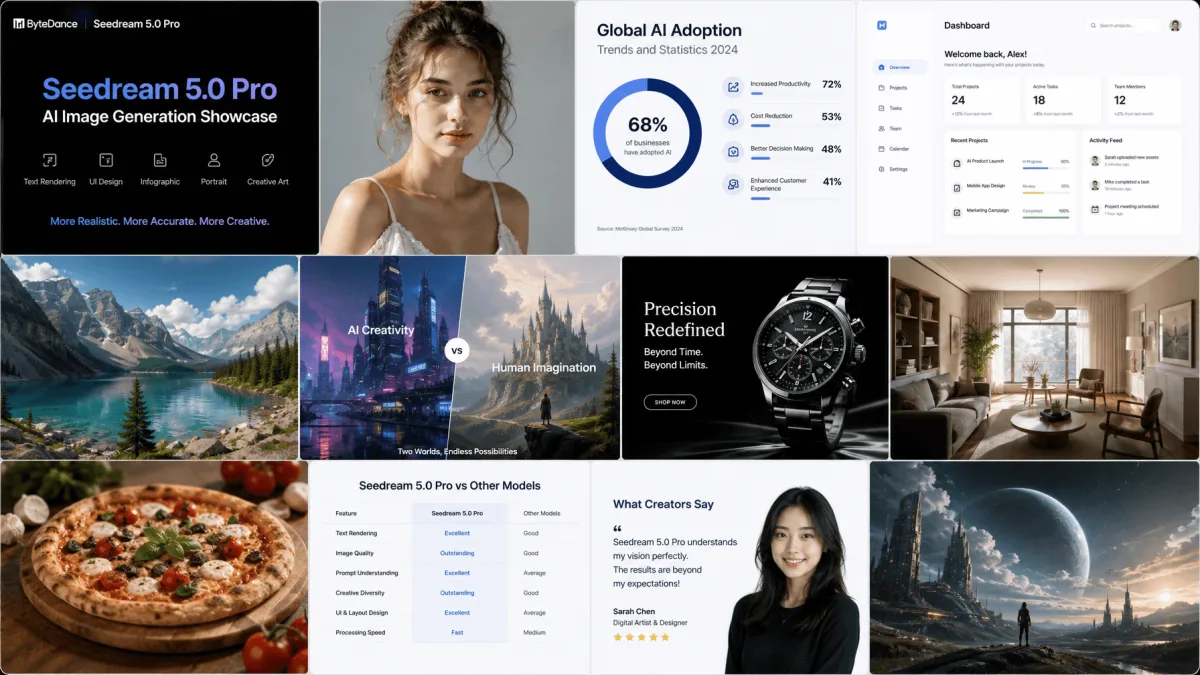
The newly released ByteDance Seedream 5.0 Pro has officially pushed the company into the top tier of AI image generation. Tested extensively across realism, complex data visualization, and design, the text-to-image model proves highly competitive with OpenAI's GPT Image 2, though it adopts a distinct approach prioritizing safety and structural clarity over raw authenticity.
For digital designers, marketers, and developers, this model offers a powerful new tool for rapidly generating UI mockups and technical infographics. The integration of the model into platforms like Doubao, Jimeng, and the Volcengine Ark experience center signals ByteDance's aggressive push to dominate enterprise and consumer AI tools, requiring paid plans for full access.
Realism and Safety Guardrails
When tested against GPT Image 2 using identical prompts, Seedream 5.0 Pro revealed strict, deliberate safety mechanisms. In WeChat screenshot generation, the model created highly realistic interfaces but intentionally displayed obviously fake transfer amounts - a deliberate guardrail against financial fraud and deepfake scams. In vintage photo generation, Seedream produced technically accurate images but with a noticeably cleaner, newer aesthetic, missing the authentic aged degradation seen in its US counterpart.
However, its ability to replicate physical screen imperfections is remarkable. The model successfully rendered fingerprints, water stains, window reflections, and oily smudges on a phone screen with extreme fidelity, even if the phone itself appeared to float unsupported.
Complex Visualization and Design
Complex information visualization stands out as the model's core strength. Seedream successfully generated a Generative AI Technology Stack infographic featuring proper hierarchical layouts, clear typography, and coherent data visualizations like bar charts and network diagrams. It also accurately produced a three-panel robot cost breakdown and a science education graphic explaining why AI chips need HBM.
In design tasks, it excelled at precise local editing - flawlessly replacing a chair's material from red to dark green velvet while preserving the original perspective, shadows, and ambient lighting. However, e-commerce UI generation remained visually basic, and Chinese text rendering showed inconsistencies, with characters occasionally appearing blurry in dense graphics.
The Liability Shield Disguised as an Aesthetic
ByteDance's approach with Seedream 5.0 Pro highlights a fundamental shift in how tech giants are deploying generative AI. By intentionally nerfing the realism of financial transfers in WeChat mockups and keeping vintage photos looking slightly "too clean," ByteDance is actively building a liability shield directly into the model's output layer.
While GPT Image 2 chases absolute photorealism, Seedream is optimized for commercial utility - infographics, posters, and product mockups - where structural accuracy matters more than deceiving the human eye. This strategy ensures the tool remains highly valuable for enterprise clients on Volcengine Ark while minimizing the risk of regulatory backlash over AI-generated fraud.
This article was written by AI from reporting by pandaily.com.