Google has quietly introduced the Google Dreambeans app, a new experimental tool within Google Labs that masquerades as a personal assistant but functions more like a TikTok-style feed of targeted ads. By scanning users' private data across Gmail, Calendar, Photos, YouTube, and Search history, the app generates a daily scrollable list of upcoming events. However, rather than simply helping users manage their schedules, the platform conveniently pairs almost every personal milestone with a prompt to spend money.
The app's hand-drawn aesthetic evokes the feeling of opening a digital diary, presenting users with personalized "stories" each morning. While Google claims the app covers the things that matter most to users, early hands-on testing reveals a thinly veiled monetization engine. Instead of offering the straightforward utility of asking Gemini for a schedule summary, Dreambeans focuses entirely on driving commercial engagement under the guise of lifestyle inspiration.
How the Google Dreambeans App Monetizes Your Schedule
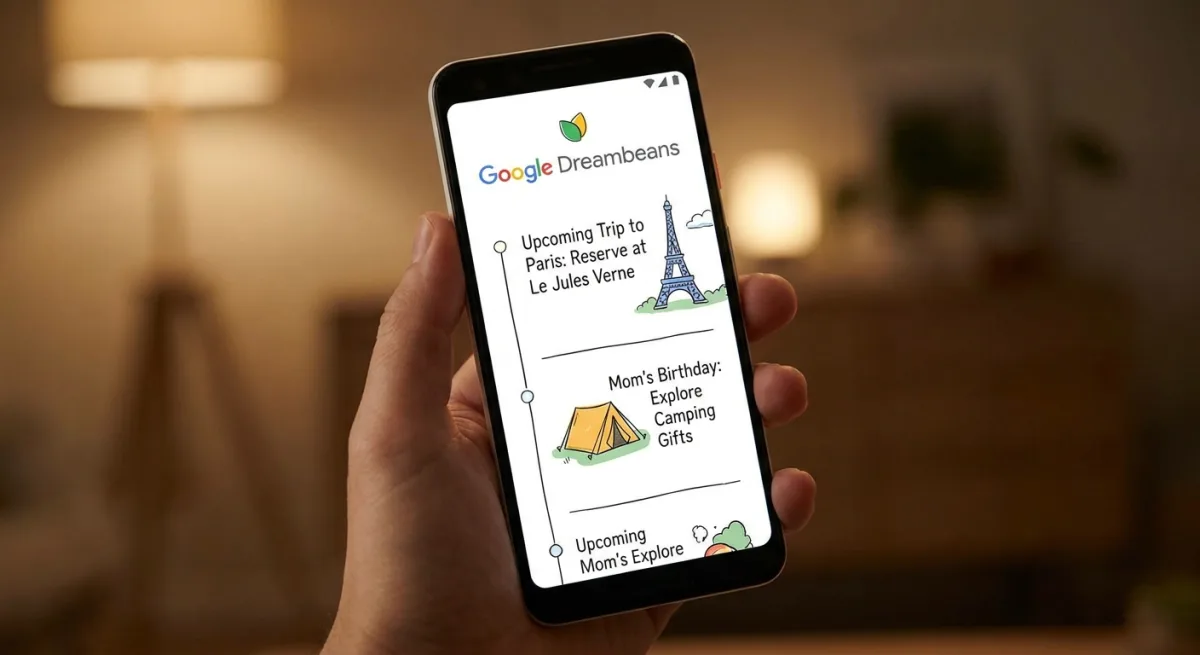
The core mechanic of the Google Dreambeans app relies on extracting upcoming life events and immediately suggesting a related purchase or reservation. As users scroll through the vertical feed, they can tap on individual stories to explore suggested actions. The launch materials provided by Google highlight exactly how the company intends to manipulate this data into actionable commerce.
The pattern of targeted ads is blatant across the app's suggested actions:
- Upcoming trip to France with your mother: Prompts you to reserve a table at a specific suggested restaurant.
- Saved store credit available: Urges you to explore a curated list of suggested items to buy.
- Friend's upcoming birthday: Pushes you to explore specific camping gift ideas.
- Getting a new puppy: Suggests reading guides on what supplies you need to purchase to prepare.
Every major life event is treated as the top of a sales funnel. Even the seemingly helpful advice regarding a new pet is explicitly tied to purchasing the necessary supplies, proving that the app's primary goal is delivering sponsored content rather than genuine assistance.
AI-Generated Artwork Replaces Real Memories
Perhaps the most frustrating aspect of the app is its reliance on artificial intelligence for its visual presentation. According to the official Help Center, every story is illustrated with personalized, AI-generated artwork. If a story involves real people in your life, the app uses Google Photos and the Nano Banana 2 model to generate a customized scene.
Instead of surfacing a genuine, emotional photograph of a relative for their birthday reminder, the app generates a soulless, artificial rendition of their face. By ignoring the emotional weight of actual memories in favor of AI-generated slop, the app fails its own mission statement of connecting users to what matters most. It stands as a stark contrast to genuinely helpful Google Labs projects like Literature Insights, feeling more akin to the widely criticized Project Genie.
The Shift Toward Predictive Commerce
The existence of this app signals a concerning shift in Google's advertising strategy, moving from intent-based search to predictive commerce. Traditionally, Google serves ads when you actively search for a product. With this experiment, the company is attempting to bypass the search bar entirely, using your private calendar and inbox data to tell you what to buy before you even realize you need it.
This aggressive push into predictive monetization risks severe user backlash. Consumers are already experiencing fatigue with AI tools that overstep privacy boundaries, and an app that reads your emails just to serve you a restaurant ad feels highly invasive. While this specific experiment will likely die a quiet death in Google Labs before reaching a wider audience, it reveals exactly how far the company is willing to push AI to maintain its advertising dominance.
This article was written by AI from reporting by androidpolice.com.