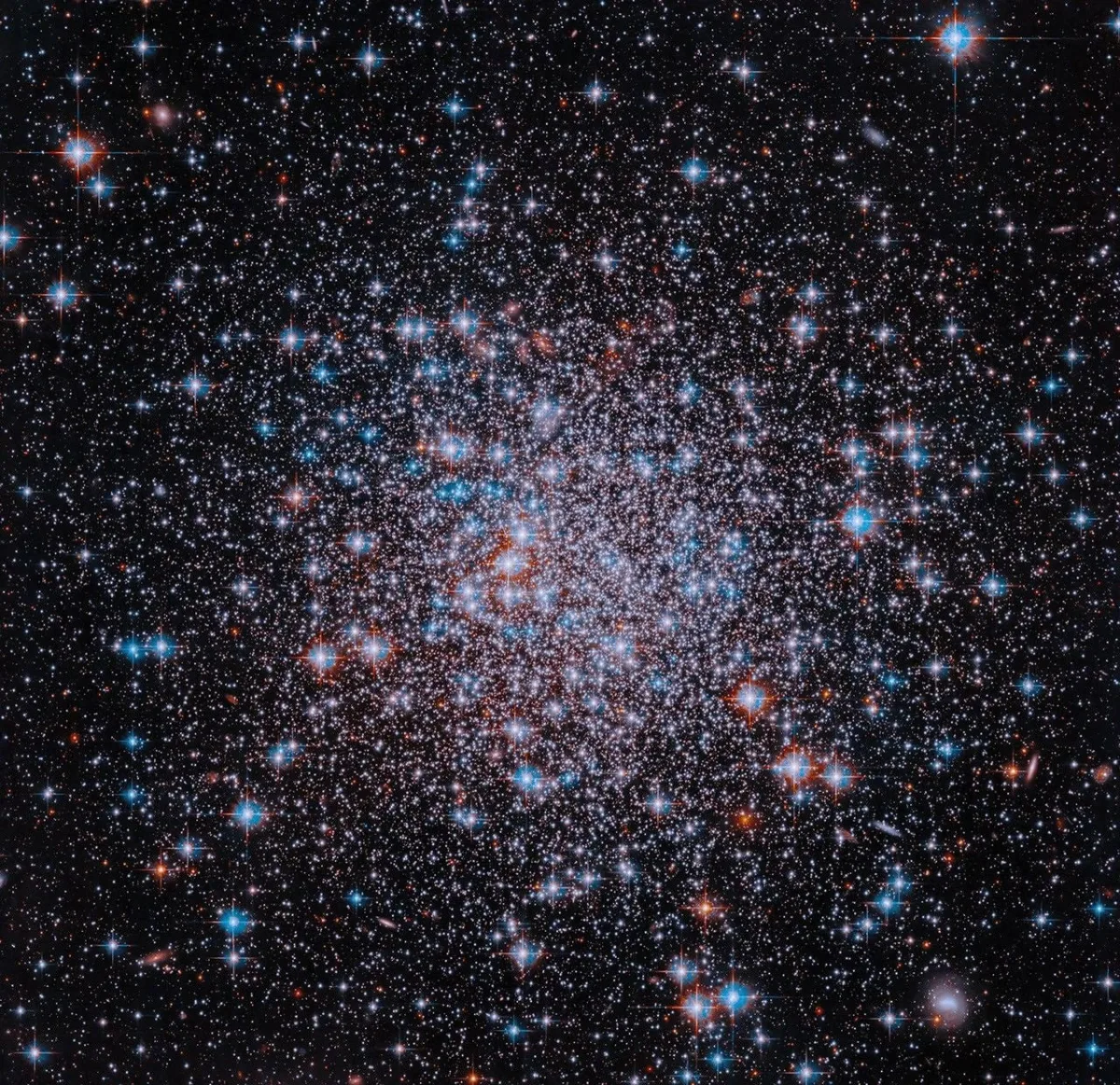
NASA has unveiled a dazzling new NGC 6426 Hubble image, capturing a globular cluster that is nearly as old as the universe itself. Released to coincide with the United States' 250th anniversary, the striking red, white, and blue stellar display offers astronomers a rare window into the earliest stages of cosmic history.
For astrophysicists and space enthusiasts, this observation provides critical data on low-metallicity environments. By studying these ancient stellar systems, researchers can better determine their exact ages and gain new insights into how the Milky Way formed and evolved over billions of years.
The Science Behind the NGC 6426 Hubble Image
The image features NGC 6426, a tightly packed globular cluster located in the outer halo of the Milky Way. Astronomers estimate the cluster to be approximately 13 billion years old, making it only slightly younger than the 13.7-billion-year-old universe. Because the stars in a globular cluster typically form from the same collapsing cloud of gas, they share a similar baseline age.
The vibrant colors captured in the observation are not merely cosmetic; they represent specific wavelengths of light tied to stellar temperatures. Blue indicates shorter wavelengths of visible light emitted by hotter stars, while red highlights cooler stars emitting longer visible wavelengths and near-infrared light.
Crucially, the stars within NGC 6426 exhibit low metallicity, meaning they contain very small amounts of elements heavier than hydrogen and helium. These conditions closely mirror the young universe, before massive stars had the time to forge heavier elements through nuclear fusion.
Evidence of Stellar Evolution
Researchers analyzing the cluster have identified evidence of two chemically distinct groups of stars. This discovery suggests that a second generation of stars formed after the cluster's earliest massive stars exploded as supernovae.
These powerful stellar explosions enriched the surrounding gas with newly created heavy elements. The scattered materials provided the necessary building blocks to form future generations of stars and, eventually, planetary bodies.
The Hidden Value of Ancient Stellar Graveyards
The discovery of two distinct generations of stars in NGC 6426 proves that early cosmic environments were highly dynamic, rather than just static clouds of primordial gas. This ongoing mapping of the Milky Way's halo by the Hubble Space Telescope serves a critical strategic purpose for the future of astronomy.
As the Nancy Grace Roman Space Telescope prepares for its scheduled launch in late summer, Hubble's foundational surveys ensure that next-generation observatories know exactly where to point their instruments. By identifying these ancient, low-metallicity clusters now, NASA is effectively creating a targeting map for the James Webb Space Telescope and the Roman Space Telescope to decode the universe's first supernovae.