

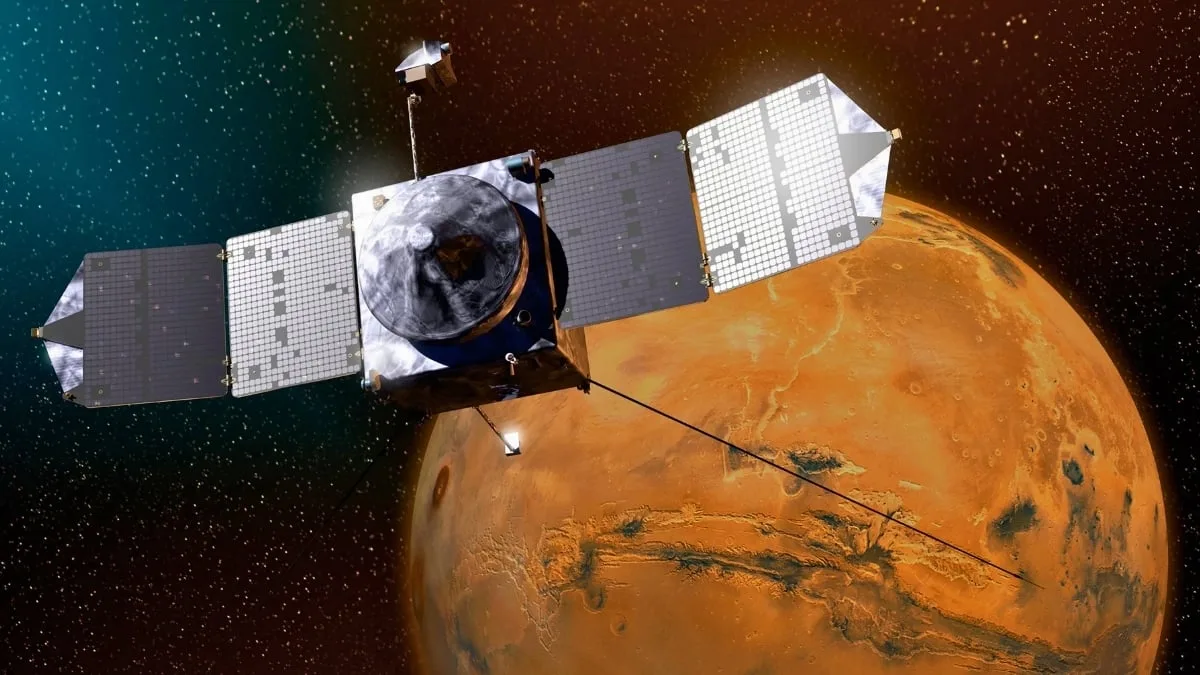
After a decade of studying the Martian atmosphere and a six-month period of radio silence, NASA has officially declared the MAVEN spacecraft dead. The orbiter, which launched in 2013, mysteriously lost contact in early December after passing behind the Red Planet.
Telemetry data indicates that the spacecraft entered a rapid, uncontrolled spin, which destabilized its orbit and completely drained its onboard batteries. Following a comprehensive assessment, a NASA review board concluded that the probe is unrecoverable. "The team really did experience the loss of a loved one with the end of the mission here," said Mike Moreau, NASA project manager.
During its operational lifespan, the NASA MAVEN spacecraft fundamentally reshaped our understanding of Martian weather and atmospheric evolution. Its instruments captured stunning ultraviolet auroras triggered by a 2017 solar storm and even observed a stray interstellar comet. Beyond its own scientific observations, MAVEN served as a critical communications relay for the Curiosity and Perseverance rovers operating on the Martian surface.
Despite the loss, surface operations will continue uninterrupted. NASA officials confirmed that a network of four other orbiters - two American and two European satellites - will assume MAVEN's relay responsibilities, ensuring no rover data is lost. The defunct spacecraft is expected to remain in a stable orbit for another 50 to 100 years before eventually crashing into the Martian surface, posing no collision risk to active missions in the meantime.
The team is certainly broken up about this. But at the same time we are incredibly proud of the science we've accomplished over the last decade.
- Shannon Curry, University of Colorado Boulder
The Hidden Strain on Mars Communications
While NASA has assured the public that rover science will continue uninterrupted, the loss of the NASA MAVEN spacecraft exposes a growing vulnerability in our interplanetary infrastructure. The Martian communication relay network relies heavily on aging satellites; for instance, the Mars Reconnaissance Orbiter and the European Space Agency's Mars Express have both been operating for roughly two decades. Removing MAVEN from this delicate web forces these older orbiters to shoulder a heavier data load from the Curiosity and Perseverance rovers.
This sudden failure serves as a stark reminder that deep-space assets cannot operate indefinitely. As space agencies prepare for data-heavy future endeavors, including the highly anticipated Mars Sample Return campaign, the current relay bottleneck will need to be addressed. Relying on a shrinking fleet of legacy orbiters is a temporary fix, accelerating the urgent need for dedicated, next-generation communication satellites around the Red Planet.
