

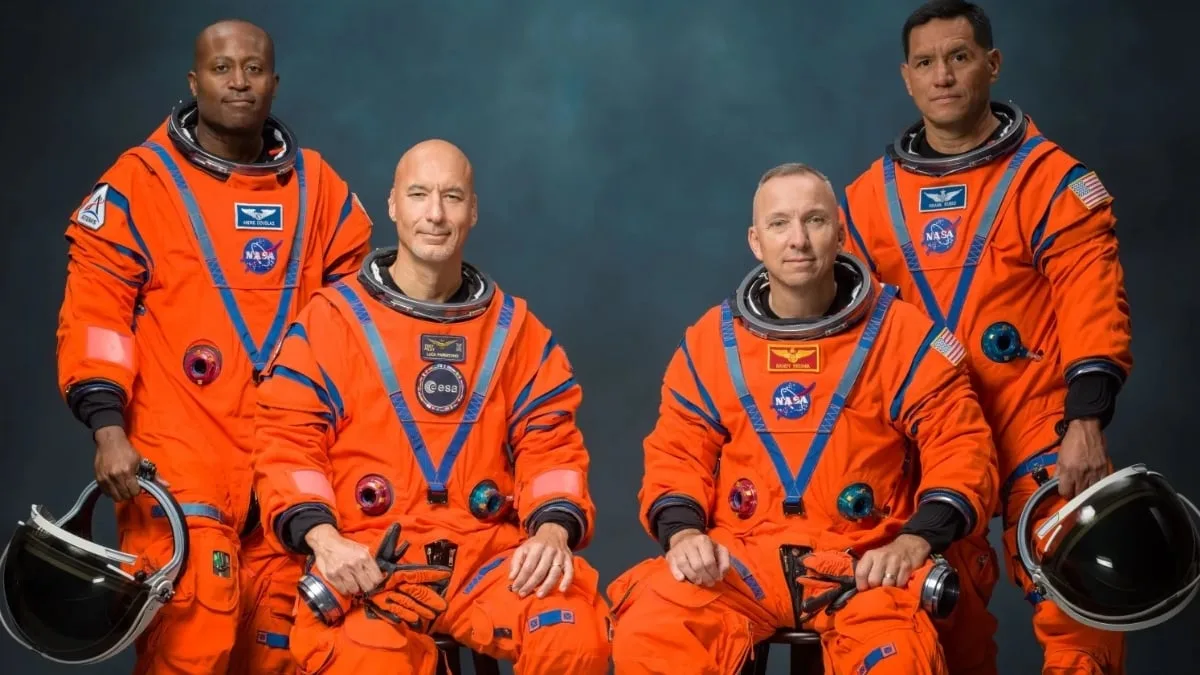
NASA has officially named the four astronauts who will pilot the Artemis III mission, marking a critical pivot in the agency's accelerated timeline to return humans to the lunar surface. Rather than heading directly to the moon, the 2027 mission will serve as a high-stakes orbital test, requiring the Artemis III crew to dock their Orion capsule with lunar landers from both SpaceX and Blue Origin in Earth's orbit.
The newly announced crew includes NASA astronauts Randy Bresnik, Frank Rubio, and Andre Douglas, alongside the European Space Agency's Luca Parmitano. This two-week demonstration flight is designed to validate the complex docking maneuvers required for future lunar descents. By practicing these procedures in Earth orbit, NASA aims to mitigate risks before committing to the revised 2028 target for an actual lunar landing.
The mission's success heavily depends on commercial partners SpaceX and Blue Origin, who are currently racing to deliver the necessary lunar landers. The timeline faces significant pressure, especially following a recent setback where a massive Blue Origin rocket exploded during an engine-firing test on a Florida launch pad. Despite the dramatic anomaly, NASA's Jeremy Parsons framed the incident as a crucial learning opportunity, expressing confidence that the hardware will be ready for the 2027 launch window.
The announcement, which follows Artemis II's record-breaking circumlunar flight, was met with enthusiasm across the agency. Expedition 74 crew members currently aboard the ISS sent a congratulatory video message to their colleagues. "We are certainly humbled as a crew to be able to be your crew that executes this Artemis III mission in space," Bresnik, the mission commander, stated during the official NASA reveal.
My brain - it is going a mile a minute right now. But my heart, it is so warm. It is so full.
- Andre Douglas, Mission Specialist, NASA
NASA Administrator Jared Isaacman emphasized that this revamped, fast-tracked approach mirrors the aggressive testing cadence of the Apollo era. Beyond the immediate goal of a 2028 lunar landing, the agency recently awarded hundreds of millions of dollars to four companies to develop rovers, drones, and infrastructure for a permanent moon base. Isaacman noted that this lunar infrastructure will lay the essential foundation for a future Mars expedition.
The Strategic Pivot That Saves Artemis
NASA’s decision to transform Artemis III from a direct lunar landing into an Earth-orbit docking demonstration is a pragmatic masterstroke. By decoupling the Orion capsule's flight test from the immense pressure of an immediate lunar descent, Administrator Jared Isaacman is buying crucial time for SpaceX and Blue Origin to mature their lander technologies. The recent Blue Origin engine anomaly highlights exactly why this buffer is necessary; testing complex docking procedures in Low Earth Orbit (LEO) ensures that if a critical hardware failure occurs, the crew remains hours - not days - away from a safe return.
Furthermore, this revised 2027-to-2028 cadence effectively mirrors the Apollo 9 and Apollo 10 missions, which rigorously tested the Lunar Module in orbit before Apollo 11 attempted the landing. While it pushes the actual moonwalk to 2028, this step-by-step validation drastically reduces the risk of a catastrophic failure in deep space. It ensures that when humanity finally returns to the lunar surface, the infrastructure is genuinely ready to support the long-term goal of reaching Mars.
