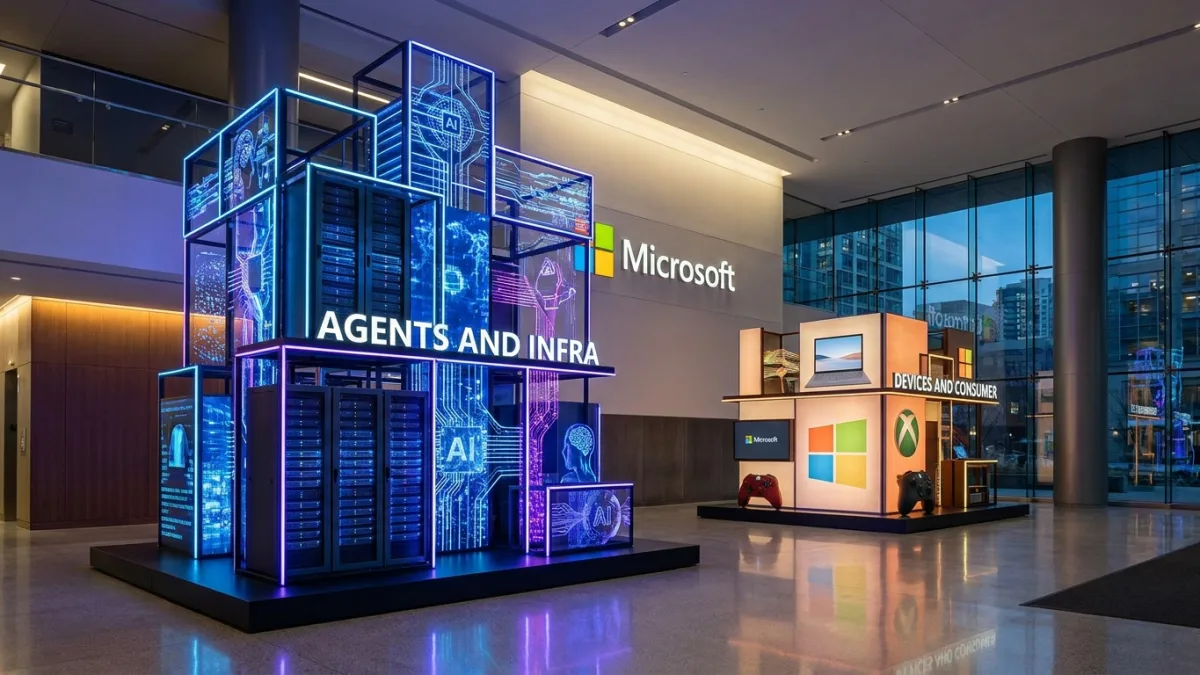
Microsoft is fundamentally restructuring its corporate reporting segments, abandoning its traditional three-pillar system in favor of a streamlined, AI-centric approach. The tech giant is dividing its operations into two newly named divisions: Agents and Infra, and Devices and Consumer. This structural overhaul, driven by CEO Satya Nadella, reflects how deeply artificial intelligence is altering the internal boundaries and financial reporting of the company.
Previously, Microsoft categorized its business into three somewhat dated segments: Productivity and Business Processes, Intelligent Cloud, and More Personal Computing. According to a report by The Wall Street Journal, these legacy categories are being retired to make way for a structure that better aligns with the company's current focus on AI models and cloud infrastructure.
The New Organizational Breakdown
The reorganization splits Microsoft's massive portfolio of software, hardware, and services into two distinct halves. While the new naming convention leans heavily into corporate jargon, it provides a clear look at where the company's priorities lie.
- Agents and Infra: This division houses Microsoft's AI models, GitHub, Azure cloud infrastructure, and Microsoft 365, which is now heavily saturated with Copilot features.
- Devices and Consumer: This segment covers Xbox, Windows, and the company's search and advertising divisions, including Bing and LinkedIn.
While the division makes sense on a macro level, it does create some internal inconsistencies. For example, separating Microsoft 365 from Windows places two deeply integrated products into entirely different reporting segments. This restructuring also highlights Microsoft's long history of unique corporate terminology, dating back to former CEO Steve Ballmer's "One Microsoft" initiative and internal slang like "dogfooding" (using your own software) or referring to profit margins as the "accountability margin."
The $60 Billion Enterprise Reality Check
The most revealing aspect of this restructuring is not the quirky naming convention, but the staggering financial disparity between the two new divisions. The Agents and Infra segment is projecting approximately $75 billion in revenue for the first quarter of next year. In stark contrast, the Devices and Consumer half is projecting just $15 billion.
This $60 billion gap is the ultimate proof that Microsoft is no longer a consumer-first technology company. Despite owning massive consumer brands like Xbox and Windows, the company's lifeblood is now entirely dependent on enterprise cloud contracts, AI infrastructure, and developer tools. By isolating its consumer products into a much smaller financial bucket, Microsoft is signaling to investors that its future growth relies almost exclusively on selling AI agents and server space to other businesses, rather than selling devices to everyday users.
This article was written by AI from reporting by earther.gizmodo.com.