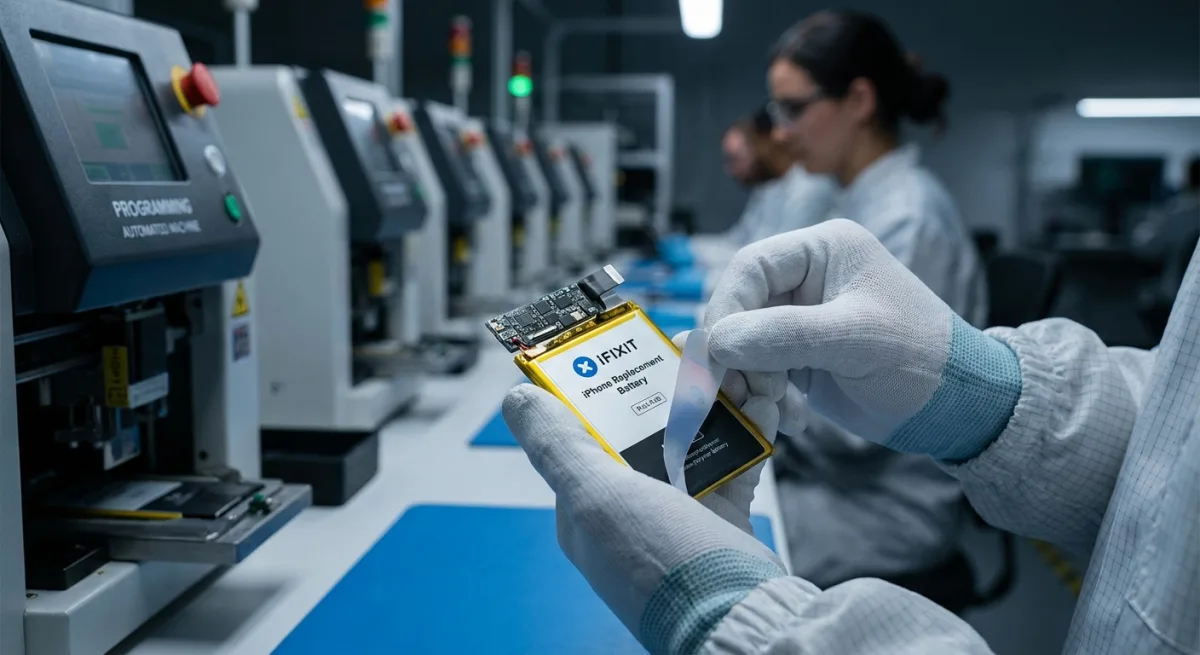
Producing nearly 13 million smartphone battery cells every month requires a staggering level of precision that goes far beyond simply packaging raw chemicals. A new behind-the-scenes video by iFixit reveals the exact manufacturing process for its iPhone replacement batteries, taking viewers inside a massive production facility in Weao, China.
The foundation of modern smartphone battery manufacturing relies on raw lithium-polymer cells, constructed from dozens of ultra-thin layers folded to microscopic tolerances. However, applying raw electricity directly to these cells is highly dangerous. To safely regulate power, each unit requires a dedicated Battery Management System (BMS) board. Inside the factory, rows of blank BMS boards are connected to specialized programming machines that flash custom safety software designed to prevent catastrophic overcharging and overdischarging.
Once the software is flashed, technicians weld the BMS board and its connector cable directly to the raw cell. To maintain the compact footprint required to fit inside a modern iPhone, the BMS is carefully folded over the cell itself. This folding process introduces the risk of short circuits, so workers apply specialized protective tape to the edges before securing the final assembly with an external sticker.
Before any battery leaves the factory floor, it must pass a rigorous gauntlet of diagnostic checks. Dedicated machines test each unit for internal impedance, overall capacity, and overcurrent safety thresholds. The BMS is also read electronically to verify that the initial state of health registers at exactly 100 percent and that the design capacity meets strict operational requirements. Finally, the notorious pull-tab adhesive strips are applied, completing the transformation from a raw chemical pouch to a consumer-ready component.
The Hidden Cost of Right-to-Repair
The sheer complexity of this manufacturing process highlights exactly why third-party battery replacements have historically been a minefield for consumers. When a factory produces 13 million cells a month, the difference between a safe component and a fire hazard comes down to the microscopic tolerances of the BMS board and the strictness of the final diagnostic checks.
As the right-to-repair movement forces companies like Apple to make their devices more accessible, the burden of quality control shifts heavily onto parts suppliers. The transparency shown here is a strategic move to build trust, proving that premium aftermarket parts undergo the same rigorous software flashing and impedance testing as original equipment manufacturer components.
This article was written by AI from reporting by androidauthority.com.