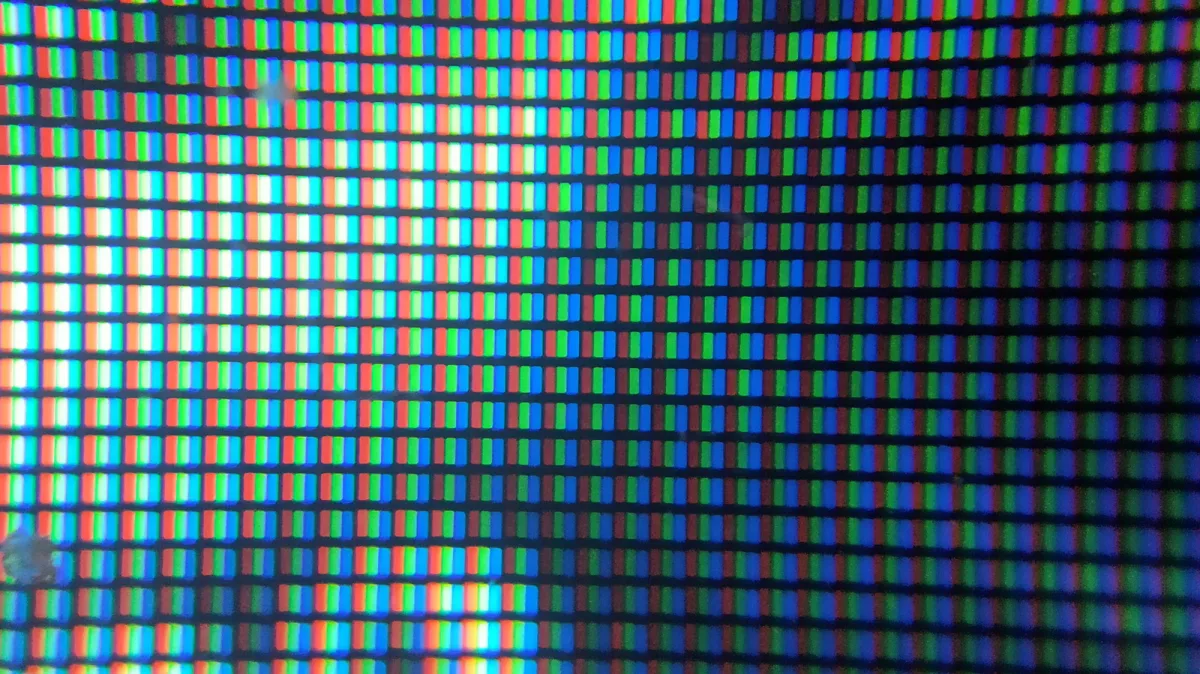
Your living room TV might boast OLED, WOLED, or QD-OLED technology, but you will almost never see it branded as AMOLED - the gold standard for smartphone displays. While both devices rely on an active matrix at their core, the manufacturing recipe that makes a 6-inch phone screen vibrant becomes a logistical nightmare when stretched to 65 inches. For consumers, understanding this divergence explains why flagship TVs and smartphones require entirely different engineering approaches to achieve perfect black levels and high contrast.
AMOLED (Active Matrix Organic Light Emitting Diode) relies on a grid of thin-film transistors (TFTs) sitting behind the screen. Each pixel gets its own switch and a capacitor to hold a charge, ensuring sharp, responsive images. To drive these self-lit pixels, smartphone AMOLEDs use a specific transistor process called LTPS (low-temperature polycrystalline silicon). While LTPS delivers the steady, strong current needed for small displays, its complexity makes it nearly impossible to scale up.
OLED panels are notoriously delicate. The organic materials crammed inside are highly susceptible to moisture and contamination, where a single manufacturing slip renders the entire panel useless. When scaling an LTPS backplane to TV sizes, the chances of these flaws cropping up multiply exponentially. Furthermore, phones build color by laying down three separate glowing materials for red, green, and blue (RGB). Replicating this exact RGB layout at a massive scale is a manufacturing hassle, forcing TV makers to abandon LTPS in favor of oxide semiconductors and alternative color methods.
How TV Makers Solve the Scaling Problem
- LG WOLED (White OLED): This approach uses an OLED layer that only produces white light. Colored resins act as filters to create red, green, and blue, while a fourth white subpixel pushes the overall brightness higher. This method is significantly easier to produce than true RGB, resulting in higher yield rates.
- Samsung QD-OLED (Quantum Dot OLED): Instead of white light and filters, Samsung starts with a special blue OLED light source. It then uses quantum dots - tiny particles that shift light into different colors - to conjure up reds and greens. By eliminating color filters, QD-OLED achieves high brightness levels without sacrificing contrast.
The Brightness Battle Driving Display Tech
The technical split between AMOLED vs OLED TVs highlights a fascinating reality in consumer electronics: bigger is not simply a scaled-up version of smaller. By abandoning the LTPS backplane used in smartphones, TV manufacturers have sparked a parallel innovation race. Samsung’s QD-OLED initially exposed the brightness limitations of traditional color filters, forcing LG to respond aggressively.
LG’s recent integration of stacked Tandem WOLED technology into its latest TVs is a direct counterattack to quash those brightness concerns. This ongoing rivalry proves that the inability to scale smartphone AMOLEDs was actually a blessing for the TV industry. It forced manufacturers to engineer specialized solutions like quantum dots and tandem stacks, ultimately delivering brighter, more durable living room displays than a scaled-up phone screen could ever provide.