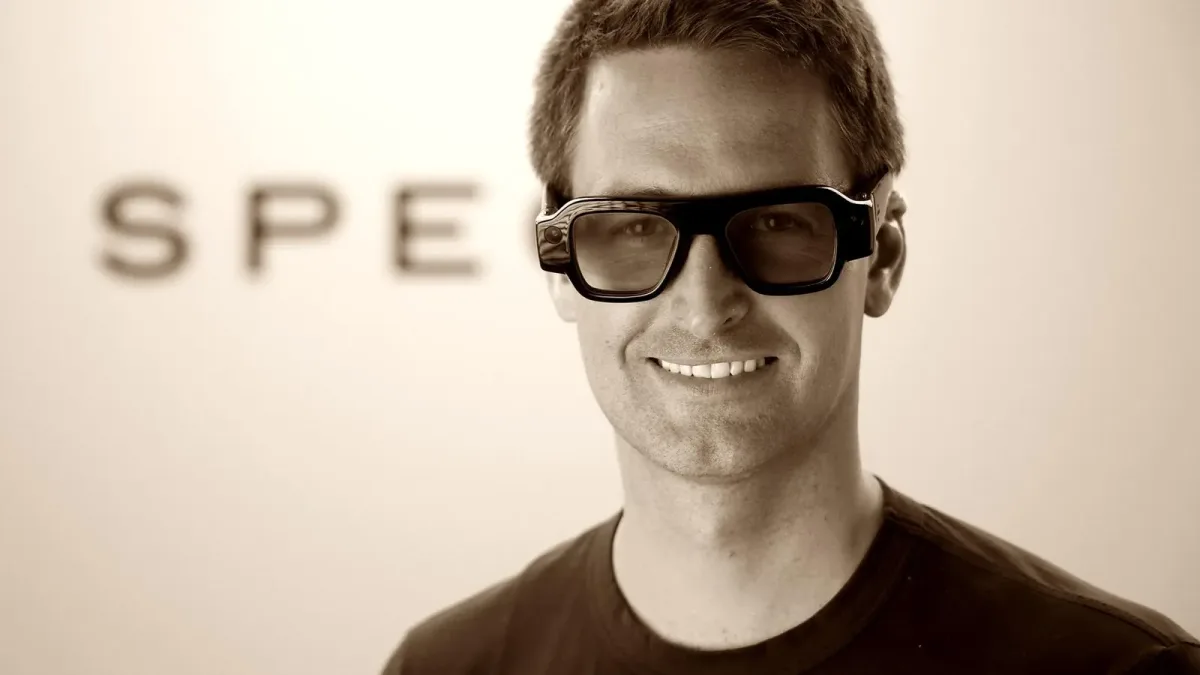
Evan Spiegel has staked $3 billion and the future of his company on a pair of $2,195 chunky black smartglasses. During a mid-September launch event in a Beverly Hills theater, the 36-year-old Snap CEO attempted to demonstrate the new Snap AR Specs by pulling up a YouTube video. The voice command failed, leaving a minute of dead silence before the feature finally registered.
"The suspense is killing me," Spiegel said, fiddling with the device. "Why is that not clicking? Should we try again here?" When the video finally loaded, he read the title aloud: "AR Smartglasses Are Finally Here. Goodbye Meta Ray-Bans," prompting laughter and applause from the audience.
This live demo glitch mirrored the broader narrative surrounding Snap: ambitious technology overshadowed by execution hurdles and the relentless presence of Mark Zuckerberg's Meta. The rivalry dates back to 2013, when a 23-year-old Spiegel famously rejected a $3 billion cash buyout offer from Zuckerberg, who was then worth around $13 billion. Meta retaliated with a wave of copycat features, including Poke and the wildly successful Stories format that became a pillar of the Instagram app.
The Hardware Divide: True AR vs. Smart Glasses
While Snap employees internally compared the thickness of their frames to Meta Ray-Bans, the two devices represent entirely different technological approaches. Meta's glasses, which top out around $500, rely on standard frames equipped with video recording, audio playback, and the Muse AI assistant. In contrast, the Snap AR Specs are true augmented reality devices capable of drawing digital whiteboards over a user's field of vision or turning a tabletop into a board game.
Snap views its true competitor as Apple and its $3,700 Vision Pro headset, rather than Meta's current offerings. However, Meta's own Orion AR glasses were announced in 2024, signaling a looming clash in the advanced hardware space. To justify the $2,195 price tag, Snap integrated the Specs Intelligence assistant and a Shopify-powered augmented-reality shopping feature.
It’s easy to critique how something looks on the outside but we all know it is about what’s on the inside. And the inside here is magic.
- Josh Elman, Andreessen Horowitz
| Feature | Snap AR Specs | Meta Ray-Bans |
|---|---|---|
| Price | $2,195 | Up to $500 |
| Core Technology | True AR (Digital overlays, spatial computing) | Video/Audio recording, AI Assistant |
| Design Strategy | In-house, bulky frames for developers | EssilorLuxottica partnership (Wayfarer, Oakley) |
Financial Strain and the Specs Inc. Fortress
Despite the technological leap, investors remain deeply skeptical of Snap's hardware ambitions. The company's stock currently hovers around $5, a steep decline from its post-Covid peak of about $80 in 2021. In March, activist investor Irenic Capital Management published a scathing open letter demanding layoffs and the complete shutdown of the Specs business.
Snap subsequently cut about 1,000 jobs in April, representing 16 percent of its workforce. Major institutional investors also retreated, with Fidelity selling off roughly a quarter of its holdings in the second quarter and BlackRock offloading about 7 percent. Yet, the core Snapchat app remains highly lucrative, pulling in $1.6 billion in revenue last quarter - a 19 percent year-over-year increase - and boasting 970 million monthly users compared to the estimated 560 million on the X platform.
Spiegel has insulated his hardware division from the corporate turbulence by creating a subsidiary called Specs Inc. Housed in a dedicated building at the Santa Monica headquarters with special badge access, this unit was entirely spared from the April layoffs. According to current and former employees, regular Snap staff were even transferred into the protected group.
Spiegel’s Iron Grip and the Project Cheetah Lesson
Snap's 5,200 employees operate strictly within Spiegel's orbit, a stark contrast to the decentralized leadership at trillion-dollar giants like Google and Meta. He relies on an elite design team of about 20 people who travel to lavish offsites in Japan, India, and Italy for inspiration. One former employee joked that Spiegel treats this inner circle like the psychic Precogs in the film Minority Report, relying on them to predict consumer trends.
Spiegel's affluent upbringing in Pacific Palisades, as the son of two powerful lawyers, initially gave him an intuitive understanding of his wealthy teenage demographic when he and Bobby Murphy built the Picaboo app at Stanford. While Snap notes that 80 percent of its users are now over 18, Spiegel's personal life has evolved alongside the company, including his marriage to supermodel Miranda Kerr and raising their children alongside Orlando Bloom's teenage stepson.
His foresight has occasionally led to disastrous premature pivots, most notably after a 2017 trip to Beijing to visit ByteDance. Inspired by the Toutiao app, Spiegel launched Project Cheetah to shift Snapchat to algorithmic ranking, resulting in massive celebrity backlash and a petition signed by over a million users. He eventually issued a 6,000-word apology memo and reverted the changes, proving he was right about the TikTok-style future, but wrong about the timing.
The Distribution Flaw in Snap's AR Strategy
Snap's refusal to partner with established fashion brands exposes a critical vulnerability in its hardware distribution model. Meta leveraged its partnership with EssilorLuxottica to embed technology into iconic Oakley and Wayfarer frames, successfully selling over seven million pairs because consumers do not feel ridiculous wearing them in public. By keeping design entirely in-house, Snap forces early adopters to choose between advanced holographic capabilities and basic social acceptability.
The broader market has already begun to price in Snap's fading influence as a primary tech antagonist. When Meta agreed to pay up to $18 billion to settle a lawsuit regarding teenage social media addiction, it published full-page newspaper ads urging rivals to adopt a two-hour daily limit. The open letter was addressed exclusively to TikTok and YouTube, completely omitting Snap.
This omission highlights a stark reality: while Meta and Google command market capitalizations of $1.8 trillion and $4.2 trillion respectively, Snap remains a $9.4 billion mid-cap company. A new generation of leaders, including OpenAI's Sam Altman and Anthropic's Dario Amodei, have captured the industry's attention. If developers reject the $2,195 Specs, Spiegel's $3 billion investment risks becoming an expensive monument to a future he predicted but could not commercialize.